Showing posts with label Cloud collar. Show all posts

Friday, 9 June 2017

Pelican outfit #7: The completed outfit


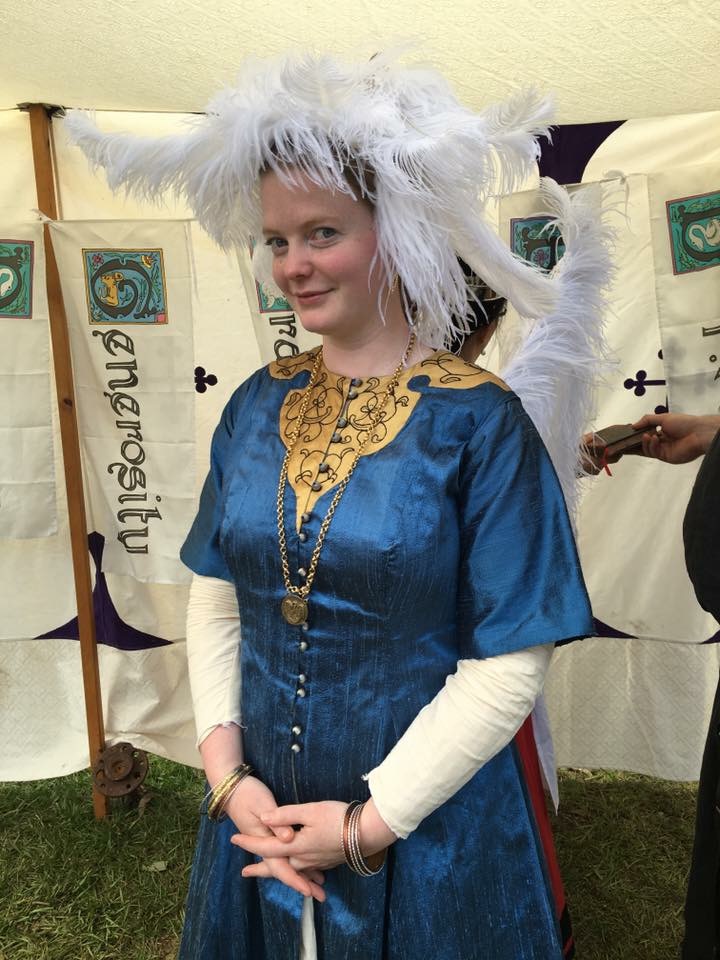
Testing the outfit the night before - who wore it better?

I'm really happy with how my Pelican outfit turned out. It's by far, the best thing in my closet at the moment. I'll wear it at other peoples special occasions. HUGE thanks to everyone who took photos for me, the Peers who spoke of the virtues. My crazy friends who helped me sew the hems, and make the hats and wings and were generally supportive of my ideas. Massive thanks to THL Elizabet Hunter who painted some lovely silk banners of key virtues I believe any peer should uphold and Sharon of Elizabet's Handspun who handspun the black silk thread I used to embroider the golden cloud collar. I love you all!


Wednesday, 7 June 2017

Pelican Outfil #5 - Test collar & dress

I got so heavily involved in making the outfit, I never actually completed the outfit diary. The 1st anniversary of my Pelicaning is fast approaching, so here it is:

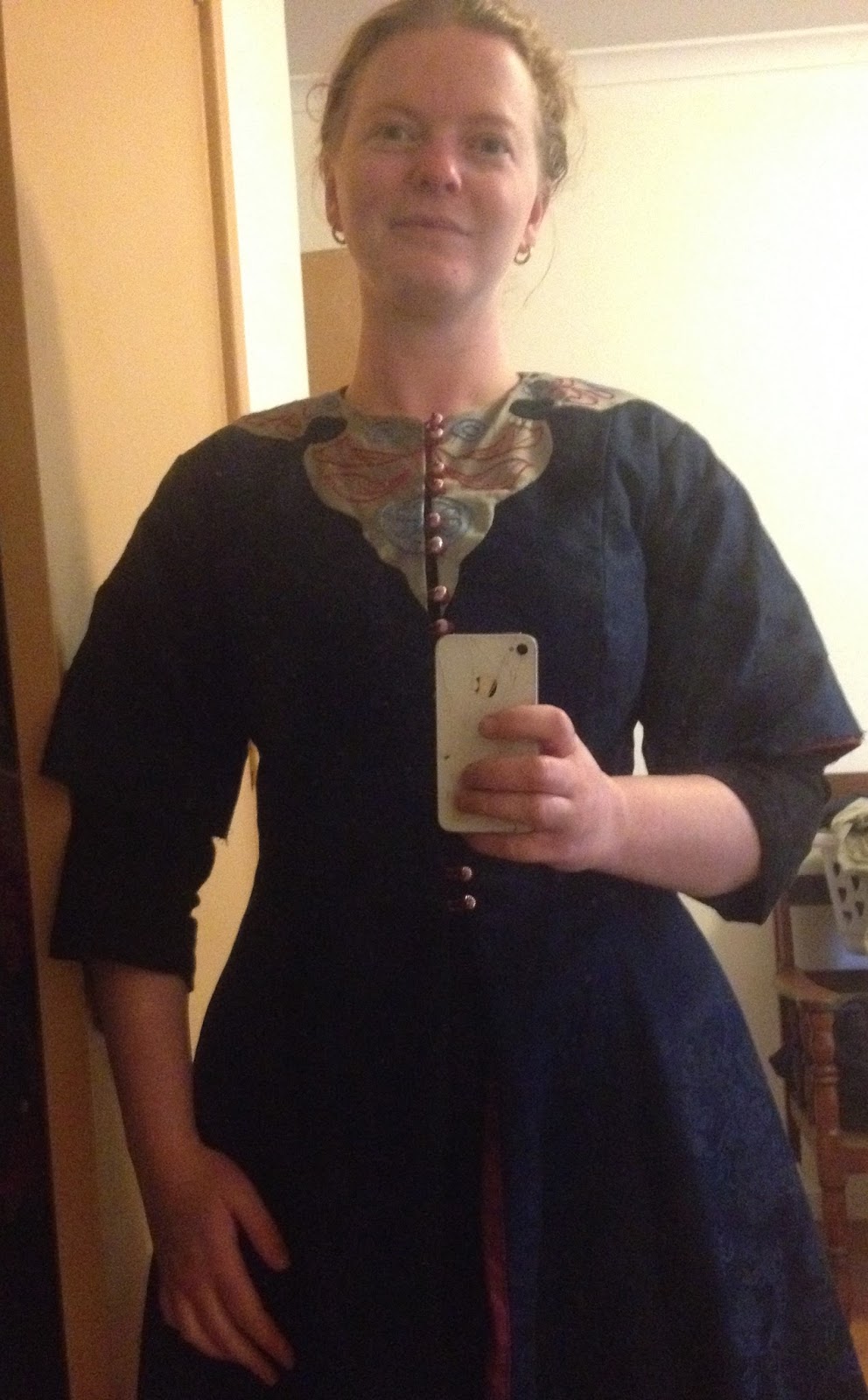
I made another test piece with a dark blue brocade (with modern roses). I designed a collar of silver silk with red and blue silk embroidery. The intent of this was to test our my patterning skills, my embroidery skills and to create a backup outfit just in case I didn't get the final one done in time. In the end, the Lovely Iglasia wore the backup and we looked fantastic!

The embroidery was a simple design based on some of the pottery I'd been working on. I started by tracing my collar pattern onto the silk using a washable marker pen. I included a seam allowance and then free-handed the design. Once I was happy with the design, I simply tensioned it using a cane hoop and split stitched my way around each of the symbols and created

Once the embroidery was complete. I cut out the pattern with my sharpest scissors and sealed the edges very carefully with Fray Blocker. This made the edges a little crispy but it was worth the effort to ensure that the applique doesn't fray and lift of the dress.


I'm aware that many of the extant images show the collar crossing the shoulder tip however I'm not very good with attaching sleeves so wanted to leave my options open. As a result, the collar just kisses the sleeve seam. I pinned it down and then sewed in the lining. The meant the collar and front opening would be as tidy as possible. I then folded the rest of the seam allowance under, and invisi-stitched the whole thing down.


Buttons for the dress were created by wrapping silver coloured ripple beads in the same colour silk thread. A small bead was used as an anchor and I created a pin with my trusty long nose pliers.

Here I am in the finished dress feeling quite smug about what my limited sewing skills can produce. I quite like how fitted this dress is to my bust without being restrictive. These photos also made me decide to wear a lighter coloured under-tunic on the day as the black sleeves don't contrast well.


The key challenges with this collar revolved around finding a way to stop the silk from fraying. Fray Blocker works but needs to be applied with a brush or toothpick otherwise too much and it'll leech into the silk and darken / stiffen it. Silk that's been saturated in Fraw-blocker won't be easy to puncture with a sewing needle so it's importing to ensure it doesn't take up all of your seam allowance.


Saturday, 30 April 2016

Pelican Outfil #4 - Cloud collar design research

As mentioned in a previous post Miriam of the Alawim of Stormhold has given me a number of PDF's of Persian Cloud Collar images. I believe she collected the images for a Laurel Prize Tourney entry. This week I've been analyzing the images in my typical science before art process. (This is going to be an image heavy post). My conclusions are as follows:


The first set of images Miriam sent me come from one manuscript. Firdawsī, Shāhnāmah, Book of Kings. which is Turkman/Timurid style. Dated 23 Jumadi II 891 (26 June 1486). This manuscript features to main styles of cloud collar, a floral style, and what I've been privately referring to as the geese style. Cloud collars of either design don't seem to be restricted to a certain class or sex and can be seen on a variety of coat styles. I've drawn up the designs from a couple of the images in black and white to make it easier to see the particular elements.


In both of the images above, the same goose like shape can be seen as a major symbol surrounded by blobs and tick marks. The goose is always pointing towards the left and is rarely inverted to balance out the pattern on the opposite shoulder. Given the frequent occurrence of this decorative element I began to wonder what it symbolised so I spent some time squinting at the screen and trying to determine what it actually was. One figure has a single goose on the upper thighs so I worked out the shape as best I could.

After looking at many examples of the goose, I've some to the conclusion that it's possibly a word or phrase written in islamic calligraphy. Islamic calligraphy is a beautiful art form but difficult to read for a Persian newbie. I've waxed lyrical about my reluctance to copy something I don't understand so that leaves the floral designs. Two of these come from military figures which wear a chain mail or scale coifs. Given the regular pattern and symbols, and the fact the pattern isn't adjusted to the lobes of the collar just the center neck, I'd suggest this fabric would have been a brocade rather than embroidered. Brocades are harder wearing and can be cut from second hand garments. The threads of the embroidery are more likely to be caught and damaged by the rings used in construction of either coif. The third floral design appears to be a leaf pattern and I copied it because it seems to blend seamlessly with the coat along the arm. Perhaps this one is embroidered directly onto the coat rather than onto a separate piece of applique attached to the shoulders?


Second manuscript set of images Miriam sent me were from The Khamsah' of Niẓāmī which dates from 1539-1543. This manuscript features cloud collars which were counter-coloured against the coat. The designs are stylistic and floral reminiscent of the Iznik tiles produced in the area. There's one I particularly like which has a tiny bee or month amongst the flowers. Once again, all sorts of figures wear these sorts of collars. The manuscript also has a number of indivisuals with the gold on base style collars seen in the previous manuscript. I've drawn up two of these designs.


The first is a seated man with a repetitive design on his collar. This may be done in multiple colours of silk. I've drawn the central medallion with a Star Wars twist as it's hard to tell what it is given the size of the image. The other collar is gold and features floral designs which are repeated in each lobe. This figure also has a slightly different floral design around the sleeve cuffs. I like both of these designs as repetition creates balance but I'm also away it may not be possible with my pattern given the different shapes and sizes of the lobes. This is something I'm going to have to research further and maybe draw up a bunch of mini images to see what I like the most.


One question you might be asking, if you've been following these posts, why am I researching Timurid / Turkish cloud collars when I've already stated I wanted to make an Indo-Mughal outfit?
The reason being is the image I'm most drawn to is Babar seeks his Grandmothers advice. It's a Mughal manuscript which depicts the Turkish born (1483) Babar who established the Mughal empire. At first I thought this image, painted around 1590, was a 16th century impression of garb worn by Persians in the 15th century. I then did some more research and found that cloud collars were a thing well past the 16th century so it was possible this scene was depicted with the figures wearing 'modern' clothing to assist the audience in relating to the tale. The Mughals did wear cloud collars and Persian inspired outfits. I've found a few other images that document this and will continue looking for more.

Detail - Court of Ravana, folio from a Ramayana. India, 1605. Met Museum, Accession no. 2002.505


Tuesday, 26 April 2016

Pelican outfit #3 - Cloud collar patterning

I've started work on the cloud collar. First step was getting the dress (mostly) right so I knew the collar opening and shoulder dimensions. To work out the neck line I simply sewed the dress front and back together then lay the resulting collar shape over some scrap paper to sketch out the neckline.

This next step involved sketching various designs from period references before drafting the cloud collar pattern onto paper. While I am referring to my two primary images from the previous post, I'm also using some of Miriam's research. She kindly sent me PDF's of her complied images which have been extracted from a variety of manuscripts. Her focus is on the Persian examples of cloud collars while I'm trying to look at the Timurid / Persian / Chinese influence on the garb of the Indians of the Mughal. You can see from my previous posts regarding the range of garb the Indians wore (including venetian dresses) that the fashion forward ladies of the Mughal Empire were likely to adopt a variety of designs.

The shape of the collars in the Indian reference is very similar  to the Persian examples so given the huge collection of Persian images I find myself in possession of, I've based the shape on them.

To get the shape I took my neckline sketch, I folded it, refolded it and folded it some more until I could get each of the lobes symmetrical. They also had to fit the scrap of silk I'll be using for my test outfit #3.

Evolution of the back shape. When I decided I had cut away too much paper, I sticky taped another section on and extended out that part as you can see is occurring on the left from the middle down.

Once I had my shapes, I cut out a whole collar to see what it'd look like around my neck. Being paper it didn't drape well and I couldn't tell if it was right so I cut it out of yellow fabric and pinned it to the toile I discussed in the previous post. I knew I was on the right track because it looked like some of the out of period collars I'd managed to google.

I pinned the yellow collar to the black cotton toile. I liked the narrower point at the front and the slightly wider point at the back however the points on the shoulders weren't lining up with the seams, they were about 2cm off. Back to the drawing board

The main difference between these two collars are the angles of the lobes. The previous attempt had the center lines of each lobe at 90 degrees from the previous one. This one has slightly smaller lobes on the shoulders and back and larger on the front resulting in 80 (ish) degrees between center lines. The key hole cut outs between the front and side lobes weren't working properly so I redid the one on the right. The one on the left is too close to the neckline and may get sewn in when the garment is sewn together. I only need half this pattern to cut the fabric so I've left the bad one in to remind me to pay attention to the neckline seam.
I took the plunge and appliqued this one once I assured myself the neckline matched up and the lobes on the shoulders worked. I need to practice applique with the machine or do it by hand for the final one because even though I covered the thing in pins, I still managed to buckle some of it. I think more, smaller pins and a sharper, thinner sewing machine needle might be the first step. I could also leave some lines of embroidery with which to sew the applique down onto the dress with to help avoid buckling. Maybe a line around the outside? Hand sewing is never as tight as machine sewing and I'm quite worried about messing up with my embroidered collar. I'm going to have to practice a lot!

I'm not sure I like the wider front and narrower back, I'll have to decide if having the shoulders off set from the seam is such a bad thing, or maybe I can just alter the lobe without changing the front. The shoulder lobes wouldn't be symmetrical then but it'd allow the front to become narrow. I may line the toile just to see how much of the front I'll lose to the seam and see if that fixes the problem.

Either way - pattern 95% done!

Saturday, 9 April 2016

Women with cloud collars


So, I've documented a range of cloud collar type things were worn in the Indian Sultinate (Northern India) pre 1600's. Unfortunately, the number of pictures of women wearing such things is limited. This is because illustrations of women seem to make up a smaller proportion of the preserved images available in the museums and on auction sites such as Christies and Sotherby's. It is also because other styles of clothing were worn at the same time so the choice of garb the artist painted was dictated by this school as well as his clients. None the less, I present some women wearing cloud collars with attention paid to where these images are from.


<-Iran

Detail: mid-16 c. Portrait of a Woman Tempura on paper. Dimensions: H. 16 7/8 in. (42.8 cm) W. 10 1/4 in. (26 in.)  Met Museum, Accession Number: 52.20.6.

Mughal (India) ->

Detail - Bābur Seeks His Grandmother's Advice Leaf from the Read Mughal Album, but formerly fol. 86 in the British Library's Bāburnāma. Mughal, ca. 1590–92, probably by Sānvalah, with early-nineteenth-century borders. 440 x 294 mm Purchased by Pierpont Morgan, 1911.; MS M.458.18. 


<- Iran, Tabriz?

Wine Drinking in a Spring Garden Object Name: Illustrated album leaf or single work Date: ca. 1430 Geography: Iran Culture: Islamic Medium: Opaque watercolor and gold on undyed silk Dimensions: 8.5 in. high 30.20 in. wide (21.6 cm high 11.87 cm wide) Met Museum. Accession Number: 57.51.24 

Iran, Tabriz ->

Detail: "The Feast of Sada", Folio 22v from the Shahnama (Book of Kings) of Shah Tahmasp

Painting attributed to Sultan Muhammad (active first half 16th century)
Folio from an illustrated manuscript ca. 1525 Iran, Tabriz Met Museum Accession Number: 1970.301.2


<- Turkey

An Ottoman Drawing of a Peri, attributable to Veli Can, Turkey, 16th century. Sotheby's - Arts of the Islamic World 24 April 2013, Item 97
Turkey, Istanbul ->

Kneeling Angel with Cup and Bottle mid-16th century Shah Quli Ottoman period Ink, opaque watercolor and gold on paper H: 19.3 W: 10.8 cm Freer-Slaker Museum, F1933.6


More cloud collars

The Sultan awakens the drunken judge at dawn by Mahmud Muzahhib, Burkara. 1560-61. Christies, Sale 1180, lot 26.


The Sultan's collar comes to mid upper arm and seems to extend in a straight line to his belt. The drunkard's coat is slipping off and shows embroidery to the navel, as well as above and below where the belt would go, at the end of long sleeves and along the base.
Smug guard guy gets a pointier collar that appears to have at least three lobes (one in the back too?_ and matching embroidery on his sleeves Right hand man gets an honourable mention due to his fancy collar. Either the lining of his outfit is brocade or embroidered or his collar is embroidered. I wonder what it says.


Thursday, 7 April 2016

New obsession - cloud collars

Persian cloud collar, 15th century.

I haven't posted in a while because I've been doing pretty much nothing on the creative side. I made some brooches for their Maj's and some other random odds and ends but no heavy research and minimal ceramic painting. Well, right until Tamar asked me what I wanted to wear for my Pel ceremony. Frankly I hadn't given it much thought because saying 'sure' was a hard enough decision. Then I got to thinking, maybe I should wear Indian, because it's unusual and hell, it's not often you get to drape yourself in all your best garb and parade around Then I thought, maybe Persian,  because you know, pants.

So I started researching both and fell down a minor rabbit hole called cloud collars. Seems like they were something the Chinese had been doing their garb for quite some time but it also features in middle eastern art of the time as well as turning up in Indian manuscripts. The illusive images I'm hunting are from the time of the sultinate. The images that feature both Indian and Persian ladies in different poses and types of garb.

Anyhoo, while I hunt for them, I keep getting distracted by these collars. I've only seen them on one other sca-er and he was wearing Mongolian at the time. I'm thinking it might be a nice pun on my newly registered name Ant Blowme (pronouced bloom) of Saint-Cloud.

I have a little pinterest collection started up for cloud collours, timurid designs and other related items but a basic run down is as follows:

Cloud collars are an embroidered gold design on a long tunic like outfit that buttons down the front. It typicaly is lined in a darker fabric and has a turned collar. The tunic can feature long (past the wearers hands) fitted sleeves or shorter wider sleeves. The short sleeves may also feature embroidery. Both short sleeve and long sleeve garments were worn over a similar undergarment of a striking and contrasting colour. I'm not sure yet if the embroidery is appliqued on or applied to the fabric directly. There are very few extant cloud collars from this time period but it's not clear if the original garment was made from the same piece of cloth. The following image, Visit to a Dervish, contains a selection of men wearing both cloud collars and non decorated garb as well as long and short sleeves. The colours indicate the cloud collars were made of the same colour fabric of applied directly.

Visit to a Dervish. 1560-1561.  Christies, Sale 6622, lot 12.

Spikey and small, point just reaches point of shoulder Short matching sleeves, more vine like. Drops just onto arm
Small collar and chest (not waist lobe). Also, wear it like a straight jacket! Dark lining for sleeves and collar but additional plane lining? Circular collar
Extra lobes down to the belt, collar extends to mid arm. Embroidered sleeve guy has no collar. Paired buttons, wide collar, lining dark but not contrasting.
Slightly cloud like, long sleeve Two lobes to belly button, very child drew a cloud shape