Showing posts with label Egypt. Show all posts

Thursday, 19 March 2020

Albarello collab

I’ve been posting this project at some of its stages already. It has now been fired so I thought it was about time I did a write up.
Fired!

Background:
Many years ago I participated in the laurel prize tourney. I don’t recall what I was displaying, I think I was in the middle of the A& S challenge so neck deep in my decorative glazing obsession. The laurel prize tourney helps participants engage with a variety of laurels to receive useful feedback and advice. It’s also open to non-laurels to review so you can inspire and engage with the rest of the Sca as well. Individual laurels will often give various participants small tokens. In this year in particular, Master Alex the Potter presented me with two handthrown bisque fired albarello. At the time I had no way of firing them myself and I wasn’t confident that I could do this limited resource justice.

Now, years later, I’m throwing my own pots. I haven’t yet created an albarello I like but I’m close enough. I can also get anything I like commercially fired to stoneware. Time and beyond to do something with the bisque I’ve had since before I moved to this state (at least 5 years ago). I’ll admit, I was really worried this mystery bisque wouldn’t hold up to the high firing temperature. Especially after the slumping seen in the Olla lid mystery bisque.


The original choice which was closer in shape to the bisque Extant arbarello from the Louve ref. OA 4091.


On inspiration:
On the right is the original choice. Unfortunately when I sketched it onto the bisque the symbols just didn’t balance right. So I switched to something else. The left is my final choice. I’ve had this image pinned to my ceramic inspiration page for a while. I’ve loved the simplicity of the component elements and the complexity of the background work for sometime. This style really has been a favourite of mine for a while and this seemed like the perfect time to execute it. Part of my decision lay in the colour fastness if black oxide and cobalt blue. Both can withstand high temperature firing with pretty good colour consistency. I couldn’t be sure how other colours, like the super fickle purple, would do so very late period Italian designs are out for now.

Of the two design choices, the second one was more balanced once sketched onto the bisque using 6B pencil.

On execution:
Glazing this took a fair while. I worked the main body in sections with the main design free handed and then double glazed to ensure colour integrity. The background super detailed swirls were a single stroke with a 5zero paint brush trimmed down to have shorter bristles and increase its stiffness. I’m pretty happy with the colour consistency achieved there. I was a little worried they’d end up streaky it grey.

The blue is ‘Cobalt Blue’ from Chrysanthos. It was painted on as a single layer as it was important to me that the black detail come through the blue. I added more blue than was on the original design because I had more foot space and thought the colour balance worked better. I’m not a huge fan of the free blue leaves at the top, I much prefer the blue outlined in black.

I designed the foot pattern myself utilising elements from the extant item. I considered a detailed swirl pattern in the background but decided that it would reduce the impact of the main panels. I really needed more light space to balance the overall look. I think it is important to understand not only the design context but the impact of the piece as a whole. I took for inspiration the bold black line features seen in many items of the time. I’m really pleased with how this came together. Using the lines also let me tie them into the shoulder pattern. Again, I could have overlooked this geometrical change and continued the extant pattern down but it wouldn’t have worked with the shape of the bisque. I did consider a vine design but decided the area would be to thin and the vines would look weird as a result. Plain black bars helps divide the d ensign
Elements without detracting from them.

On the future:
Overall, I’m very pleased with how this piece came out and I’m super relieved it didn’t deform in the kiln! I probably wouldn’t change the rim decoration even though it doesn’t overly appeal to me because it is a direct copy of the extant item. I will be using the other bisque item to trial an Italian or Spanish polychrome design next now I’m more confident in the integrity of the bisque in the high firing temperature.


Saturday, 13 May 2017

Festival cups

In theory, the cups have all gone to their new owners so I can post the posse of my latest experiments. Three different eras, three different styles and three different colour sets! I'm very please with how these turned out. I was a little unsure if the new glazes would have the right tones and if the shading would work well but I seemed to have nailed the contrast I needed.

Cup 1 reference:
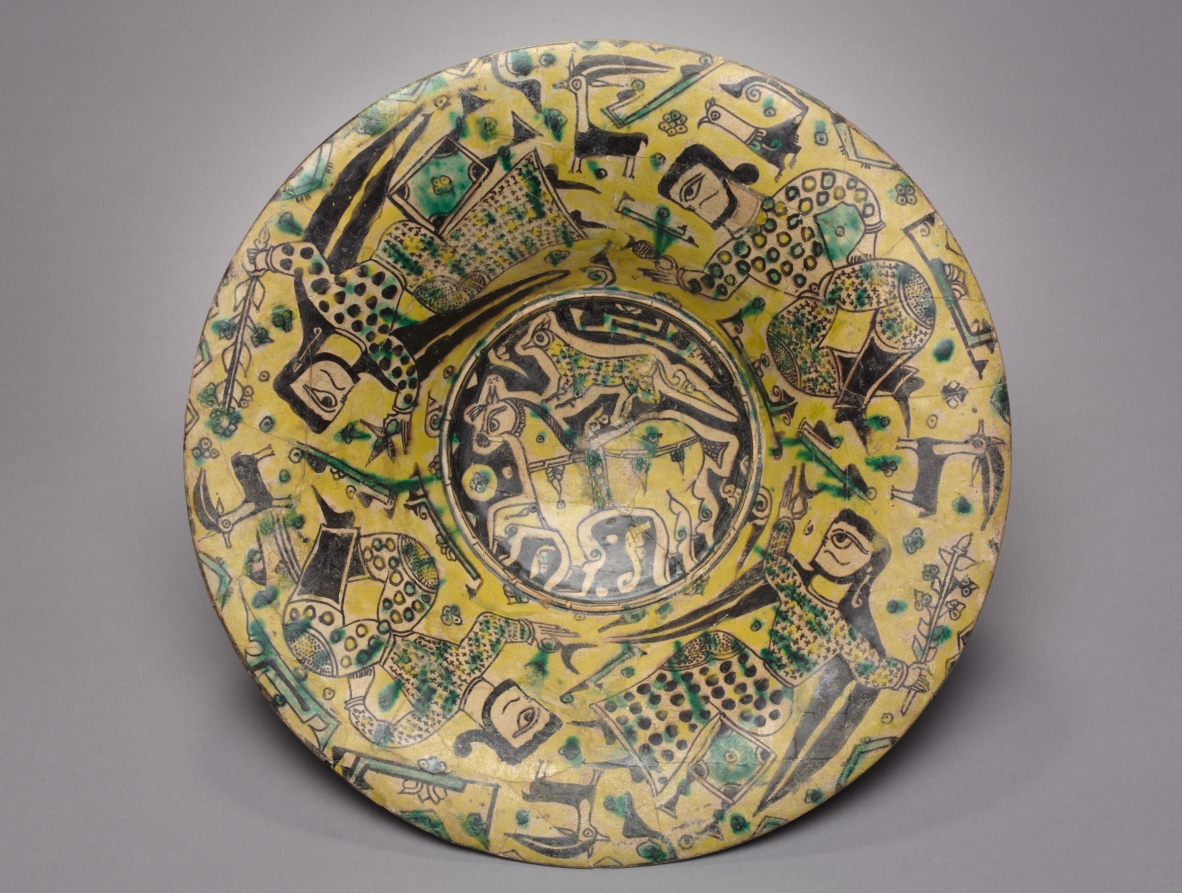
I've been sitting on this reference image for a while. If you've visited my Pinterest collections you'll know I mostly have blue and white ceramics however I am fascinated by other extant artifacts as well. This plate features a black horse with a cheetah on it's back. The original is reportedly in the Asian Art Museum of San Francisco however I haven't been able to find a formal online reference for it. At the moment the only two bits of information come from flicker and trip advisor. Not the best resources. That said, I have managed to find a piece in a similar style, depicting the same subject matter in the Cleveland Museum of Art (here, and info here). The Cleveland one apparently dates to the 900's so it's fair to assume the my one is from around the same time and place.
Horse with Cheetah, 800-1200.Nishapur, Iran. Asian Art Museum, San Francisco. 
Cup 2 reference:
This one turned up when I was trolling The Met for references for a different research project. I stored it away on my Pinterest and when I wanted to make a prize for the Fighter Auction Tourney I thought this would be perfect. I really liked the style of the griffin but wasn't too keen on the rest of the bowl. It didn't translate into a cup as well as the horse did because the griffin is too long compared to it's height. I should have shrunk it down more and put two on the cup with a vine border at the top but i didn't know what the vines would look like until I was done. Ah well, I can always do a reprise if the mood strikes me.
Bowl with Griffin. 11th Century, Egypt. The Met Museum. Item no. 1970.23
Cup 3 reference:
I didn't find this reference. It was passed onto me as a suggestion for a different project. I modified the design at the request of it's new owner to suit her heraldry. This cup is based on a typical Albrello (Drug Jar) which features three sets of wings. When I find the original (I suspect The Met due to the background), I'll post it here.
Albrello (drug jar), Italy. Museum and date unknown.

Pre firing:

Finding myself not so sure about the layout and I modified the nose into a beak
.
Blue and gold, light yellow and green, gold and red.


Saturday, 18 April 2015

Blue on White Ceramics, Egypt- Extant objects

These are the images of extant items referenced in my previous post on Egyptian Blue on White ceramics. It's lengthy so this post is hidden behind a jump cut.

Monday, 13 April 2015

Blue and White ceramics - Egypt


Blue on White ceramics: the reciprocal influence of Chinese porcelain on European and Middle Eastern ceramics - Egypt

Other essays on the history of BoW in Iraqearly Iranlate Iran, JapanChina, Turkey, Spain, The Netherlands, Italy and England.

This brief investigation of blue on white ceramics is focused on Egypt as my previous investigation suggested that the potters of Basra moved to Cairo around the 10th century and the rise of the Mamluks.

Pre 10th century
The Ancient Egyptians produced some beautiful items with blue overglaze such as these bowls (1, 2, 3). Over a long period of time, the Egyptians were producing items such as the iconic scarab in solid blue or turquoise overglaze (4). This range of blueish-turquoise items is sometimes call Egyptian blue (copper-calcium-silicate) but others appear to have been coated in a cobalt glaze the source of which is suggested to be evaporite deposits. Interestingly, the combination of blue and white doesn't seem to be culturally attractive and there are very few extant examples from this time (5).

In the 5th - 7th centuries Egypt was controlled by the mostly Christian, Copts. Coptic earthenware featuring blue motifs seems to have consisted of red clay objects that were fired (or dried) and then decoratively painted. Many jars were painted with lines of text however there are some examples of figures or patterns. The British Museum collection contains a number of whole (6) and fragmented items (7) from this period. This decoration method appears to be traditional in the region as similar ones can be found dating to the 18th Egyptian Dynasty (8) (1543 - 1292 BCE).

The 7th century saw the Byzantinians fighting a loosing battle for control of Egypt against the Rashidian Caliphate. The islamic influence of the Rashidians and later the Umayyadian Caliphate resulted in the conversion of much of the population. I have yet to find any items with blue glaze from this period but the Rashidians are important to note as they established the capital at Fustat (now part of Cairo), near what was Coptic Cairo. After the Umayyadian Caliphate (the largest Empire in the world at the time), the Abbasid Caliphate came to power.

10th-13th centuries
The 10th century saw the Baghdad based Abbasidian Caliphate suffering from internal political strife. Sections of the empire were breaking away, and trade relationships were fluctuating. Fustat (Old Cairo), under the Fatamid dynasty, was rising as a political power at this time, resulting in the shift of production from more marginalized regions of the empire, i.e. Basra, to Cairo (Attwood). I have found no extant BoW items that support this theory as there is no evidence of the simple designs employed by the artists of Basra in items recovered from Egypt. The Egyptians do seem to have adopted the lustreware first developed in Iraq around this time. It's possible the lack of local cobalt, the local penchant for turquoise and the desire for the more decorative lustreware squashed the transfer of the BoW designs.

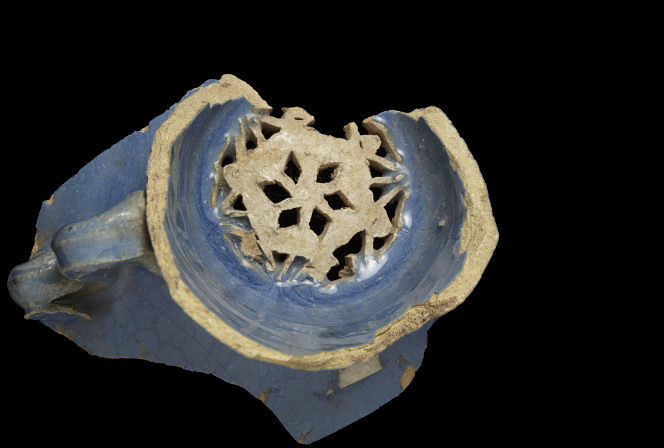
In the 10th century common ceramic objects in Egypt are still being dipped in overglaze before being fired (9) as part of the ongoing traditional decorative theme. The blues are becoming more varied by the 12th century with the introduction of a more purplish tint to the glaze (10). This may indicate an iron contamination in the cobalt source. This shift away from the more traditional lapis or turquoise colourings may be a result of the Islamic influence or a reduction in quality/quantity of pigment sources. The blue-purple strainer is an interesting item because typically these lovely objects are natural clay (11) and rarely glazed. I have found a couple of extant items that were glazed in turquoise as well (12, 13) indicating the love of this colour is deeply rooted in the Egyptian potters traditions. It seems that even though more complex and decorative methods are available, the production of common household goods such as filters and lamps (14) continued to involve simple glazing techniques. Lamps are of particular interest because they need to be glazed to prevent the terracotta from absorbing the oils. Lamps are also a common household object that would require mass production. Colours range from yellows (15), to greens and turquoise (16) and the rare blue (17). (side note: I love the pied colour of this one - 18).

Support for Attwood's suggestion on the move of Basra potters to Cairo is derived from lustre-ware items (19) recovered from Fustat. Stylistically these items are very similar to objects produced across the Abbysaid Empire (20) and even imported from Spain (21). This makes identification to a hobbiest like myself particularly challenging and I initially assumed the stylistic diversity at Fustat was solely due to their geographic location and the importation of high-level ceramics. However sherds such as 22 are marked with 'sa' which may be a potters mark, a workshop or a Fustatian tradition, either way, the item has been identified as Egyptian in origin. Essays on Islamic ceramics on the Ashmolean Museum propose that the Basra potters migrated to Egypt bringing the skills of lustreware. These potter families them migrated to Syria and later spread to Spain after the fall of the Fatamid dynasty in the 12th century.

10 - Bluish-purple strainer from Fostat, Egypt. 12th century, glazed fritware. Victoria and Albert Museum, item number c.914-1919

13th - 14th century
By the 13th century, the Mamluks had risen to power in Egypt ousting the Abbysaidians. On a side note: the Egyptian Mamluks seem to have made the greatest imprint on history, but the Delhi Sultinate was also controlled by the Mamluks which is often overlooked by hobbies scholars discussing this period in the middle east. Through the 13th and 14th centuries, Egypt was an important trading hub connecting the Mediterranean, the Red Sea, India and the East Indies.
Where the potters of Basra produced stylistically individual designs which are reasonably easy to identify. If anything, the potters of Fustat can be most easily identified through the use of solid Egyptian blue and turquoise glazes. This method of identification unfortunately, doesn't work for styles that require the use of different glazes. Items recovered from Fustat have a broad range of stylistic influence with sgraffito (23), incised and dipped (24) and polychrome underglaze (25) items all being produced from the 10th - 14th centuries. The position of Fustat as the hub of trade networks allowed local potters to adopt patterns and techniques from across Europe, the Middle East and Asia. A good example of this is the black and blue (BBW) items produced in Fustat during the 14th century (26). Some blue and black fragments have been recovered from Fustat (27, 28) and the style is quite similar to items produced in Syria at the time (29, 30)

Blue on White in Egypt
The production of BBW items in Fustat indicates the potters are conversant with the method of applying a white underglaze, then decorative elements and a clear overglaze. Sherds of Chinese porcelain (31) have been recovered from Fustat confirming the transport of such items to Egypt. There is no doubt these items influenced local designs. Sherds have been recovered that sport chrysanthemum like flowers (32), ducks (33) and other Chinese motifs (34). A number of sherds have been recovered from Fustat with patterns are reminiscent of Asian and iznik designs (35, 36, 37, 38, 39, 40). While I would like to wax lyrical regarding BoW trends in this region, I simply do not have sufficient extant objects to do so.

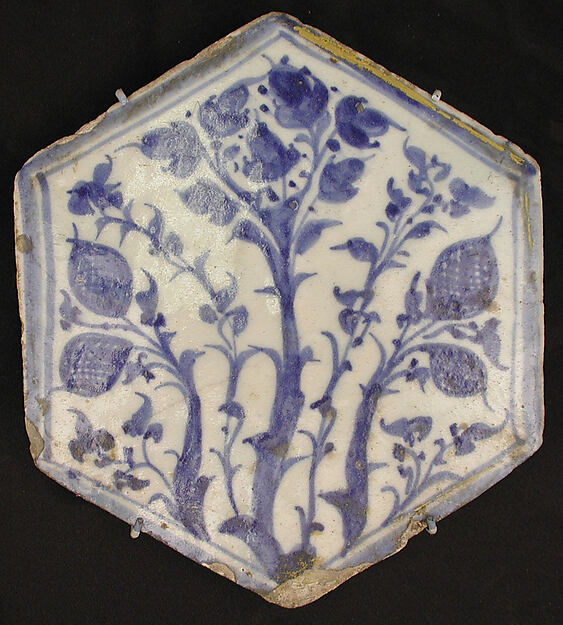
As well as the importation and imitation of Chinese BoW items, the Mamluks were producing BoW tiles (41, 42, 43, 44, 45, 46) very similar to the turquoise and blue hexagonal tiles being created in Syria with an almost Iznik flavour (47).


45 - Hexagonal Tile, 15th Century, Egypt. The Met Museum Accession Number 67.69.6


Additional resources:
A section on the Abbasiddian potters from a web based teaching course on islamic ceramics hosted by the Ashmolean Museum. http://islamicceramics.ashmolean.org/Abbasid/pottery.htm 

A PDF article on the Abbasid perception of Chinese Ceramics.
Hallet, J. 2010 Pearl Cups like the Moon, The Abbasid perception of Chinese Ceramics. Shipwrecked: Tang Treasures and Monsoon Winds.. eds Krahl, R. Guy, J. Wilson, J.K. Raby, J. Arthur M. Sackler Gallery, Smithsonian Institution, pp 75-81

A great scientific paper PDF on the reciprocal influence of Tang China and Abbasid Iraq ceramics.
Wood, N., and Tite, M., (2009), ‘Blue and White – the Early Years : Tang China and Abbasid Iraq compared.’ Transfer : The Influence of China on World Ceramics. (Colloquies on Art & Archaeology in Asia No. 24. Percival David Foundation of Chinese Art. ed. Stacey Person, ed. London University, pp 21-45

A short article on Basra's Potters and their developments
Attwood, R. 2005 Basra's Inventive Potters. Archeology Reviews. Vol 58, 2.

A PhD thesis I'd really like to get my hands on, scientific analysis of the origins of cobalt.


My collection of BoW images mapped to location of creation. Note: only 80 items initially load, you need to scroll to the end of the collection before they'll all show up on the map. Zoom into your area of interest to see clusters around centers of production.