Showing posts with label Peacock. Show all posts

Friday, 4 July 2014

Item 31 - Peacock cup

I've been playing with cups recently. They make a good, quick, hand-held project and there are far too many op-shop ceramic stemmed goblet things out there in use. This project started with a spare bit of bisque and some research that I'd been doing on cup shapes. When browsing the V&A I stumbled upon a beautiful jug that had a device on it (like Alliette's cup) and a beautiful peacock motif in the background. I didn't have anyone specific in mind for a cup but I wanted to try the motif as I've seen it work on some beautiful plates (below).

Peacock Jug, Cafaggiolo, Italy 1515. Tin glazed earthenware, V&A Museum item 2602-1856
 Plate featuring peacock detail, 1480-1490, Deruta, Italy. V&A. Museum number C.2069-1910

Peacock plate. Tin glazed earthenware 1480 - 1490. Deruta, Italy. V&A Museum, 2606-1856. 


The main motif inspiration came from the jug, particular the angles on the peacock feathers. I used the first plate to help me vary the size of the feathers smoothly. The second plate inspired the blue feather lines. This is the first item I've entirely painted, inside and out. I'm really happy with how warm the yellow looks - it's lovely!

The peacock cup, ceramic item 31. The yellow is much richer in real life. (same yellow and blue as in the Stormhold Fidchel set, just different lighting)

Saturday, 16 November 2013

Notes

Notes from Persian Ceramics from the 9th to the 14th century:

An alkaline solution obtained with potassium oxide is easily altered and ceramic objects will often take on a very characteristic iridescence if they come into contact with the earth or other chemical agents.

(This explains the iridescence seen in the peacock plate! I wonder if this iridescence was ever deliberately engineered by burying items or soaking them in special solutions)

Cobolt was imported from Europe via Venice. Muzarrad is a black stone used to make black, probable utilising antimony and comes from the mountains of Jajarm in Khorasan, Eastern Iran.

Turquoise is obtained from copper oxide and an alkaline glaze (well ozygenized). Copper oxide and a lead glaze (in reduction) produces green hues as well.


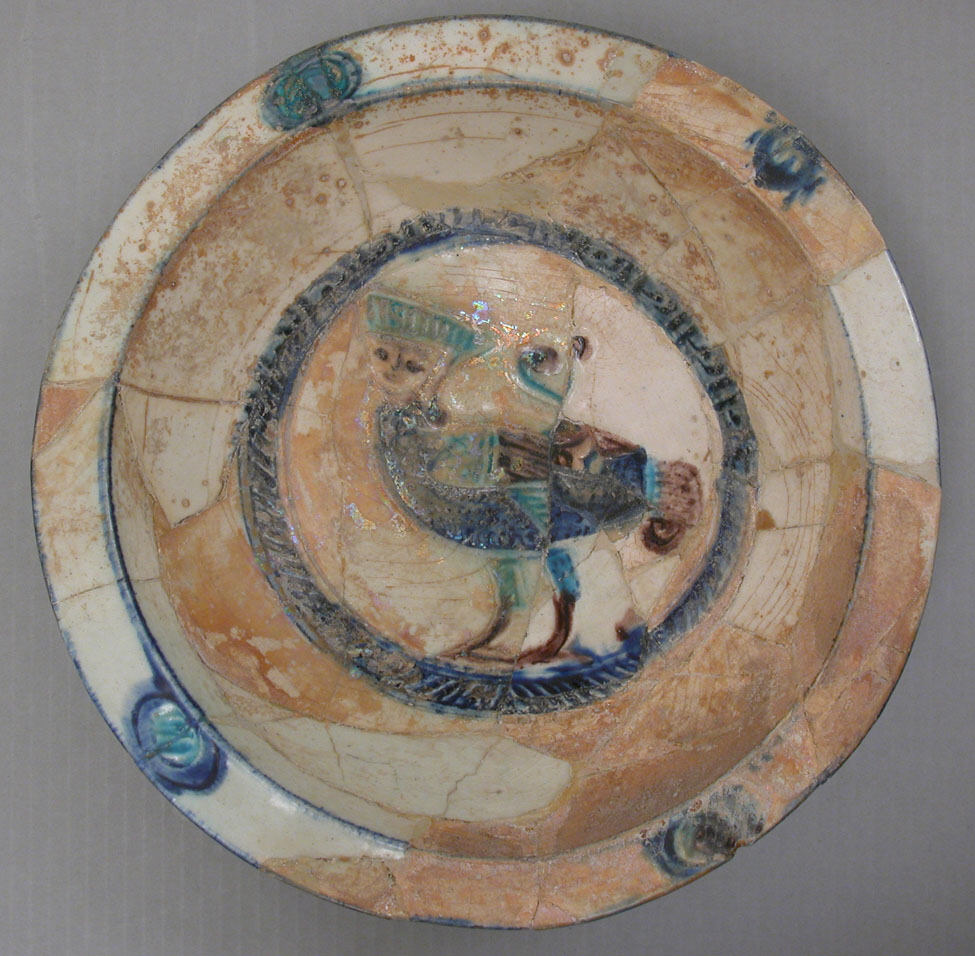
Bowl, 12th century, Iran. Met Museum of Art, Accession number: 29.160.12. Showing a slight hint of the iridescence.

Sunday, 7 April 2013

Plate 8 - part II


So I finished the plate, sent it off for baking and then promptly left for Rowany Festival. Ah, such a delightful event. This year we had fire, flood and tears. I left the boy with instructions to collect the completed plate and fly up with it. This he achieved (eventually) and the plate arrived intact and in all it's blue/green glory. I took it to the Laurels Prize Tourney (which is not a tourney, has no prize and the laurels don't compete) and showed off all my different pottery type experiments. I got some excellent feedback and ideas from laurels and non-laurels alike which I will post about at a future time.

Without further ado.. the plate.

Plate 8: The peacock, replica of a 12th c Syrian dish.

The plate turned out to be rather simple once the option for iridescence had been undocumented. I quite like the chevrons and wibbles that outline the body banding. The main difference between the original and my copy is the lack of a rim as the copy is a plate not a dish. The second difference is that the original has been repaired while my plate is currently in two pieces (it broke on the way home from Rowany somehow). The bits have been placed in Dash's mosaic pile and will hopefully see a new life at some point. I'm not to heartbroken over the breakage as the peacock hasn't made the top five favourite projects.

Monday, 18 March 2013

Plate 8 - part I


After a long break, mostly due to guilt at not finishing the two plates that languish in my kitchen cupboard, I have started decorating plates again. This resurgence of interested was prompted by a post by Aliette of Stormhold quite a few months ago. She posted a rather nice plate (13th Century I think) that sported a simple cat motif. While looking for the details of the original I stumbled upon something much more interesting, a 12th century peacock dish from Syria (Figure 1).

Fig 1: Peacock plate from Syria. 12th Century. Accession number: 29.160.17. Metropolitan Museum of Art


The back of the dish is plain and shows minor green staining. Interestingly, when stood 'flat', the plate appears to slant towards the left of the peacock. The rainbow luster around the edge of the plate and around the breast of the peacock bothered me initially. In my limited knowledge of ceramics, I associate that effect with modern day fairies or ballerina ceramics, not 12th century dishes. Looking at the unstained head of the peacock where the plate is the whitest there is no iridescent coloration. So, the two most likely causes are 1. a pigment used to outline the peacock and add decoration to the edge of the dish as been changed to create the irridescence, 2. groundwater or whatever stained the dish orange transported chemicals onto the plate to create the irridescence.

Cause 1 - pigment conversion
I have sifted through the Met's Syrian 12th century ceramic collection and found a fragment of a bowl (Figure 2) featuring a bird which has a similar white outline of the wings and features to the peacock. Given there is no trace of a decorative motif on the rim of the peacock plate this suggests that the void around the wing was intentional not the result of alteration of pigment causing the iridescence.

Fig 2: Fragment of a bowl. late 12th - first half 13th century. Composite body, underglaze painted. Syria. Accession number: 1978.546.9 The swan (?) depicted has voids outlining it's primary leg and wing.


Cause 2 - pigment discoloration
I have examined the images of most of the Met's Syrian ceramic collection and have found others with the iridescent staining (Figure 3 and 4). Both plates feature blue and green images similar to the peacock in colour. The Faun? (Figure 4) has the best example of irridescence as it only appears on areas that also exhibit orange staining. The likely cause of the iridescence is groundwater interacting with the underglaze chemicals (copper?) and causing the staining.

Fig 3: Syrian (Raqqa) plate featuring a Sphinx. late 12th- first half 13th century. Made out of stonepaste, under-glaze painted under a transparent, greenish colorless glaze. Accession number: 13.219.1. Metropolitan Museum of Art.

Fig 4: Syrian (Raqqa) plate featuring a faun? Stonepaste, under-glaze painted. Accession number: 56.185.5. Metropolitan Museum of Art.


So. Having made the conclusion I can ignore the iridescence, I can now happily paint a white plate with a beautiful blue and green peacock.