Monday, 23 September 2013

Choli tops in Medieval Indian art

Some reference images I'm gathering for my class on choli tops for Rowany Festival.

Detail from a folio from a Kalpasutra Manuscript. Gujarat, 1350. Ink and opaque watercolor on palm leaf. Page 86 in Indian Painting, 1000-1700, by Pratapaditya Pal. ISBN: 0810834655
The image above shows two nuns separated from two ladies. The lady in the front is identified as Hiradevi, the chief hearer. Both ladies wear mid length choli tops over which they wear arm bangles.


One of a Pair of Jain Manuscripts (Patli), early 12th century India (Gujarat) Opaque watercolor on wood  Central figure wears a mid length choli top in contrasting colours.


Detail from a folio, Manjusri and Scenes from the Buddha's life. Bihar, Nalanda, 1075. Image of the goddess Prajnaparamita. Page 57 in Indian Painting, 1000-1700, by Pratapaditya Pal. ISBN: 0810834655  The goddess either wears a short choli top and arm jewellery, or a mid length choli top which has been embroidered or had jewels sewn on. The goddesses feet and hands seem to be coloured red, suggesting the use of henna perhaps. (not the delicate and intricate patterns we see at ren faires today though).

Thursday, 19 September 2013

Ceramic experiment 15 - Tile 3

Star and cross tiles in a manuscript. From Bābur Seeks His Grandmother's Advice Leaf from the Read Mughal Album, but formerly fol. 86 in the British Library's Bāburnāma. Mughal, ca. 1590–92, probably by Sānvalah, with early-nineteenth-century borders. 440 x 294 mm  MS M.458.18. The Morgan Library & Museum.


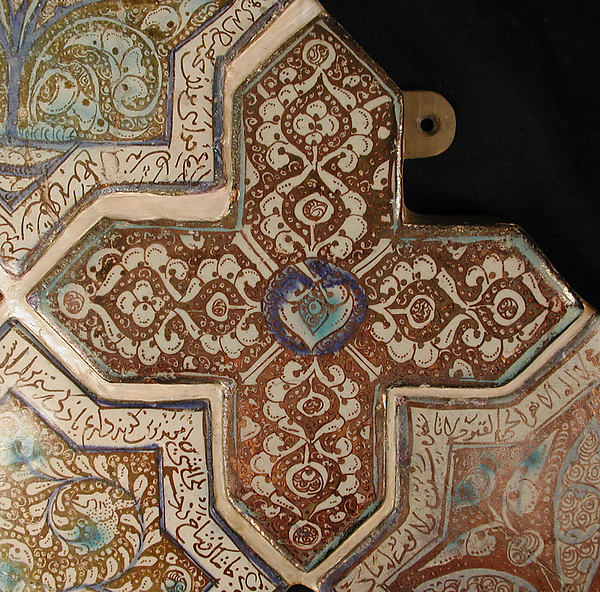
Star tile, Iran, Kashan, 1260-1270. The Met Museum. Accession Number: 41.165.22


I have completed my third islamic tile. It has also been designed to link to tiles 1 and 2. I'm rather happy with how it came out. While I can't claim this is an experiment, this is part of my ongoing A&S 50 challenge. Given that I'm now at number 15, and I have another 35 to complete in a little over a year and a half, I need to get cracking.

Tile from Iran, Kashan, 1000-1250. LACMA Kashan tile, 13th Century. Met Museum of Art.


Tiles 2, 1, and 3 in order.


Tuesday, 17 September 2013

Blue persian fabrics and ideas for block printing

Due to my, mostly, successful block printing experiment I've started looking into different patterns and styles of drape on Persian garb. Mostly in the Safavid period. I currently have a roll of light yellow linen and bright blue cotton / linen blend sitting around my house. I've never thought the bright blue would be suitable for more western European SCA garb, it's just too bright. However, the blues I've been finding in Persian manuscripts are beautifully bright. Before you comment to point it out, colour pallet available to painters is entirely different from that available to the dyers (and ceramic painters too). From this small collection of images, it appears that blue garb was usually accompanied by orange, red or other 'warm tones'.
I am going to have to think carefully about this garb choice. Artistically, the preferred depiction of women seems to be more willowy than modern paintings of this culture. I suspect I'm a little too buxom to wear under-dresses that gape between the breasts unless they're uncomfortably tight.

Detail from Wine drinking in a Spring Garden. Iran, 1430. Met Museum.


Detail from an illustrated and illuminated leaf from a manuscript of Firdausi’s Shahnameh: Bahram at the court of the Indian king Shangol, Persia, Safavid, Shiraz, 16th Century. From Sotheby's.

Woman with a spray of flowers ca. 1575, Safavid period, Iran
I got the idea for my first printing stamp from this image.

Mohammadi, Herat, circa 1565, Seated Princess. I don't know where it's located, but the link for the full images is here. I love the blue coat (entari?), the yellow dress, and the black under dress. And the image below is from the same site.

Detail of - Seated Princess has a cloud collar, an orange coat, a light blue dress and a dark blue underdress. Plate 57. Persia, Circa 1500, Collection of L. Cartier, Paris, France La Miniature En Orient by Ernst Kuhnel 1925  Attributed to Miraz Ali, 1540.


Lot 297 Sotheby's London UK. 04/30/1992
Detail of - Fariburz comes before Kay Khusrau enthroned within a draped chamber, three chained prisoners in foreground, hilly landscape under gold sky, an illustrated leaf from a manuscript of Firdausi's Shahnama copied by Salik ibn Sa'id for Sultan Ali Mirza of Gazan (reigned 1478 - 1504) Turkmen Court Style, dated 1494


See also:
  • Persian embroidery a study in miniatures (some great images here)
  • this guy has some great images and translations, even though the layout is jumbled and confusing at times, also, his main page clumsily sells carpets (he appears to be an expert) and has no link to the Persian miniatures. (he also has a bunch of Mumluk items)
  • My growing Pinterest Persian board.

Saturday, 14 September 2013

Block printing experiments

I made my first attempt at block printing today. I spent a bit of time over the last week browsing online how-to's and gathering images of period paintings and extant fabric samples. Here is a great video of block printing in Jaipur. The video starts with a multi-colour print using four speerate blocks and then demonstrates a great method for turning corners - using newspaper to make angles. It's also comforting to see that professions (who do this every day) sometimes misalign the blocks. This morning, I felt confident enough to make my own attempt on a scrap of pale yellow linen I had lying around.


From what I can gather, a lot of block printing is done using wooden or copper blocks like the one in the image above (grabbed from a random ebay auction). The blocks are crafted in such a way that the design will flow from each printed block. The raised section of the block is covered in fabric paint or dye from an ink pad and then the block is stamped onto the fabric.


For my first attempt I decided not to buy a block from ebay as I only wanted a small design. Also, alot of them seem to be discarded blocks from India and I would want a complete pattern. Instead, I crafted a mini-block using 'Make 'n' Bake', a mont marte femo knock off. I got the idea from aan article by Lindsay Boardman for a polymer clay cookie stamp. I took the idea and made a small quatra-heart pattern stamp. The hard part was getting the hearts flat. As you can see in the image above, when I defined the groove between the hearts, the bottom two buckled. I used Pebeo's Setacolour opaque for this first experiment. Mostly because I have a couple of pots sitting around my house from a previous abortive fabric painting attempt. I ended up painting the dye onto the stamp as I didn't have an ink pad and I wasn't going to be doing many stamps. It took me a while to master getting most of the design on the fabric. The left two stamps in the image below are the best print I achieved with the stamp alone. The print on the right I touched up with a paint brush.

I quite like this effect and will try it again to make a small Persian headscarf or possibly even a full tunic (if I get around to making more stamps). In the mean time, I'm going to look for a rubber stamp of two crossed quills. The type of rubber stamp Samantha used to use for her card embossing art. I suspect it may work well for a small block printing project.


Friday, 13 September 2013

Embroidered cushion Mk II


Japanese fabric (?) I found on flicker, so simple and effective.

Since making the previous mint cushion, I've been pondering more cushions. Ideally I'd love to have a pile of them to flop on in front of the heater. As I had plenty of mint green bed-sheet left over after my previous cushion attempt, I decided to make another green cushion. This time I've taken my inspiration from two sources, a blog by ArtisticFingers who makes the most beautiful embroidered items and the image above.

I started by cutting out section of cloth with 5cm allowance on each side. Then I divided it into squares with coarse stitches. Since then I've been filling in the blocks in alternatively with whatever pattern appeals to me on the day I start. I have completed five squares so far. I'm not entirly happy how some of the patterns turned out, but I also don't dislike them enough to unpick them. I am really loving the texture of this cushion so far.

(The fabric is a little crumpled, because I took it to Bairnsdale on Friday so I could work on it between classes.)


------

Additional:  I'm down to four more squares and I'm running out of ideas. Generally, I'm trying for geometric patterns. I even unpicked a sort of star field because it didn't really fit the theme. Suggestions are welcome!

Thursday, 5 September 2013

Block printing


Cotton red and brown block printed textile from Fustat, Egypt. Item 73.408 The Textile Museum

I don't tend to do image round-ups all that often, because you can only show a few choice images in a good blog post. Instead, I store all my reference images in Pinterest so my collection slowly grows rather than remaining a static blog post, or even worse, having to revise or repost. Since receiving two beautiful block printed sarees from Flori of Northshield I've been investigating the process of block printing. I'll also been looking at various scraps of block printed fabric originating from India. Most of these scraps were found in Fustat, the old capital of Egypt. Due to the drier climate and the fact the Egyptians don't really burn their dead, these pieces have been preserved. According to the Textile Museum, Fustat fragments are red or blue dyes with a variety patterns, both open and closed.

I've included a number of images here as I'm considering doing my own block printed item, probably a small headscarf or heraldic favors. Once I've worked out what works best for me, I may even teach a class at St Monicas. Time to see if my vague recollections of what Piers taught me 10 years ago actually work!
Textile fragment. India. Gujarat, 13th - 14th C. Cotton plain wave, block-resist dyed. From LACMA


Textile Fragment, Egypt, Early Medieval. Linen plain weave, resist dyed. From LACMA -  (M.2002.1.695)

It seems that the complexity of the extant patterns in period are similar to what is achieved today, there are some lovely examples on my Pennsic Treasures 2 post. Also, this white and red dupatta which I got at the same time as my Pennsic Sarees.


Monday, 26 August 2013

Ceramic experiment 14 - Tile 2


The star tile reference for tile 2 is about 150 years older than the reference for tile 1. Tile 2 shares some of the references for the crosses with tile one. As with previous works, I haven't replicated the inscriptions as a) I don't know the letters so I can't be sure when I screw it up and b) I'm not going to write anything I can't read/understand. Due to space limitations, I did bastardise one of the cross tile replicas, leaving out a third repetition of the droopy flower things.

14th century polychrome tile from Kushan, Iran. Victoria and Albert Museum. Item number 734c-1888.


Cross tile by Ali ibn Muhammad ibn Abi Tahir. 1262. Iran. Victoria and Albert Museum. Item Number 1838B-1876

I actually made tile 1 and tile 2 at the same time so I could line up the designs properly. So, without further ado, the two tiles: I'm going to keep making these until I have enough for a bathroom feature, when I buy a house (I have plenty of time!). So now the hard question... keep going left to right forming a line, or create 2 more below to make a square?


Ceramic experiment 13 - Tile 1

Ceramic number 13, my first tile in blue 28.

So I worked on this one for about a week. I originally bought some tiles when I collected Miriam's plate. I was thinking of using them to practice shading with underglaze for Benjamen's plate. I'd already pinned a number of tile images from the 12c, heraldic lions and whatnot and was considering making them as colour samplers. However, I like to make items that I'd use, and I can't see myself using those tiles for anything, not even pot holders. However, the dove plate has been on my mind a bit as I'm quite taken with the Sultanabad colours and patterns. So that led me to Iranian pottery, and Persian plates which took me to their lovely tiles.

 Image 1: Tile from a frieze from the shrine of Imamzadeh Yahya in Varamin. Made in Kashan, Iran, 1262. Victoria and Albert Museum, Museum Number: 1837L-1876

In the 13th century, shrines were covered in beautiful lustreware, monochrome tiles. These are in the form of eight pointed stars and crosses. Unfortunately, many of the tiles have been removed from their original location and the panels have been divided between collectors and museums. From the 30 odd I've pinned there are a huge range of motives and inscriptions. If I get it together I may do a proper analysis of this.

Shape
As the original tiles are stars and cross and my tile is a square I needed to decide if I was going to have a full star and partial crosses or vice-verse. As I have many more images of star tiles which are not mirror image or geometrically laid out I decided it'd be easier to have a complete star and partial crosses. I created an eight pointed star template so the star would be the same in subsiquent tiles.


Patterns
For the first tile, I used a tile from the shrine of Imamzadeh Yahya (image 1), painted by Ali ibn Muhammad ibn Abi Tahir . For the four partial crosses I used two isolated crosses, and two from a panel of tiles . Clockwise from the top left they are:


Cross shaped tile, 13th C. Iran, probably Kashan. The Metropolitan Museum of Art. Number 41.165.34
A cross from a panel composed from tiles in the shape of eight pointed stars and crosses. Iran, 1260-1270. The Metropolitan Museum of Art, Number 41.165.22.


 Lusterware Cross-shaped tile from the tomb of Imamzada Yayha at Veramin. Iran 1262. The Walters Art Museum. Number 47.1290
A cross from a panel composed from tiles in the shape of eight pointed stars and crosses. Iran, 1260-1270. The Metropolitan Museum of Art, Number 41.165.22.


Wednesday, 21 August 2013

Yoda

I'm practicing shading for my next complicated plate. I'm rather happy with how this one turned out, though he looks like he has a slight overbite due to the shading on his chin. Before you mention it, yes, I know he should be green, but I had none so had to make do with red. This one is A5, reducing him to 3cm across and retaining level of detail needed to make Yoda right might be beyond my skills. An additional challenge with the shading too as the glaze dries quite quickly making smooth strokes a challenge.


Tuesday, 20 August 2013

Mint cushion

Last night I completed another cushion for my collection. I'm aiming to make a pile for in front of the heater for winter napping and book reading. The idea for the cushion originated from my lovely bottle green georgette saree. The fabric wasn't period but I loved it because it draped so nicely. This year at Pennsic, when I tried it on, I noticed a couple of stains on the pallu. To make matters worse, I sampled the dimsims from the Australian Grill place and dripped soy sauce all over it. Three washings later, I've had no luck getting the stains out and since they're in a rather obvious place when I use my standard drape I can't really keep using this sari.


One of the reasons I liked this sari so much is the embroidery. It's done in simple colours and while it has some sequins, it's comparatively understated. I always thought it was machine embroidered, but now I've had a really close look, I can see it's aari work and hand stitched. I couldn't throw away the embroidery, so I backed it with a light green and added it to my trim stash. The main embroidery on the pallu has a beautiful plant motif, with sequins. There's not really enough to do anything medieval with but I really liked it. So I made a cushion out of it.


How to cushion it up:
Step 1: Purchase a cushion insert and a zip from your local craft store. I had a 61 cm square cushion insert left over from my embroidered cushion UFO.
Step 2: Cut one 63cm square (if you are overlocking the edges, use 65cm instead), This is the back of your cushion.
Step 3: Cut one 65x63cm rectangle. This is the front of your cushion.
Step 4: Pin and sew one side of your trim to the front of your cushion, right side to wrong side.
Step 5: Use the extra 2 cm to make a 1cm fold at the base of your trim. Machine sew one side and handstitch the other down, securing the edge of the trim with the fold..
Step 6: Place front and back right sides together, sew the zip side with widely spaced stitches. Open and press.
Step 7: Pin the zip to the back of the new seam and sew.
Step 8: Unpick the seam over zip.
Step 9: Pin front and back right sides together and sew. Open and press.
Step 10: Trim corners for neatness, stuff in cushion insert, zip closed, plump and enjoy.


Things I learned: When sewing a 61cm cushion, use a 59 cm zip. If you use a 61cm zip you end up with really messy corners. Also, gourgette is hard to sew neatly as it's more slippery than the poly cotton (ex-sheet) I used for the main body of the cushion and tends to bunch.


Pennsic treasurers pt 2

Cream cotton sari drying on the line (strange concept for the Americans, older rentals don't come with white goods here, and we've got plenty of solar energy, in summer at least). From Garvi Gurjari, cost $12 USD.

I've just finished washing some new sarees in cold salty water as I didn't know if the dye would run. One of the hardest parts of coming home after Pennsic is dealing with the mound of wash. As Slippery Rock is so humid, even your clean clothes come home smelling musty after being trapped in a suitcase for 24-30 hours. Thus everything has to be washed, which is perfectly fine for the mundane items as they can be tossed in the dryer. The handmade garb needs to be washed carefully and line dried, a difficult prospect when you're returning to Melbourne winters which involve significant lengths of overcast cold weather and drizzle, and a sun that seems to rise and set while you're at work. Add to that the complication of washing and drying 10 lengths of 6-9 foot fabric with limited line space. The result: still finishing off the wash two weeks after returning from the event.

Brown, dark brown / black and green cotton block printed sari. The green lines appear to have been block printed on separate from the dark brown/black motifs. From Garvi Gurjari, cost $12 USD.

~


I'm not sure if Garvi Gurjari is a shop name or the name of the weavers/dyers of this sari. Google isn't helping much either. I'm going to assume the trader or maker takes their name from Gujarat. This is a north western state in India (above) and was a well known center for fabric crafts and trade in the middle ages. Many of the scraps of imported fabric found in Egypt are attributed to Gujarat. Below is an example of cotton block printed fabric that shows incredible intricacy and precision. I'll post at another time about the process of block printing, I may even try it myself.
While washing these two sarees, I half convinced myself they'd make beautiful Persian garb. Given I now have a plethora of sarees, I'm contemplating turning one of these two into a nice light under-dress/tunic. The block printing is lovely and perfect for the application. I'm also unlikely to wear a brown saree as I haven't an appropriate choli at this point. The only thing holding me back at this point is I've never sewn Persian garb before, and I'm really hesitant to cut up such nice fabric (I suspect this hesitation is also the secondary cause of my fabric stash).


Monday, 19 August 2013

Blue

Some things about blue to read later

The invention of blue and purple pigments in ancient times by H Berke


Page 47 in Part 5, Scientific Research in conservation of Ancient Sites on the Silk Road
Development of Ancient Synthetic Copper-Based blur and purple pigments. H Berke et al.

Page 56 in Part 5, Scientific Research in conservation of Ancient Sites on the Silk Road
Ishkor glazes of Uzbekistan. P Vandiver et al

Which has a quote that resounds with my work: The Asian view, predominant in China for the past thousand years as well as in contemporary Uzbekistan, is that replicas are not fakes and forgeries but a complement to a past tradition that is being revived, continued, and collected as an heir to that tradition.


Persian garb for Jour d'Honnuer (Krae Glas)

So having gotten the hard part of my first Persian outfit out of the way by simply buying the upper garments I now have to create a full outfit with them for this weekends do at Krae Glas.
As I see it, accessories make the outfit and a wonderful informative list by Baron Afrasiyab al- Isfahani has given me a good start.


My accessory list for the weekend:

prayer beads - check
necklace - thanks dash!
seal ring - check  (yay for family treasurers)
scarf - I may be able to rustle something up. I'm going to go with the fabric belt, and sew two strips of appropraite fabric together. That way when I twist them together the colours will be revealed.
shoes - conversation with louisa of st mons gave me the idea of fabric coating a pair of slip ons.
leggings / sock things - thanks Candice!
earrings - the goldish pirate hoops may work.

and finally, headwear which may or maynot happen. there's a _huge_ variety to pick from.

Saturday, 17 August 2013

On Ikat

This year at Pennsic I was super lucky and managed to acquire some sarees from Flori of Northshield. She and her partner are moving back to the US from India and she offered to buy sarees for anyone interested on the SCA_India site. Given that I love the look of sarees, and I couldn't remember how many I had stored with Ronin I asked for 5, greedy yes I know. Flori was amazing , not only did she bring alot of sarees back to the US for us, she also labeled them with their source. She brought be 5 beautiful and varied new sarees one of which is an ikat saree in green and maroon.


I had never encountered ikat before but I loved the look so much, I bought some 'Persian' garb made out of ikat too. So, for those, like me, who have never encountered ikat before I present my notes made after returning home.


Ikat is the process of making cloth from pre-dyed thread. The thread is dyed in such a way that when woven it creates designs in the cloth. The process is very labour intensive as the threads need to be hand dyed in specific patterns before weaving. The Persian garb I bought was made out of double ikat were both the warp (up/down threads the weft thread is woven around) and the weft (left/right threads woven over and under the warp) are dyed and woven together to make a pattern. In the case of my Persian garb, there is no specific pattern rather a more modern take which features the colours and the weaving style. For more intricate patterns, the warp and weft are tied separately with cotton thread before being dyed, this is called double ikat. The thread is then removed and the warp/weft are retied and dyed again to create another layer of colour. Finally  after all the dye is applied, the weft is carefully strung and the warp carefully lined up and woven. Double ikat silk available in India and Indonesia is called patola (or single, patolu). Given I have trouble remembering if I'm on the third or forth coat of glaze half the time, I'd have a nightmare keeping track of which threads go where.

Arm of the persian top showing the texture of a random double ikat.

My new sari could be called double ikat as it has patterns dyed into both the warp and weft however these sections don't overlap and each creates an individual motif, either horizontal or vertical. Indian Ikat Textiles by Rosemary Crill (1998) includes some beautiful examples where double ikat has been used to feature designs such as elephants. In images of the more complicated and time consuming weaving, it's difficult to tell if the image is ikat or dyed on later. It's only when you look closely you can see the fuzziness that occurs when the dyed sections don't quite line up perfectly that you can tell. In the best examples, you can't tell without physically examining the fabric yourself.


Ikat is a old tradition that can be dated back to the Ajanta Caves in India. In the listening to the sage scene below, featured in Cave 1 of Ajanta, you can see various figures wearing striped cloth. The prince (?) wearing a garment made out of slightly fizzy arrow heads. Given the level of detail on other individuals, the fuzziness is assumed to be intentional and representative of the fuzzy outlines seen in ikat fabric. According to Crill (1998), Chandra (1960) was the first to highlight this, however that specific reference is rather hard to find. Crill (1998) suggests that arrows, broken and solid stripes and check patterns can all be found in the caves.

In summary:
1. Ikat is period for an Indian persona
2. Double ikat may also be period, more examination of images is required. Chandra 1960 suggests that 12th century Deccani sources reference double ikat.
3. The more precise and complex the dying, the more time consuming and expensive. This may have been a status symbol as well.
4. I'm glad I now have an ikat sari, thanks Flori!
5. Now you know why my last post was looking at sources of dye in India.


Resources and References:

Books:

Crill, Rosemary. 1998. Indian IKAT textiles. V&A Publications. 176. ISBN: 1851772421
Chandra, Moti. 1960. Indian costumes and textiles from the eighth to the twelfth century. Journal of Indian Textile History Vol 5.
Chandra, Moti. 1961. Costumes and Textiles in the Sultanate Period. Journal of Indian Textile History. Vol 6.
http://www.abebooks.com/book-search/title/journal-indian-textile-history/page-1/

(if you have a digital copy of either of the Chandra papers, I'd love a copy)


AMAZING resource for the Ajanta Cave 1, I'm still trying to navigate the rest of the website and find more (and see if I can access them without a student number). I'm also going to pin as many of these images as possible just in case they decide to block them.


Three useful websites which cover the basic concepts (not really good references though):