Saturday, 30 November 2013

Persian block printed head scarf.

 Some Persian head scarves, possibly block printed:

1                                                                                  2
   
 3                                                                  4
 
5

Head scarf examples. Patterns range from simple monotone, to complicated potential brocades or embroidery. All involve a triangular (or folded square) headscarf, draped over what appears to be a circular cap and braid case of a different fabric (often the same as the pants). Recently on the Persian Clothiers facebook group there was recent discussion on the shape of these headscarves. I propose that the contrasting colours on no. 2 & no. 4 (red & white / orange ) indicates a single layer whereas the two sided print and potential for two points on no. 5 suggest towards a double layer resulting from a square shape. The shape of no.'s 1 and 3 are indeterminate. No. 1 shows the same pattern on the underside, which may be a woven, reversible fabric or a doubled over square shape.

So I started with a square design because it's easier to measure and cut. I cut it out, block printed it with my quatra-heart stamp, ironed it and then machine sewed the hems.  As you can see below, the square is a little too small, too stiff and really the wrong shape. I also used an artifical silk scarf for the braid case and the cotton headscarf kept slipping off. Quite vexing.
Marshalling at November Crown, Stormhold, 2013.


Wednesday, 20 November 2013

Ceramic 17 - Tile 5

Tile 5


It's getting harder and harder to find good crosses. I tried three different ones for this tile. One of them was a rather floral, skinny cross. I started with a solid background and carved the flowers into it. It really didn't work well. The original was too skinny and I couldn't reproduce the dimensions, even after removing one of the flowers. I guess I was right to avoid animals and such figures. Upon investigation, the tile is Tamurid not what I'm looking for

So I painted over it and carved a more swirly pattern (below). I've only managed to find one, not very good at all, image of this cross and had to extrapolate. I'm rather happy with how it turned out but as the glaze was so thick, this tile has a texture to it.

Cross tile from the mausoleum of Imamzada Yahya in Veramin near Tehran. Part of a panel of glazed lustre-ware tiles. State Hermitage Museum. Inv. nos IR 1026-1062. 1097 - 1118.


The other cross on this tile is also a new one. The cross in the image below on the left is the one I used. It's in the Louvre as a panel. The image in the Louvre is small, but there's a good collection of representative images of different regions and art styles at the Walter Chapin Simpson Centre for Humanities.

Details of panel made of individual tiles.
Iran, Kashan, 1267 CE/665 AH. Fritware, overglaze lustre with color splashes. The panel if from the tomb of imamazade Djafar at Damghan. Inv. no.: OA 6319. Website (photo shows whole panel). Individual panels can be found here.

It saddens me that so many tiles have been pillaged from the Imamzada Yahya mausoleum. It's good that they are ending up in museums so internet hobbiests like me can appreciate them, but I really think they should have stayed on the mausoleum. I'm feeling particularly annoyed by it at the moment because there's a whole bunch of tiles in Shangri La, Honolulu, a rich woman's beautiful home. There are no good close up images but there's treasure upon treasure there, all hoarded away. It's like taking fossils from the rocks - these are things that will never occur again. They should be left for others to appreciate rather than squirreled away by people who have more resources than sense.

Tile 5. First of the second line.

Tuesday, 19 November 2013

Ceramic 16/18/19 - Tiles 4, 6 & 7

Tiles 6, 4 and 7


Tile 4 is the terminus star tile (in the center). So there are no new cruciforms, just one star. I still haven't decided how big my tile panel is going to be, but I do know where one end is now. Tile 6 and 7 are edge tiles, covering only one quarter cruciform. I'm quite happy with how these three turned out and look forward to completing the whole set.


This close up shows how much better I am at getting the quarter cruciforms to line up.

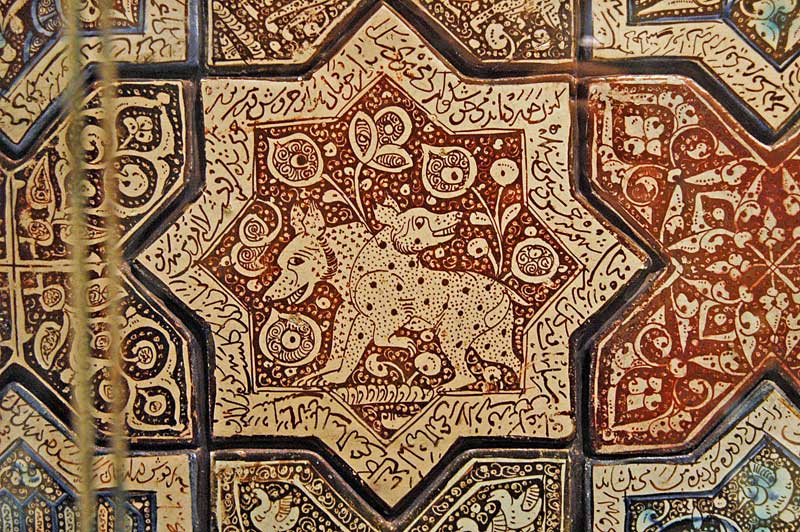
The original star tile is one of a group of 12 tiles auctioned at Bonhams in 2008. The tiles are Kashan and date from the 12/13th century. As has been my policy throughout this tile project, I've removed the writing and replaced it with a wide blue border.

Saturday, 16 November 2013

Notes

Notes from Persian Ceramics from the 9th to the 14th century:

An alkaline solution obtained with potassium oxide is easily altered and ceramic objects will often take on a very characteristic iridescence if they come into contact with the earth or other chemical agents.

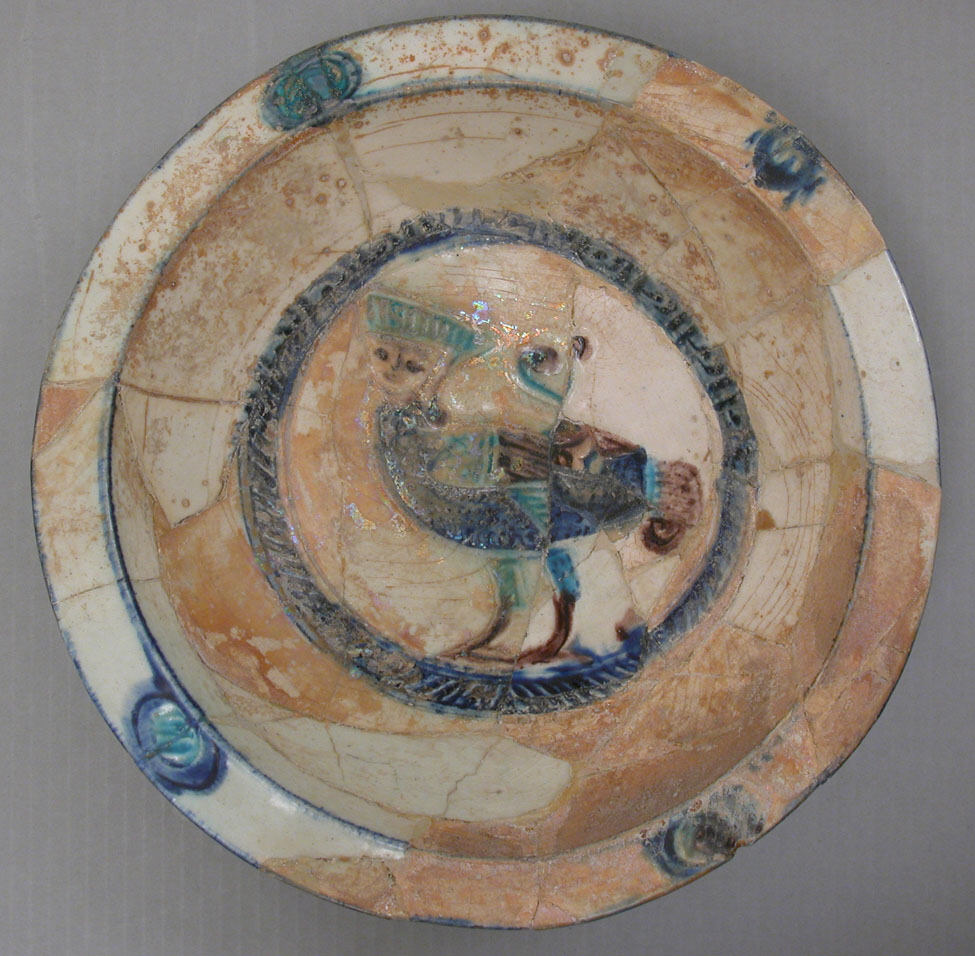
(This explains the iridescence seen in the peacock plate! I wonder if this iridescence was ever deliberately engineered by burying items or soaking them in special solutions)

Cobolt was imported from Europe via Venice. Muzarrad is a black stone used to make black, probable utilising antimony and comes from the mountains of Jajarm in Khorasan, Eastern Iran.

Turquoise is obtained from copper oxide and an alkaline glaze (well ozygenized). Copper oxide and a lead glaze (in reduction) produces green hues as well.


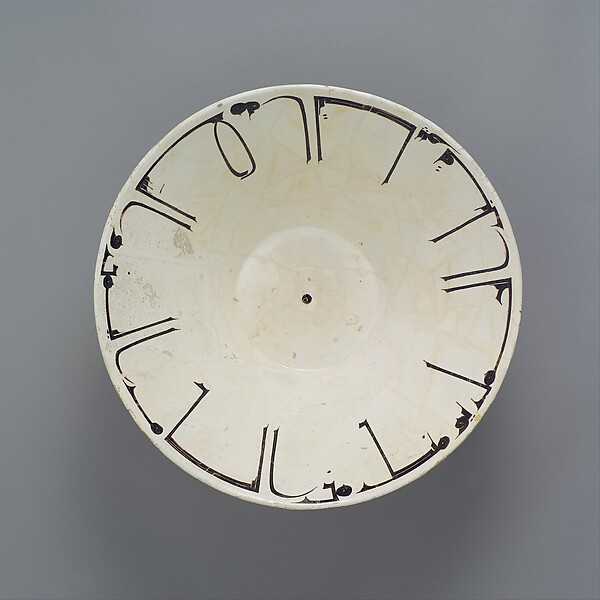
Bowl, 12th century, Iran. Met Museum of Art, Accession number: 29.160.12. Showing a slight hint of the iridescence.

Friday, 15 November 2013

THe Ashmoelean on Iranian tiles

From the Ashmolean on Iranian tiles:

Tiles were not produced in great quantities before circa 1200, and large-scale tile production kicks off at basically the same moment as the new "Kashan" style of painting: it is rare to find tiles decorated in the "Monumental" or "Miniature" styles althought they do exist. However, from the turn of the C13th, much of finest work of the Kashan potters is on tiles. The two prominent figures in this development are the potters Muhammad ibn Abu Tahir and Abu Zaid, who are known through signatures to have worked together on the most important tilework projects of the pre-Mongol period.
Their earliest dated joint effort is a sarcophagus in the tomb-chamber at Qumm, where the top panel is signed by Muhammad and the main frieze is signed by Abu Zaid. This work is dated 1206. At Mashhad in 1215 they undertake a much more ambitious project, cladding the walls in star and octagonal tiles surmounted by an inscription frieze, and installing two large and elaborate mihrabs, one of which is signed by Abu Zaid as well as a number of the star tiles. This is extremely high quality work, and shows that Abu Zaid produced some of the best products of the whole Kashan industry. There has been some confusion over dating this shrine, because two dates exist side by side in the inscriptions: 1215 and 1118. It is now thought that the tiling dates to the C13th, but the earlier date is included to commemorate the decoration that was replaced in 1215.
This pre-Mongol era in tile production sees a peak of artistic and technical achievement that is never again matched. The sudden decline in tile production after 1220 may be a result of the first wave of Mongol invasions, but may be equally due to the death of the pottery industry’s two major figures, Muhammad ibn Abu Tahir and Abu Zaid. The former’s last dated work was 1215 (Mashhad) and the latter’s was 1219. Thereafter there appears to be a vacuum which proves difficult to fill.


From this vacuum emerges the next generation of potters, who attempt to imitate the high quality work of their predecessors, and who do produce some masterpieces, but the technique and quality of execution is generally more simplified and standardised than the earlier products. The leading lights of the next generation emerge first in the 1220s and 1230s, but their artistic talents do not really emerge until the resumption of large-scale tile production in the 1260s. Hasan ibn al-Arabshah signed the mihrab from the Maidan Mosque in Kashan (d.1226) which according to Watson is timid and restrained in design; the son of Muhammad ibn Abu Tahir, Ali, produces a mihrab in 1242 for Mashhad, in which the cobalt has run badly, implying Ali’s technical skills are not yet developed.
Very few dated pieces are known from the period 1220 – 1260, but thereafter a number of grand commissions by the new Il-Khanid rulers stimulate the Kashan industry into a resurgence of productivity, in which Ali ibn Muhammad ibn Abu Tahir dominates. The major complex of the 1260s is the tomb-chamber of Imamzada Yahya at Veramin. The Ashmolean holds a group of these tiles in its collection. There are a series of lustre tiles from different dates from this complex, beginning with star and cross tiles dated 1262; a large mihrab is dated Sha’ban 1265, and another mihrab is added to the complex in Muharram 1305, signed by Ali’s son Yusuf.
The tomb-chamber of Imamzada Ja’far at Damghan (d.1266-7) is the next big dated complex with lots of lustre decoration: star and cross tiles survive with animal and human figural decoration, and inscriptions bearing Persian poems. There is a beautiful panel of these tiles in the Louvre. The sizes of the tiles are smaller, and they use blue and turquoise in the design. Watson thinks the drawing naïve compared to pre-Mongol production, but the technical quality is excellent.
The most important commission in the 1270s is the extensive palace complex at Takht-i Sulaiman, built by Abaqa Khan: this is the sole surviving secular building of this period which has lustre decoration. It is lavishly decorated in tiles of different techniques including lajvardina, which is the medium in which the new Chinese designs (phoenix, dragons, lotuses) especially appear. Star and cross tiles with inscriptions in Persian verse are dated 1271, 1272 and 1275; pictorial friezes show scenes of hunting and fighting, and also scenes from the Shah-Nameh: a lustre tile frieze tile in the V&A shows the hero Bahram Gur hunting with his favourite concubine Azada.


The next upturn in production is the first decade of C14th: in November 1300, 250 tiles were installed in mosque of Ali in Quhrud near Kashan. These bear arabesque and floral motifs, and Quranic inscriptions; further tiles were added in 1307, identical in style though with inscriptions in Persian verse. Yusuf ibn Ali ibn Muhammad ibn Abu Tahir also signs an inscription frieze dated 1310-11. After this, production again tails off, with a final and surprising burst of activity in the1330s when Yusuf signs a large mihrab for Imamzada Ja’far in Qumm (1334); a series of star tiles installed in same building d.1337 contain two which are inscribed: "…in the place Kashan in the workshop of Sayyid of Sayyids, Sayyid Rukn al-Din Muhammad son of the late Sayyid Zain al-Din Ali, the potter; the work of the most noble, the most excellent master, Master Jamal, the painter (al-naqqash)."
A few other tiles carry dates in the 1330s, but the very last dated item to be produced from Kashan kilns is a star tile bearing the date 1339. In the year before this, another star tile bears the desperate plea: "…in the place Kashan, may Allah, be He exalted, protect it from the ravages of time." Was this a cry for help in the face of declining orders? 

http://islamicceramics.ashmolean.org/Kashan2/profiles.htm

Also visit the above website for dish shapes

Wednesday, 13 November 2013

Wisdom of the ages pt I

I present Wisdom of the Ages, part I. And by ages, I mean my grandfathers pottery diary he kindly gave me when he realized I was interested in glazes. Originally I didn't realize how valuable this little notebook was, but it contains years of experiments and notes on glazes and firing regimes so I have decided to transcribe some of it here so it won't be lost when he passes on and I eventually lose the book or die myself. This book was written by a man who can write in 7 languages and speak 10. Before coming to Australia he worked as a translator in The Netherlands. Once here, the only positions he could find to support his family were menial jobs, such as working on the production lines of a moccasin or glass factory.
He is a thin wiry man who enjoys digging holes in outback Australia and looking for opals even though he's had a triple bypass. As the only grandparent I have left he continues to impress me and each time I see him I do my best to learn more about him before he's gone forever.

In transcribing his book, please forgive the spelling mistakes or random words. Poppa writes in a beautiful flowing cursive hand which can be difficult to translate at times.

Decorating with slips or engobe

Slips or engobe is a mixture of clay, water and colouring oxides. The most refined form (Terra sigillata?) seived through 200 mesh mill burnish to a high polish without glazing.

Stir the slip regularly, otherwise it will separate. Dip the pot briefly, the shake off any drips.

Cut out paper stenciles. Sponge the newsprint carefully onto the surface. Dip. When dry, the paper stencil can be peeled carefully away.

In sgraffito ? decorating the dipped slip is scratched away in lines or areas, to reveal the contrasting colour of the clay beneath.

When using terra sigillata on a fine clay surface, leave the pot after it returns to leatherhard for some tume until it is almost starting to dry out. Then polish the surface with the back of a metal spoon..

In slip braiding, the slip is piped through a rubber bull in the manner of icing a cake. Experiment on leatherhard clay; any mistakes can be easily sponged off. Before starting, expell all air from the container - shake it to make the air rise to the surface; then gently squeeze it out

Trailing on a wet ground, horizontal surfaces can be covered with an even layer of slip - then trail a contrasting slip onto the set surface. Work quickly and when finished, tap the supporting board to flatten the slip covered surface.

Marblling is done as above with a variety of trailed slip colours in a simple design of lines or blobs. Just leave off tapping the board, agitate it with a quick circular motion until the slip colours begin to swirl into each other.

Feathering is draggin thin strands of one colour of braided slip into another using a single broom bristle on a pen.

Cut plastic foam into a variety of shapes and use these to sponge slip onto the leatherhard surface.

10th C Bowl, Iran. White Engobe / Slip has been scratched to crate a decorative border which states "Planning before work protects you from regret; prosperity and peace". Met Museum of Art, Accession No. 65.106.2.

Friday, 1 November 2013

Preliminary documentation for potential November Crown A&S entry. Pt 1

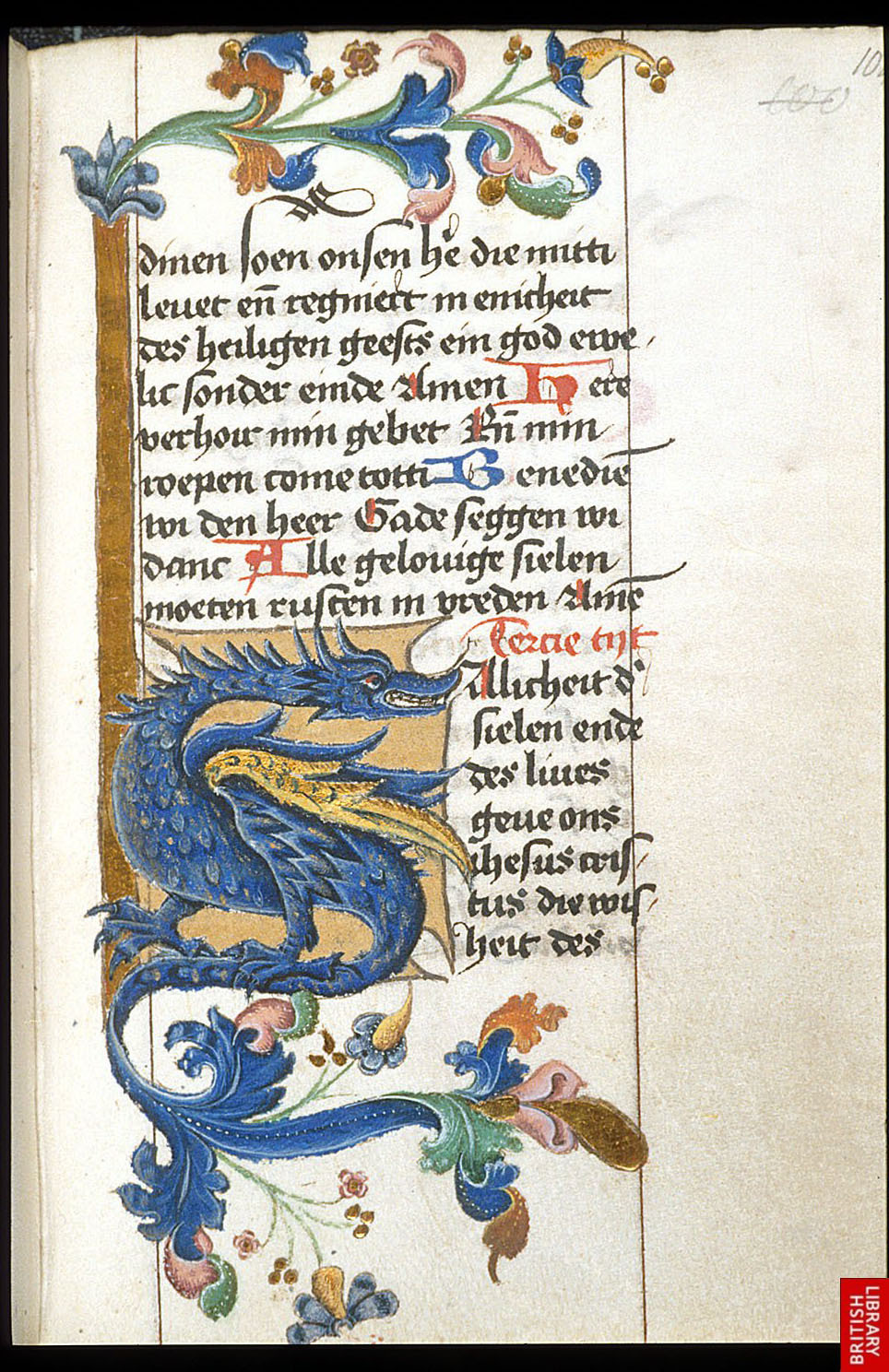
Preliminary documentation for potential November Crown A&S entry - an Illuminated letter


H (12)
Title Codex Vindobonensis Palatinus 1173
Description Zoomorphic initial H. Dragon.<br>Bible. Old Testament: Job, Tobias, Judith, Esther, Machabaeorum II, Isaias, Jeremias, Baruch et Ezechial
Date 15th century
Source 17560
Language Latin
Folio 199 f.
Further Information For further information, visit http://www.hmml.org
City Wien
Library Österreichische Nationalbibliothek
Country Austria
Shelfmark Codex Vindobonensis Palatinus 1173
Folio Number f.123v
ImgBC IM00025587


T, R, C, S, Y, M (13)

Secondary source, The art of illuminating as practised in  Europe from the earliest times. Illustrated by borders, initila letters and alphabets, selected and chromolithographed by W.R Tymms. With an essay and instructions by MD. Wyatt, archt. Published 1866 by Day in London

Plate detail: 12th Century. Mr Henry Shaw, in his beautiful work on illuminated manuscripts has devoted no less than eight plates, giving an entire alphabet of initial letters, to the illustration of the remarkable MS, which is well known as the Harleian No. 2800 and which has furnished the material for the Plate under notice, as well as for our pl. 28 of the same century. Sir Frederic Madden considers the MS. to be "written in the class of character which came into use at the close of the 12th century, and which formed the link between the round open letter of the preceding century and a half and the square or Gothic letter of later period.
(caption for plate 28 reads: the alphabets have been selected form the Harleian MSS No 2,800 which contains in three large folio volumes a series of lives of Saints for the whole year. The voluyme formerly belonged to the Monastery of St Mary and St Nicholas at Arnstein in the diocese of Treves. The initial letters throughout are for the most part executed in red, with the grounds of the scroll-work, of which they are composted, filled in with light blue and green, after the usual German manner of the 12th century. The drawing of the altogether conventional foliage is good throughout the whole work, which is ascribed by Sir Frederic Madden to "about the year 1190".


R (14)
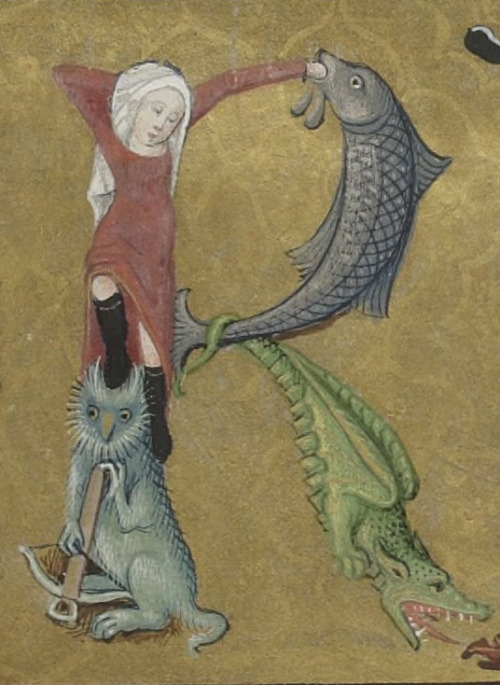
Bibliothèque nationale de France, Latin 1173, two initials from f. 52r. Horae ad usum Parisiensem. France, 1475-1500.


O or Q (15)
 

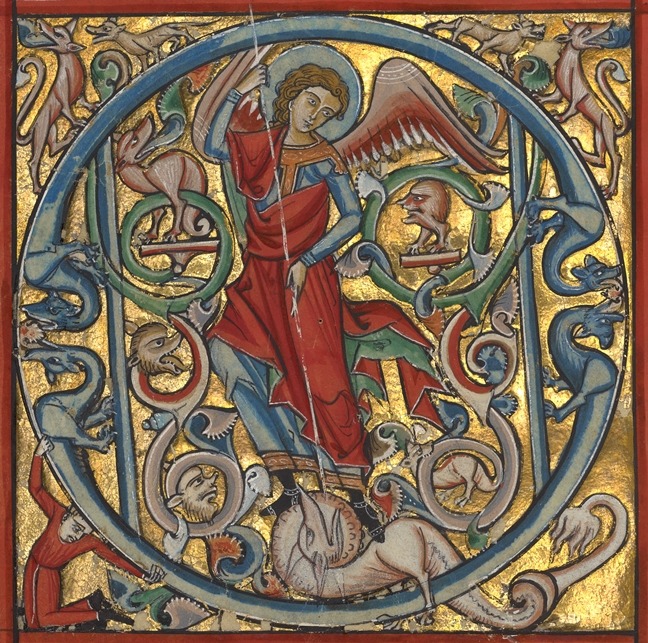
Saint Michael and the Dragon in an initial Q by an Unknown master German, Würzburg, about 1240 - 50 Getty Museum

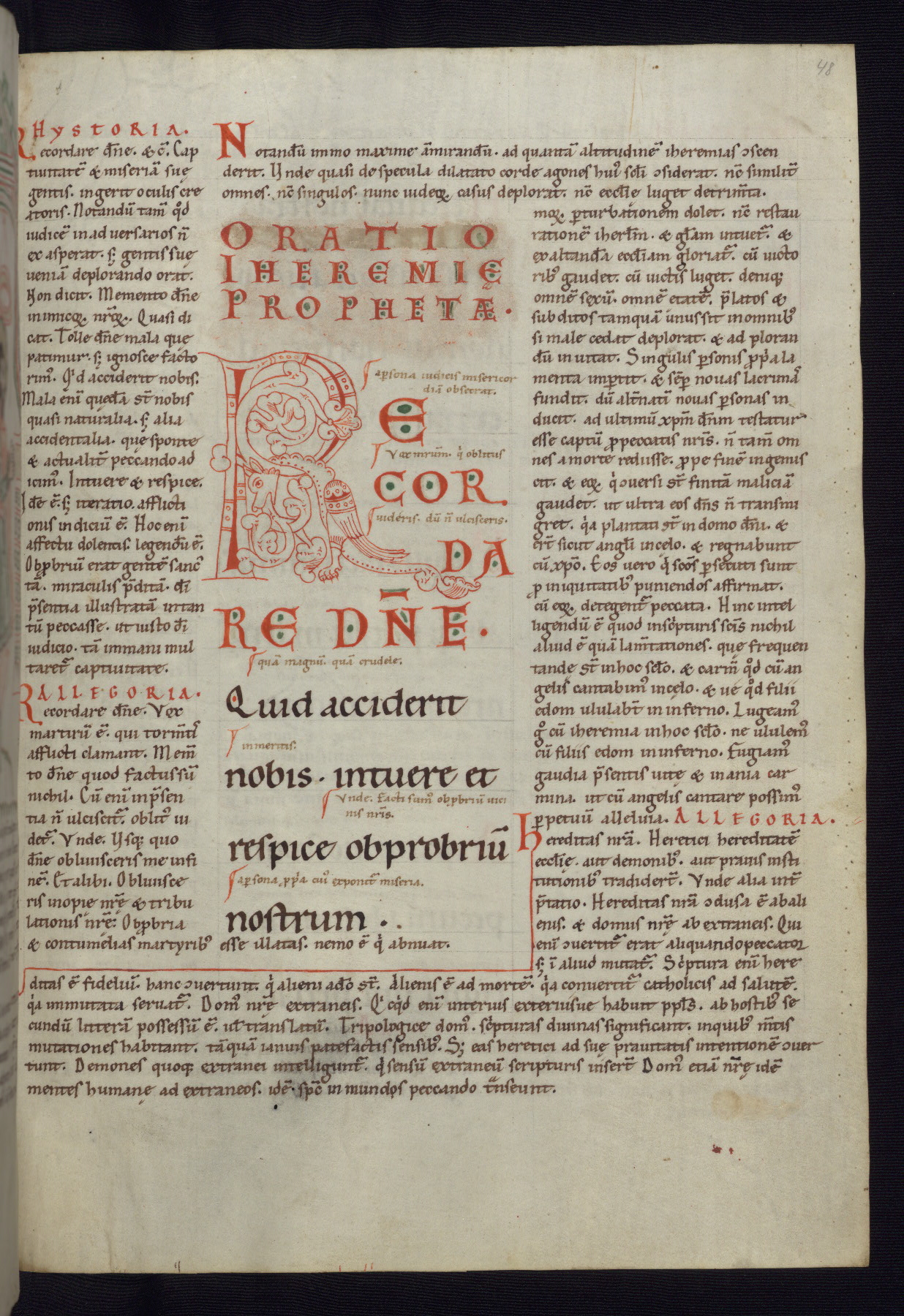
This illustrated copy of The lamentations of Jeremiah with the gloss (or interpretation) of Gilbert of Auxerre was written in Austria in the second half of the twelfth century and comes from the monastery of Seitenstetten. Gilbert died in 1134, and the manuscript is an early and important witness to his text. The gloss is written in a small script and is both interlinear and marginal. This layout is typical of glossed books of the Bible from the twelfth century. The illustrations of the sack of Jerusalem and the return to Babylon give valuable information on twelfth-century armor. The manuscript is in its original binding.
For a page-turning view of this manuscript, visit art.thewalters.org/detail/19816/gloss-on-the-lamentations...
For high-resolution images and full cataloging information, visit www.thedigitalwalters.org/Data/WaltersManuscripts/html/W30/


F(16)
 Dragon with its tail tied in a knot. The initial "F" from a 12th-century manuscript at Stift Zwettl, Austria, Codex Zwettlensis 208 : HMML Color Microfilms

B(17)
A dragon forms part of the initial "B" in a manuscript from Stift Klosterneuburg, Austria, Codex Claustroneoburgensis 710 : HMML Color Microfilms

S(18)


19
 Detail of a miniature of the dragon constellation ('Draco'), in tables from Ptolemy's Almagest. Arundel 66 John Killingworth, Ptolemy, Guido Bonatti, Plato of Tivoli Almagest (extract), Liber Astronomiae, Liber Arenalis, astronomical and geomantic tables, political prophecies England, S. E. (London) 1490 Latin and French Gothic cursive

U(20)
Historiated initial 'U' depicting an interlacing pattern and fantastical animals, from the Bible of Saint-Andre aux-Bois (vellum) creator French School, (12th century)
French
lettre ornee d'entrelaces et d'animaux fantastiques;
Bibliotheque de l'Ecole des Beaux-Arts, Paris, France
vellum 12th (C12th)
 
S(21)
Second page with decorated initial S.
Minute  for  Le Miroir de la Salvation humaine .
Bibliothèque Royale, Brussels, Ms. 9249–50, fol. 1 verso.

Thursday, 24 October 2013

GoCAD helpful tips

GoCAD crashed?
Lost your unsaved data?

Well, you've made a rookie mistake and there's no recovering from that. You'll have to redo your work. I can however offer a useful tip for unlocking the project that crashed so you don't have save it as another name and create folder after folder highlighting all of your mistakes.

Go into your project folder and delete the file that starts with:

gocad_lock_read_(non-random numbers)


Your file should now be unlocked. If you want to try this without deleting a precious file, change the extension to .BAK (backup) by simply typing .bak on the end of the file name.


Second helpful tip:

The project folder is for GoCAD's use. If you save over the now unlocked file with changes you've made since, GoCAD may spitefully delete any additional files you've put in this folder, including those lovely images of your model during construction that you agonized over.


Third helpful tip:

Many people get involved in their work and forget to save important changes. Set a timer on your desk or make sure you save your project every time you get another coffee, or interact with someone in the office. Backup your projects frequently, preferentially to an external drive that is nowhere near your desk or building.

These helpful tips were brought to you by the resignation of recreating the model I just lost, and the experience of dropping my primary drive and losing 3 months of un-backed up work.


Wednesday, 23 October 2013

Kthulu onsie

I've been busy with moving house so haven't made anything new recently. I do have three half written posts about completed tiles needing photographs but they'll have to wait until I get a camera. In the mean time, I made this a while ago:

(the Kthulu onsie, not the baby)

Thursday, 3 October 2013

Embroidered cushion Mk II - Complete


I finished the embroidery on this cushion a couple of weeks ago, it just took me a while to get the zip in and finish the sewing. I've completed this just in time too, I'm moving house soon so everything is in packing chaos and I've found so many UFO's I'm being buried by the pile! I fixed the zip issue with this one by using a 59 cm long zip rather than a 61cm one. The pillow fits well in the case and is just squishy enough. It goes nicely with the first one too (which you can just make out in the background). I still haven't bought a walking foot so I'm not going to try sewing gorget again anytime soon.

I'm really happy with how some of the squares turned out. I'm especially happy with the argyle sort of one (top left), the check (upper right middle) and the circles (lower left). The design I'm most happy with is the spiral (image below). I got the idea from Dimity's Fibre Adventures, a blog I stumbled upon when looking for examples of button hole stitch. Her spiral was made with buttonhole stitch and beads. I didn't incorporate the beads, lord knows I have plenty) because I don't want bead patterns on my face when I nap on this cushion. I also like the texture of the larger stitches and I didn't want glass or plastic interfering with that.
I made my spiral by sewing the spiral in running stitch. Then I went back and made each stitch a square U shape and placed a long stitch between them.


Though I've got to finish some items from my UFO pile, I'm thinking of making more experimental cushions.  Suggestions are always welcome!

Tuesday, 1 October 2013

Places to paint ceramics around Australia

 Melbourne

328a Glen Eira Rd
Elsternwick
http://www.glazeit.com.au

568 Hampton Street
Hampton
http://www.afu.com.au/


Sydney

Colour MeMine
Shop 4, 29 Holtermann Street
Crows Nest
http://www.crowsnest.colourmemine.com/


Brisbane

Shop 3 Sandgate Arcade
Cnr Brighton Rd & Cliff St
Sandgate
http://www.teaandbisque-it.com.au/


Adelaide

17a Rose Street,
Mile End
http://www.pugmill.com.au/
(also a good place to buy home supplies, assuming you have a kiln)

Perth

29 Winton Rd,
Joondalup
http://www.firedcafe.com.au/

8/2 Hulme Ct
Myaree
http://www.makeyourmarkartcafe.com.au/

Monday, 23 September 2013

Choli tops in Medieval Indian art

Some reference images I'm gathering for my class on choli tops for Rowany Festival.

Detail from a folio from a Kalpasutra Manuscript. Gujarat, 1350. Ink and opaque watercolor on palm leaf. Page 86 in Indian Painting, 1000-1700, by Pratapaditya Pal. ISBN: 0810834655
The image above shows two nuns separated from two ladies. The lady in the front is identified as Hiradevi, the chief hearer. Both ladies wear mid length choli tops over which they wear arm bangles.


One of a Pair of Jain Manuscripts (Patli), early 12th century India (Gujarat) Opaque watercolor on wood  Central figure wears a mid length choli top in contrasting colours.


Detail from a folio, Manjusri and Scenes from the Buddha's life. Bihar, Nalanda, 1075. Image of the goddess Prajnaparamita. Page 57 in Indian Painting, 1000-1700, by Pratapaditya Pal. ISBN: 0810834655  The goddess either wears a short choli top and arm jewellery, or a mid length choli top which has been embroidered or had jewels sewn on. The goddesses feet and hands seem to be coloured red, suggesting the use of henna perhaps. (not the delicate and intricate patterns we see at ren faires today though).

Thursday, 19 September 2013

Ceramic experiment 15 - Tile 3

Star and cross tiles in a manuscript. From Bābur Seeks His Grandmother's Advice Leaf from the Read Mughal Album, but formerly fol. 86 in the British Library's Bāburnāma. Mughal, ca. 1590–92, probably by Sānvalah, with early-nineteenth-century borders. 440 x 294 mm  MS M.458.18. The Morgan Library & Museum.


Star tile, Iran, Kashan, 1260-1270. The Met Museum. Accession Number: 41.165.22


I have completed my third islamic tile. It has also been designed to link to tiles 1 and 2. I'm rather happy with how it came out. While I can't claim this is an experiment, this is part of my ongoing A&S 50 challenge. Given that I'm now at number 15, and I have another 35 to complete in a little over a year and a half, I need to get cracking.
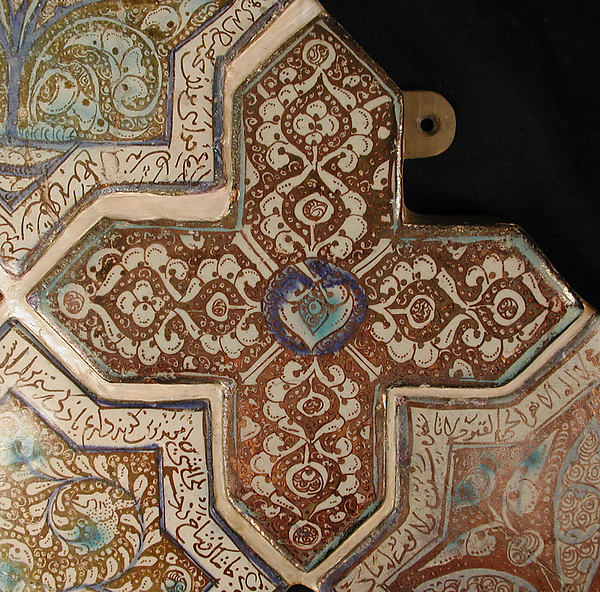
Tile from Iran, Kashan, 1000-1250. LACMA Kashan tile, 13th Century. Met Museum of Art.


Tiles 2, 1, and 3 in order.


Tuesday, 17 September 2013

Blue persian fabrics and ideas for block printing

Due to my, mostly, successful block printing experiment I've started looking into different patterns and styles of drape on Persian garb. Mostly in the Safavid period. I currently have a roll of light yellow linen and bright blue cotton / linen blend sitting around my house. I've never thought the bright blue would be suitable for more western European SCA garb, it's just too bright. However, the blues I've been finding in Persian manuscripts are beautifully bright. Before you comment to point it out, colour pallet available to painters is entirely different from that available to the dyers (and ceramic painters too). From this small collection of images, it appears that blue garb was usually accompanied by orange, red or other 'warm tones'.
I am going to have to think carefully about this garb choice. Artistically, the preferred depiction of women seems to be more willowy than modern paintings of this culture. I suspect I'm a little too buxom to wear under-dresses that gape between the breasts unless they're uncomfortably tight.

Detail from Wine drinking in a Spring Garden. Iran, 1430. Met Museum.


Detail from an illustrated and illuminated leaf from a manuscript of Firdausi’s Shahnameh: Bahram at the court of the Indian king Shangol, Persia, Safavid, Shiraz, 16th Century. From Sotheby's.

Woman with a spray of flowers ca. 1575, Safavid period, Iran
I got the idea for my first printing stamp from this image.

Mohammadi, Herat, circa 1565, Seated Princess. I don't know where it's located, but the link for the full images is here. I love the blue coat (entari?), the yellow dress, and the black under dress. And the image below is from the same site.

Detail of - Seated Princess has a cloud collar, an orange coat, a light blue dress and a dark blue underdress. Plate 57. Persia, Circa 1500, Collection of L. Cartier, Paris, France La Miniature En Orient by Ernst Kuhnel 1925  Attributed to Miraz Ali, 1540.


Lot 297 Sotheby's London UK. 04/30/1992
Detail of - Fariburz comes before Kay Khusrau enthroned within a draped chamber, three chained prisoners in foreground, hilly landscape under gold sky, an illustrated leaf from a manuscript of Firdausi's Shahnama copied by Salik ibn Sa'id for Sultan Ali Mirza of Gazan (reigned 1478 - 1504) Turkmen Court Style, dated 1494


See also:
  • Persian embroidery a study in miniatures (some great images here)
  • this guy has some great images and translations, even though the layout is jumbled and confusing at times, also, his main page clumsily sells carpets (he appears to be an expert) and has no link to the Persian miniatures. (he also has a bunch of Mumluk items)
  • My growing Pinterest Persian board.

Saturday, 14 September 2013

Block printing experiments

I made my first attempt at block printing today. I spent a bit of time over the last week browsing online how-to's and gathering images of period paintings and extant fabric samples. Here is a great video of block printing in Jaipur. The video starts with a multi-colour print using four speerate blocks and then demonstrates a great method for turning corners - using newspaper to make angles. It's also comforting to see that professions (who do this every day) sometimes misalign the blocks. This morning, I felt confident enough to make my own attempt on a scrap of pale yellow linen I had lying around.


From what I can gather, a lot of block printing is done using wooden or copper blocks like the one in the image above (grabbed from a random ebay auction). The blocks are crafted in such a way that the design will flow from each printed block. The raised section of the block is covered in fabric paint or dye from an ink pad and then the block is stamped onto the fabric.


For my first attempt I decided not to buy a block from ebay as I only wanted a small design. Also, alot of them seem to be discarded blocks from India and I would want a complete pattern. Instead, I crafted a mini-block using 'Make 'n' Bake', a mont marte femo knock off. I got the idea from aan article by Lindsay Boardman for a polymer clay cookie stamp. I took the idea and made a small quatra-heart pattern stamp. The hard part was getting the hearts flat. As you can see in the image above, when I defined the groove between the hearts, the bottom two buckled. I used Pebeo's Setacolour opaque for this first experiment. Mostly because I have a couple of pots sitting around my house from a previous abortive fabric painting attempt. I ended up painting the dye onto the stamp as I didn't have an ink pad and I wasn't going to be doing many stamps. It took me a while to master getting most of the design on the fabric. The left two stamps in the image below are the best print I achieved with the stamp alone. The print on the right I touched up with a paint brush.

I quite like this effect and will try it again to make a small Persian headscarf or possibly even a full tunic (if I get around to making more stamps). In the mean time, I'm going to look for a rubber stamp of two crossed quills. The type of rubber stamp Samantha used to use for her card embossing art. I suspect it may work well for a small block printing project.


Friday, 13 September 2013

Embroidered cushion Mk II


Japanese fabric (?) I found on flicker, so simple and effective.

Since making the previous mint cushion, I've been pondering more cushions. Ideally I'd love to have a pile of them to flop on in front of the heater. As I had plenty of mint green bed-sheet left over after my previous cushion attempt, I decided to make another green cushion. This time I've taken my inspiration from two sources, a blog by ArtisticFingers who makes the most beautiful embroidered items and the image above.

I started by cutting out section of cloth with 5cm allowance on each side. Then I divided it into squares with coarse stitches. Since then I've been filling in the blocks in alternatively with whatever pattern appeals to me on the day I start. I have completed five squares so far. I'm not entirly happy how some of the patterns turned out, but I also don't dislike them enough to unpick them. I am really loving the texture of this cushion so far.

(The fabric is a little crumpled, because I took it to Bairnsdale on Friday so I could work on it between classes.)


------

Additional:  I'm down to four more squares and I'm running out of ideas. Generally, I'm trying for geometric patterns. I even unpicked a sort of star field because it didn't really fit the theme. Suggestions are welcome!

Thursday, 5 September 2013

Block printing


Cotton red and brown block printed textile from Fustat, Egypt. Item 73.408 The Textile Museum

I don't tend to do image round-ups all that often, because you can only show a few choice images in a good blog post. Instead, I store all my reference images in Pinterest so my collection slowly grows rather than remaining a static blog post, or even worse, having to revise or repost. Since receiving two beautiful block printed sarees from Flori of Northshield I've been investigating the process of block printing. I'll also been looking at various scraps of block printed fabric originating from India. Most of these scraps were found in Fustat, the old capital of Egypt. Due to the drier climate and the fact the Egyptians don't really burn their dead, these pieces have been preserved. According to the Textile Museum, Fustat fragments are red or blue dyes with a variety patterns, both open and closed.

I've included a number of images here as I'm considering doing my own block printed item, probably a small headscarf or heraldic favors. Once I've worked out what works best for me, I may even teach a class at St Monicas. Time to see if my vague recollections of what Piers taught me 10 years ago actually work!
Textile fragment. India. Gujarat, 13th - 14th C. Cotton plain wave, block-resist dyed. From LACMA


Textile Fragment, Egypt, Early Medieval. Linen plain weave, resist dyed. From LACMA -  (M.2002.1.695)

It seems that the complexity of the extant patterns in period are similar to what is achieved today, there are some lovely examples on my Pennsic Treasures 2 post. Also, this white and red dupatta which I got at the same time as my Pennsic Sarees.