Thursday, 27 February 2014

50% of A&s 50 challenge complete - round up so far!

I have completed 50% of my A&S challenge! I've got to finish another 5 before June to succeed in one part of my Moralez-Beaumont  household challenge. I've got a little over a year to finish this thing and I've learned so much already. I've made items from a range of locations, and in a range of shapes. I am a little stuck on Iranian pottery at the moment because they have such lovely complex designs with none of the shading that's so very majolicia (Item 11).


Plate Item Style Culture Age
0.1 Un-documenting the Spanish Tazza - Spanish -
1 My household plate Lusterware Spanish 15th C
2 Gabriel's Plate Tin Glazed earthenware Spanish, Seville or Valencia 1525-1550
3 Constanzia's Plate Tin Glazed earthenware Spanish, Seville or Valencia 1550-1600
4 Relief experiment Lusterware Spanish, Reus 1575-1600
5 Ibis plate Luserware Spanish, Manises 1525-1575
6 Drollery plate 1 Illumination -  
7 Drollery plate 1 Illumination -  
8 Peacock plate Stonepaste with under-glaze decoration Syrian 12th C
9 Dove plate Earthenware Iran 14th C
9.1 Sultanabad research - Iranian  
10 Rohans household plate Lusterware Spanish 15th C
11 Hare and artichoke bowl Tin Glazed earthenware Italy, Florence 1450
12 Mirriams serving plate Tin Glazed earthenware Spanish, Manises 1400-1450
13 Tile 1 Stonepaste with lustre over white underglaze Kashan, Iran 1263
14 Tile 2 Stonepaste with lustre over white underglaze Kashan, Iran 14th C
15 Tile 3 Stonepaste with lustre over white underglaze Kashan, Iran 1260-1270
16 Tile 4 Stonepaste with lustre over white underglaze Kashan Iran 13th C
17 Tile 5 Stonepaste with lustre over white underglaze Kashan, Iran 14th C
18 Tile 6 Stonepaste with lustre over white underglaze Kashan, Iran 13th C
19 Tile 7 Stonepaste with lustre over white underglaze Iran 13th C
20 Pheasant Plate Stonepaste with overglaze lustre Kashan, Iran 12th C
21 Escher Plate Geometrical line drawing with  pigment Modern Modern-ish
22 Tile 8 Stonepaste with lustre over white underglaze Iran 13th C
23 Fox Plate Wooden plate with gesso and varnish Egypt 13-14th C
24 Tile 9 Stonepaste with lustre over white underglaze Iran 13th C
25 Tile 10 Stonepaste with lustre over white underglaze Iran 1262
26 Iznik Plate Polychrome underglaze Iznik 1575


I've sort of stalled on the tiles as it's getting harder to keep track of what designs I've already completed and where everything fits together. I am determined I will finish at least half of my tile designs as I plan on using them to decorate a bathroom, once I have a house. In other news, next time I drop by Glazeit they should have some new bisque for me to try - cups! I'm very excited and have started collecting reference images on Pinterest

Sunday, 23 February 2014

Ceramic 23 - Brooke's Fox plate


Dish - Egypt. 13th - 14th C. Mus Numer - W.40.1950 Wooden dish, with painted decoration of a long-eared quadruped, probably a jackal. Place of Origin Egypt Date 13th century - 14th century Dimensions Thickness: 2.5 cm, Diameter: 28.5 cm Object history note Purchased in London, said to have been found in the ruins of Fostat, Egypt. Located in the V&A. Item no. W.40-1950


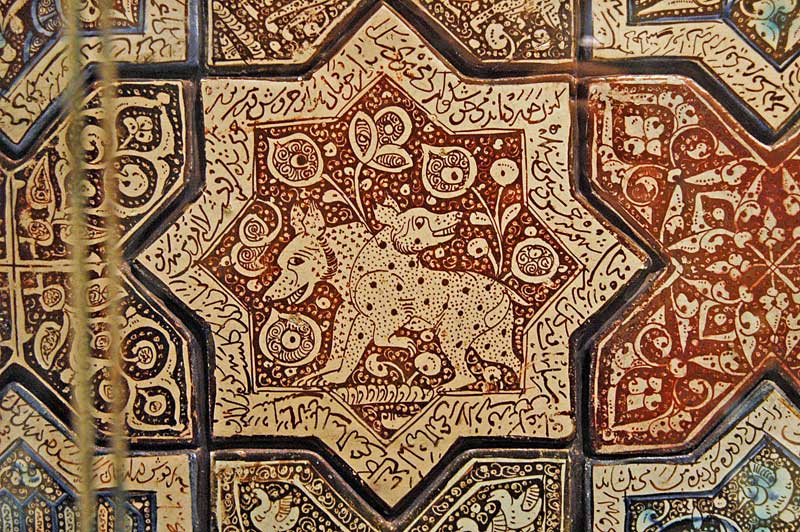
I've been looking to make a fox plate for Brooke for a while. The only foxes I've been able to find are in illuminations and one on a cruciform tile from 13th century Iran. So when I found this Egyptian plate I HAD to make it.
 Fox in progress.

The extant plate has been turned out of ficus sycomorous, painted with gesso and sealed with a varnish. The colours in the original plate will not have been available to ceramic artists of the time as these are coloured pigments painted onto a wooden object, rather than minerals fused onto a ceramic


I changed the colors around a little on this one and edited the shape of the quadruped's ears to make it more foxy. I changed the background behind the fox from an orangy red, to a green to contrast with the orange of the fox better. Also, my friends favorite colours happen to be lime green, emerald green, bright blue and orange. I really hope she'll enjoy eating off this.

I found the curlicues a fun challenge on this one. I started by painting the entire section red, then scratching the curls through onto the bisque. I then backfilled with yellow glaze. The challenge was maintaining the thinness of the lines while applying the three coats. I think it worked quite well.

Again, this is posted out of sequence so as not to spoil the surprise - it'll take me months to get it to her, because she lives in ACT and I'm not sending it via Auspost. I ended up sending it via SCA-post - Thanks Mirriam/Waldo and Neil!!


Friday, 21 February 2014

Ceramic 12 - Mirriams serving plate


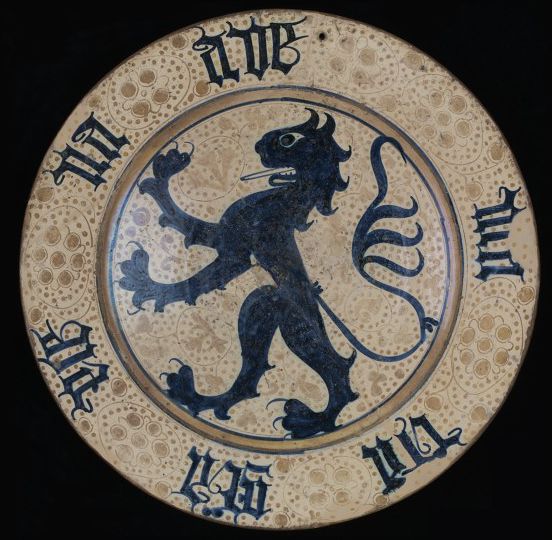
Dish - Manises, Spane. 1400-1450. Tin-glazed earthenware with lustre decoration, Item number: 1460-1870. V&A Museum.


I made Mirriams plate mid-last year. It was created as a prize for the table competition at one of the Winterfeasts I ran. I picked it up just before and event and delivered it that day. As a result I didn't get a picture, I haven't even seen the finished product!
It took me over a year to complete it because it was a large plate than I was accustom to (serving plate) and I had to make sure the design and colours suited her requirements (green). The design she chose was simple enough, a rampant lion but she also wanted a personalised motto - Agite primo recte. I will happily admit I have no idea what is written on the extant plate (hints anyone?).
So for this plate, I broke each word into two sections - Ag ite pri mo rec te. I then spent hours researching medieval hands (specific scripts and ways of writing) from both the time period and place. I couldn't for the life of me find something that looked like the very decorative script on the original. Then after a conversation with Waldo regarding woodgrain and the obvious impact on viking text I realised my mistake. The scripts I was researching were created with a quill. The shape of the quill, the viscosity of the ink and the absorbancy of the parchment would directly impact on the style of the script. The ceramic artist who painted the plate was using a brush with glaze, an entirely different medium. So, I stopped looking for scripts and tried to imitate the decorative nature of the text on the plate itself. I made up the script for the letters that I didn't have on the original and I joined a number of letters together to make sure they looked right. I then decorated the background in light green as I still haven't a working kiln for lustre experiments. I think it turned out quite well considering I didn't chose the subject matter. Mirriam seems happy with it so it's a successful project!
Also, I remember how much I dislike commissions, I hate feeling like I have to produce for a timetable.

Mirriam's finished plate - I think it's turned out quite well and is nicely balanced. The text isn't as florid as the original but that's important so the joined letters can be read.

Friday, 7 February 2014

Shield of awesome 2014

During my 6-7 year fighting career, I've gone through a number of shields. The first was a tiny pizza box shaped one out of laminated ply that Baron Piers helped me make. It was all varnished, and painted with my device and it was beautiful. As my first shield it was also very light which ended up being it's downfall. Also, I couldn't protect my leg for nuts.

A number of years later, Bryce made me a much larger shield and it was MASSIVELY heavy. Laminated, curved ply with a layer of canvass and lots of paint and a ridged handle. My leg was safe but my head wasn't. I couldn't really move it and I couldn't fight for long.

Then I went to Pennsic in 2009 for the first time. I was beginning to get serious about fighting so I bought an aircraft aluminum blank from windrose. Below is a pic of it in action at Rowany Festival 2010. As you can see, I still haven't fixed up the ittledo edging. The edging consists of the aluminum shield edging from Windrose (it's automotive door trim), stuck on with coloured duct tape in a mockery of my heraldry. The front doesn't look too bad, if you over look the aluminum-ness of it, but the back was messy.


This shield, being metal, lasted me a long long time. However I was still having problems. I often travel, and I was going to Northern War and Pennsic and Rowany Festival every chance I got. Each year at Northern War I'd borrow a shield and end up getting a very purple leg. So the next time I went to Pennsic, I bought a new shield so I could leave it in Queensland and use it whenever I flew in. That year, Waldo and I both bought shields, and Rohan got a little excited with the duct tape. (Pic of us in the woods battle, I'm 'Hit Him', Waldo is 'Look behind you')


The shield had a flat top which was a nice change but I couldn't keep the duct tape like that. So I ended up trimming it, covering it in canvas and painting my device on it. Below is an image of it in action at March Monthly Bash, 2012.


The edging kept coming off, so finally I covered it in canvas over the edging. It was white for a long time but I ended up painting it up all pretty for the January Twilight Tourney in Krae Glas. I didn't varnish this shield, and as a result it got duct tape smears all over it pretty quickly. Still, I think I did an okay job of replicating the St George and the Dragon painting with bonus velociraptor.


I used this shield for almost a year before leaving it at Gabs' and returning home with my old duct-tape quartered shield. The old shield was just strapped wrong and a bit awkward so I thought I'd re-do it eventually. I ended up letting Dash cut a hole in the middle and use it as a center grip. (Note to self: oversee every project he does using power tools, the idea of measure once, think twice, measure again and THEN cut doesn't occur to him.)

So I've been shieldless for a while now and have been trying to get my act into gear and canvas and strap the 4 blanks I brought back from Pennsic in 2013. I've finally gotten around to it.

Qantas at Dallas really weren't happy with four shields taped to my bag oddly enough. I had to make a franken-box to hold it before they'd let me continue my journey to Melbourne.

I started with a french (?) style slightly bent shield from my favourite shield people at Pennsic. They cut the shield to order and it's ready by the end of the day. This year they even delivered it to my campsite in the 38 degree heat! 
Bryce helped me strap it and make a solid handle out of pipe after which I hammered on the automotive trim. I then traced the shield onto some canvas with a 2.5 inch border. The border was then snipped into strips. The canvas was then coated in quick grip as was the shield. Apply canvas to shield and smooth out any bubbles. The strips allow the canvas to be folded neatly over the edging. This is where I stopped on my first shield but it doesn't look particularly good on the back. So I covered the back with canvas. This takes a bit of measurement and is a little fiddly when all the bits are coated in quick grip which is fast drying in the burning burning sun. I used a paper template to determine the size of the canvas back so it would be just smaller than the edge of the trim. Thus, the raised bit of the edge stops the canvas from catching and the back peice tensions the front piece of canvas and I'll never have to replace it (theoretically). The edges get additional quick grip over the top just to ensure they hold on tight.
The whole lot was given three coats of matt white undercoat and then it was ready for decorating!

Partially painted shield, at 4cm each I think the white lines are a good width.

Presenting my new shield of awesome 2014:

Gabs has frequently made the point that half the photos of people fighting feature the back of their shield. As a result all the center grips he's been making his squires have the back painted in a sort of checky blue and white pattern. I agree with him on this idea so I thought I'd follow the household's lead. The design is a field (like ermine) called palmetty. It's supposed to be leaves or scales or something. I thought it would look pretty and be a bit different than the boys' shields.

Back of the shield in all it's glory, I'm going to look amazing at Bash!

I spent a week debating what to put on the front. I could paint another figurative scene like the St George and the Dragon but it's not really distinctive on the war field and I'm not such a good painter. So I decided to do my device again even though the last time looked rather plain. This time, I decided to follow the lead of Luke of White Company. He makes the most beautiful shields where the fields are textured. I was also inspired by a pennant Lady Elizabet Hunter made for me that features the kingdom device, the St Monican device, the household device and my device... all of which are variations on red, blue and white. So I thought I'd use some of the symbols as the texture on my shield. The red quarters get stars (kingdom) and a badger (Moralez-Beaumont) and the blue quarters get crossed quills (college) and goutte (stormhold). I'd have included Krae Glas instead of Moralez-Beaumont (and put a badger on the middle of the shield) but their device is yellow and blue, and a simple diagonal line with three laurels wreaths, no real charges to utilise.


After painting, and outlining the textures and touching up the white, I covered the shield in a spray on matt sealer (twice) before applying two layers of clear matt varnish. I think it looks lovely, and should hopefully last me quite a few years.

Tuesday, 21 January 2014

Ceramic 26 - 16th C Iznik plate


AN IZNIK POLYCHROME POTTERY DISH, TURKEY, CIRCA 1575 of shallow round form with an everted rim, decorated in underglaze cobalt blue, green and relief red with black outlines, with a central flowerhead in the cavetto and four stylised palmettes on a a fish-scale design, the rim with a broken wave pattern interspersed by S-shaped motifs, the reverse with flowerheads and foliate bouquets


Rim decorations


 I tried something new with this plate. Sigal had suggested I lay an undercoat of white on my tiles before scratching off the blue. I don't feel I can start using this method on my tiles because I'm a quarter of the way through and really don't want them to be different.
So, I decided to try that method on this plate because the cleanliness of the white is essential to the design. So I painted three layers of white, and then three of red/green/blue over the top. On the up side, the large expanses of colour aren't streaky like on other plates. The downside, I have to be exceptionally careful when scratching off the glaze. There are small spots on this plate where the scratchings have remained, or the coloured glaze has bubbled off and left white dots. I'll have to try again with less white, see if having a thinner coating of glaze makes a different.


This is the last plate for a while. I've got to organise an event in March and I'm running out of time!

The complete plate.

Saturday, 18 January 2014

Ceramic 24 and 25 - Tile 9 & 10


Tile 10 - 7th star tile.


Part of the Imam Zade Yahya,Veramin group. British Museum. Museum number G.468. Fritware (stonepaste), painted in lustre over an opaque white glaze. The central field is decorated in reserve against a lustred background with foliate motifs. The border is decorated with a Qur'anic inscription. The reversed surface is undecorated


The set so far:  7 star tiles, 3 cruciform... 10/25!


Tuesday, 24 December 2013

Ceramic 21 - Escher plate (beth's plate)

This plate came about when I was searching for medieval ceramics with a fox motif. Oddly enough, the image below popped up in the google search and I thought it'd look great as a plate. So, I printed it and the image sat in my stack for a while. Right before I moved house, I wanted a non-blue project and thought it was time I started on this image.


I started by using a 6B pencil in a compass. I quartered the plate, and tried to draw circles of the appropriate sizes. I then sketched in some of the fish and got to painting. Getting the balance right on the fins was the biggest challenge on this plate (and I still didn't quite manage it). I kept having to switch between colours so I could see how the fish fit together. Because I didn't consider the complex mathematical background to this piece, I ended up getting the diameter of some of the circles wrong. This caused the potential for colour overlap in some small places. It wasn't until I was almost finished that I found THIS paper, which discusses the geometrical construction of this image... ah well, I'm still pleased with the plate even though it isn't medieval.

This one will be gifted to my sister for the occasion of her 27th birthday which is why this post is out of sequence with the rest. I've scheduled it to self post on Christmas day.


An angled view shows the wrap of the fish motif up the curve of the plate better.

On earrings

Jain art - Celestial performer Kapasutra manuscript folio Gujarat 1490


I found an interesting blog that has some musing on late period Indian garb. I'm not sure when I found this blog. I'm pretty sure I got there through a tab explosion one night while researching choli patterns. Due to my bust exceeding my rib cage by a significant value, I am on a never ending quest to find a period choli that a) I can sew and pattern myself, and b) supports my bust, or at least doesn't look saggy/sack like. But I digress, the blog in question is written by a Laurel type from Meridies (I think) who appears to be into cooking, and late period Indian (16th century, heavy persian influence).

While browsing her back catalog of posts, I found one on late period earrings. Her main focus was the revelation regarding the pointy ones you see in the upper ear. (read it here). During her discussion, and within a different post about garbing for a feast she ran, she references hoop earrings. She also has a post about some lovely hoop laurel earrings she made out of femo and beetle wings. She offers two explanations for the shape; first they may be stretching hoops, or second they may be loops that depend from the ear. She seems to favour the second type.

I have been researching jewellery myself and I would suggest the earrings in question are stretching hoops. In the images below (yes, I've posted it before) you can see both wealthy women and nuns. The nuns, who have limited worldly goods, have earlobes that are clearly stretched and dangle loosely without the bulk of the earring seen in the women in the right.


Detail from a folio from a Kalpasutra Manuscript. Gujarat, 1350. Ink and opaque watercolor on palm leaf. Page 86 in Indian Painting, 1000-1700, by Pratapaditya Pal. ISBN: 0810834655 

The stretched earlobes could be explained by the weight of gold loops exerting pressure on the skin over time (recall seeing overly stretched and grotesque old 'lady' ears?) however the ascetics don't appear to be that old. In the next image from the Ajanta caves, you can clearly see the earlobe stretched around the hoop on the lady on the left.


Also, this group of statues from Khajuraho shows a beautiful lady wearing disks served by an attendant whos ears droop.


I do not plan on stretching my earlobes anytime in the near future, so I will stick to the more dangle type of earring such as those below.

 Earrings Object ID: B86M6.1-.2 300-500 Gold and Garnets These earrings came from Gandhara, the ancient kingdom located in what is now southern Afghanistan and northern Pakistan. A famous school of Buddhist art flourished there from the 1st to the 4th century A.D., characterized by sculptures carved in a mixture of Graeco-Roman and Indian styles. Although Gandharan sculptures are included in most museums' collections, jewelry from Gandhara is rare. Asian Art Museum of San Francisco

Tuesday, 10 December 2013

Cherry onsie


I made this one for Berengar and Rachel's first. I don't know if they're having a boy or a girl, but I thought this'd be a little different. And yes, I did make them a kthulu onsie as well...


Sunday, 8 December 2013

Persian block printed scarf II


From closer examination of Persian head scarf images from the previous post, I think the argument for square / triangle is actually misdirected. If we examine no.5 from the previous post and assume a regular pattern in the fabric, the head scarf  is deliberately cut in more of a brontosaurus style, that is to say, skinny at the head/tail ends with a sort of Gaussian slope towards the wide center. The length of the tales appears to be a little over a quarter of the overall width. I propose the headscarf is cut more as a T shape:

Where A is the width of your head from temple to temple, B the measurement from your temple to your shoulder and C the measurement from your crown to your cervical vertebrae. So that's my next accessory project... after I finish moving house anyway.

Ceramic 22 - Tile 8

This is the last tile I'm going to post for sometime. There's nothing really new to say about them except post a picture of the finished tile, and the reference tiles. GIven that I plan on making 25, that's going to get mighty boring mighty fast. So I might post update photo's of the tiles together from time to time.

Tile 8, row 2.


CENTRAL IRAN, LATE 13TH CENTURY This design appears as the central design on a number of Kashan lustre star tiles bearing dates of the second half of the 13th century. It is however very unusual to find it without any inscription border at all. This tile is very similar to the centre of one of the large star tiles made for the Imamzada Yahya at Veramin, dated 1262 but painted on a smaller size tile and thus excluding the inscription border. Sold by Christies in 2004. Link and Image found on Invaluable.com, an auction search engine.


Saturday, 7 December 2013

Ceramic 20 - Pheasant plate

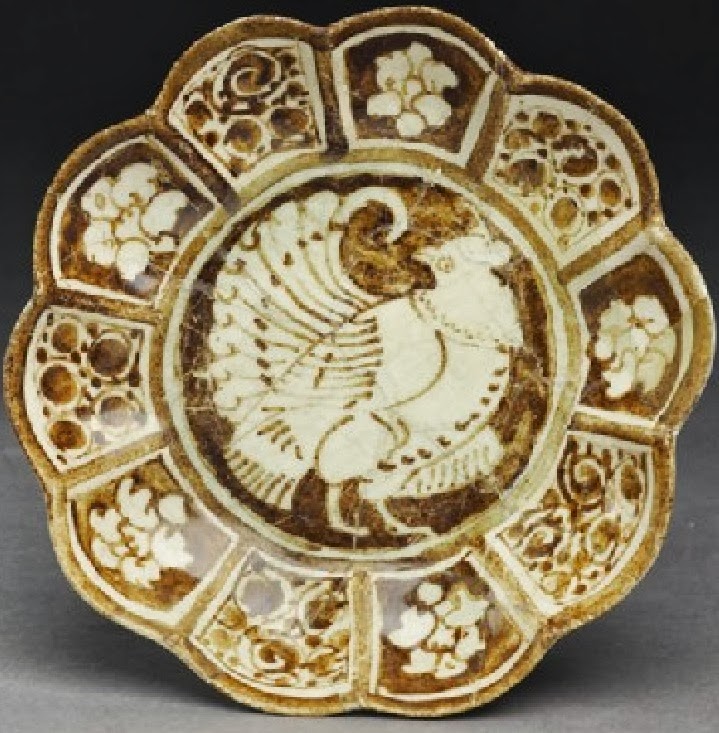
Lobed plate featuring a bird (peasant?)

Why: Because I could, and because I had a spare lobed plate from the Sultanabad Dove project and wanted a design that would transfer to my predetermined shape better. Also, I've been doing so many tiles, I thought I'd take a break and use up some of my bisque stockpile.
I'll sell this one, and the dove plate at Rowany Festival next year. I might even enter the Laurel Prize Tourney (which isn't a tourney, only involves Laurels in a feedback sort of way, and has no prizes) with the tiles.

Changes:

Original plate is 17cm in diameter, while my copy is 24.5cm. The original plate had 10 lobes, while my plate has 14. Due to it's increased size, my version is a dinner plate rather than a saucer and the lobes are still reasonably in proportion to the rest of the design.

The original was fritware with the decoration in overglaze luster, while my design is created in underglaze with no luster. This is because I am currently working primarily with underglaze, as they are the resources I have access to. I haven't mixed my own glazes and I am restricted in what methods I can attempt until I invest some money in supplies, and find a work space that isn't my bedroom.

Lobed saucer, fritware with overglaze lustre painting, 12th C, Kashan, Iran Ashmolean Museum.


Some modern lustre resources I've found:

Good youtube video showing the process and result.
http://www.youtube.com/watch?v=Ff-rmQJk3FE

Ceramics monthly article on Lustre, brief introduction with medieval reference to Iran
http://johanna.demaine.org/blog/wp-content/uploads/2013/03/Lustre-Ceramics-Monthly.pdf

This is the first thing I'm going to experiment with once I get a workshop and the kiln working properly.

Saturday, 30 November 2013

Persian block printed head scarf.

 Some Persian head scarves, possibly block printed:

1                                                                                  2
   
 3                                                                  4
 
5

Head scarf examples. Patterns range from simple monotone, to complicated potential brocades or embroidery. All involve a triangular (or folded square) headscarf, draped over what appears to be a circular cap and braid case of a different fabric (often the same as the pants). Recently on the Persian Clothiers facebook group there was recent discussion on the shape of these headscarves. I propose that the contrasting colours on no. 2 & no. 4 (red & white / orange ) indicates a single layer whereas the two sided print and potential for two points on no. 5 suggest towards a double layer resulting from a square shape. The shape of no.'s 1 and 3 are indeterminate. No. 1 shows the same pattern on the underside, which may be a woven, reversible fabric or a doubled over square shape.

So I started with a square design because it's easier to measure and cut. I cut it out, block printed it with my quatra-heart stamp, ironed it and then machine sewed the hems.  As you can see below, the square is a little too small, too stiff and really the wrong shape. I also used an artifical silk scarf for the braid case and the cotton headscarf kept slipping off. Quite vexing.
Marshalling at November Crown, Stormhold, 2013.


Wednesday, 20 November 2013

Ceramic 17 - Tile 5

Tile 5


It's getting harder and harder to find good crosses. I tried three different ones for this tile. One of them was a rather floral, skinny cross. I started with a solid background and carved the flowers into it. It really didn't work well. The original was too skinny and I couldn't reproduce the dimensions, even after removing one of the flowers. I guess I was right to avoid animals and such figures. Upon investigation, the tile is Tamurid not what I'm looking for

So I painted over it and carved a more swirly pattern (below). I've only managed to find one, not very good at all, image of this cross and had to extrapolate. I'm rather happy with how it turned out but as the glaze was so thick, this tile has a texture to it.

Cross tile from the mausoleum of Imamzada Yahya in Veramin near Tehran. Part of a panel of glazed lustre-ware tiles. State Hermitage Museum. Inv. nos IR 1026-1062. 1097 - 1118.


The other cross on this tile is also a new one. The cross in the image below on the left is the one I used. It's in the Louvre as a panel. The image in the Louvre is small, but there's a good collection of representative images of different regions and art styles at the Walter Chapin Simpson Centre for Humanities.

Details of panel made of individual tiles.
Iran, Kashan, 1267 CE/665 AH. Fritware, overglaze lustre with color splashes. The panel if from the tomb of imamazade Djafar at Damghan. Inv. no.: OA 6319. Website (photo shows whole panel). Individual panels can be found here.

It saddens me that so many tiles have been pillaged from the Imamzada Yahya mausoleum. It's good that they are ending up in museums so internet hobbiests like me can appreciate them, but I really think they should have stayed on the mausoleum. I'm feeling particularly annoyed by it at the moment because there's a whole bunch of tiles in Shangri La, Honolulu, a rich woman's beautiful home. There are no good close up images but there's treasure upon treasure there, all hoarded away. It's like taking fossils from the rocks - these are things that will never occur again. They should be left for others to appreciate rather than squirreled away by people who have more resources than sense.

Tile 5. First of the second line.

Tuesday, 19 November 2013

Ceramic 16/18/19 - Tiles 4, 6 & 7

Tiles 6, 4 and 7


Tile 4 is the terminus star tile (in the center). So there are no new cruciforms, just one star. I still haven't decided how big my tile panel is going to be, but I do know where one end is now. Tile 6 and 7 are edge tiles, covering only one quarter cruciform. I'm quite happy with how these three turned out and look forward to completing the whole set.


This close up shows how much better I am at getting the quarter cruciforms to line up.

The original star tile is one of a group of 12 tiles auctioned at Bonhams in 2008. The tiles are Kashan and date from the 12/13th century. As has been my policy throughout this tile project, I've removed the writing and replaced it with a wide blue border.

Saturday, 16 November 2013

Notes

Notes from Persian Ceramics from the 9th to the 14th century:

An alkaline solution obtained with potassium oxide is easily altered and ceramic objects will often take on a very characteristic iridescence if they come into contact with the earth or other chemical agents.

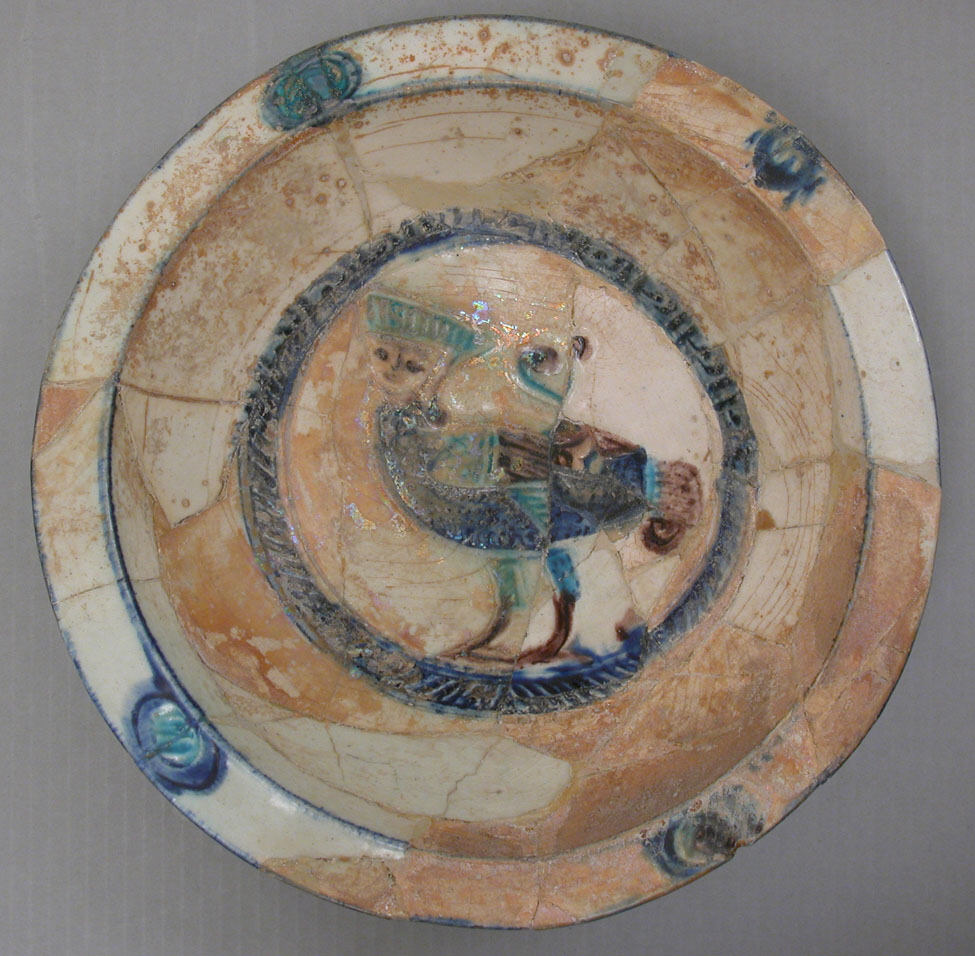
(This explains the iridescence seen in the peacock plate! I wonder if this iridescence was ever deliberately engineered by burying items or soaking them in special solutions)

Cobolt was imported from Europe via Venice. Muzarrad is a black stone used to make black, probable utilising antimony and comes from the mountains of Jajarm in Khorasan, Eastern Iran.

Turquoise is obtained from copper oxide and an alkaline glaze (well ozygenized). Copper oxide and a lead glaze (in reduction) produces green hues as well.


Bowl, 12th century, Iran. Met Museum of Art, Accession number: 29.160.12. Showing a slight hint of the iridescence.