Saturday, 11 July 2015

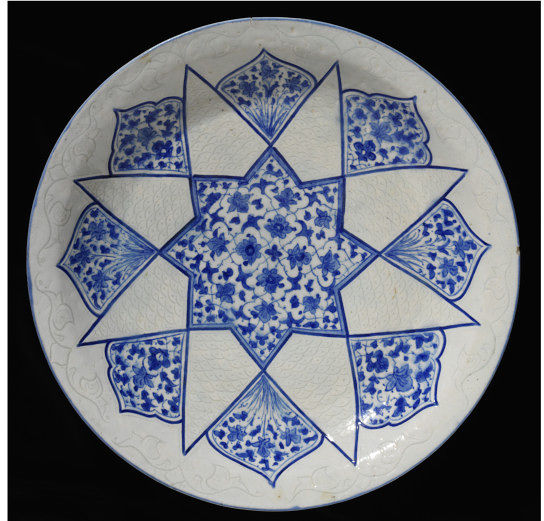
Ceramic 44 - V's cup


I found this bowl while researching Spanish Blue on White items. It struck me as being perfect for one of the local SCA ladies. Vee is pretty awesome so I thought I'd celebrate the completing of the initial Spanish post by making a Spanish cup to add to the BoW examples. I've asked Beth to pass it onto Vee at Krae Glas' Carnival this weekend. I hope she likes it.


Thursday, 2 July 2015

Blue and White ceramics - Spain

Blue on White ceramics: the reciprocal influence of Chinese porcelain on European and Middle Eastern ceramics -Spain

Other essays on the history of BoW in Iraq, Egypt, early Iran, late Iran, Japan, China, Turkey, The Netherlands, Italy and England. 


Item 11: 16th century pharmacy jar, cobalt on earthenware.
 

Spain

In the 14th century, Spanish potters were producing polychrome items in greens & browns with lovely brushwork (1). These items are reminiscent of the Sancai ware of China.. Items would often feature incised lines which would help prevent the glazes from running (2). Similar items were produced in many countries and though the artistry is lovely, the Spanish doesn't seem to have had a strong international market for these items.

The late 15th century saw the naval might of the Spanish Empire bloom resulting in the eventual settlement of the Americas. This time of growth was beneficial to all trades especially luxury goods which were traded across the empire. The Spanish potters of the 15th and 16th centuries were known for their beautiful luster work. It is thought that the method of the luster glaze had come to Spain from various conquests and trade routes from Africa. It is possible there was a direct knowledge transfer from the luster artists of Egypt (3).

Spanish potters would decorate items with a metallic luster glaze, typically both front and back (4). Motifs varied depending on the market and the region. Design elements were heavily influenced by Moorish artists with many items showing pseudo-islamic glyphs (5, 6, 7).

BoW items were produced in parallel with lusterware. In early examples the BoW earthenware features wider brush strokes and cruder patterns than the lusterware. Where luster and BoW were combined, the cobalt is used simply and is generally rougher than the luster items created at the same time (8, 9, 10). Ceramicists would eventually develop techniques that resulted in cobalt items that were as refined as the luster items.

All earthenware items were processed in wood fired kilns. One of the major challenges for potters was to ensure the temperature was consistent creating a glaze that would shine but not run. Often the temperature within the kiln would vary resulting in a well fired pharmacy jar (11) and one fired at too high a temperature (12, 13, 14). The temperature challenge could come down to the difference in degrees within 5 centimeters resulting in pharmacy jars where the glaze runs on only the top section of the jar leaving the rest of the design intact (15, 16). I had supposed that the pharmacy jars primarily suffer from running due to their height which would effect placement in the kiln and thus airflow around them however I have found smaller objects like tiles that seem to suffer from dripping as well (17).

Like pharmacy jars and other common household objects, tiles were often mass produced. One indication of this is the way their patterns are designed so the corners link together to create seamless designs (18). Some tiles seem to display an Iznik influence (19) such as half palmette (20) and other designs.  Others have a distinctly Islamic flavour and feature geometrical patterns (21, 22), Interestingly, the central fill is often clearly Spanish in design.

Item 23 is worth noting as it highlights the diversity of resources the Spanish potters drew their inspiration from. The pitcher / ewer could almost be a replicate of the Kashan (23a) vases in shape. The stripes appear to have been applied with a single stroke from a brush with six bundles of bristles.

Item 23: Spanish vase with Kashan influences

Toledo

Possibly inspired by early Tang-ware (24), the artists of Toledo produced what I call splash-ware (25, 26, 27). It's possible that splash-ware was deliberately created to ensure that even if the glaze runs, the end product can be sold convincingly. This style doesn't seem to have been adopted by any of the other production centers.

Sevillia

Sevillia seems to distinguish themselves in the Blue on White market producing some lovely BoW items (28). They also integrated some black into their designs (29, 30). The items from Sevillia often feature horror vacui, i.e. the filling of all available space with decoration (31).

Manises

In the early 15th century, Manises produced lovely luster work as well as a combination of luster and cobalt. Plates would often feature heraldic animals (32, 33), the most prominent being the Spanish Lion of the Kingdom of Leon (34, 35). My favorite group of items from Manises features a cobalt design highlighted in luster (36, 37). These items seem to have an Islamic influence with their symmetrical geometric designs. Manises also utilized cobalt to augment the pattern fill seen in item 38. Later in the 15th century, these patterns became larger and more of a design feature rather than a fill pattern (39, 40, 41, 42)


Item 37: Deep dish from Manises, Spain with lustre and cobalt.

Barcelona

Item 43, a pharmacy jar, is interesting as it appears the cobalt glaze was applied then carefully scratched off. Given that the scratching never punches through the white tin glaze, it's possible the item was fired white then fired again with the blue. Barcelona seems to have concentrated on providing items for the local market such as pharmacy jars (44). Many heraldic tiles were also produced and all  seem to be designed to fit together to create a continuous design (45, 46, 47). By the end of the 16th century, the local potters had mastered the art of fine luster-ware with blue highlights (48). The 17th century saw the develop of lovely BoW shaded work similar to the portraits featured on Italian majolica work (49).

Dish 49: Shaded portrait similar to early Italian majolica work


Monday, 29 June 2015

GNW knife

At Great Northern War i actually went to an Arts n Sciences class and made something! Martyn Wynn-Huges (Martyn the Blacksmith) runs a drop by blacksmith area. He provides hammers, a couple of anvils, a forge and plenty of advice and lets people make a huge range of things on his equipment. He also lets heavy fighters wander over and helps them fix broken equipment. He supervised me and 5 others while we worked on a variety of knives, S hooks and miscellaneous projects. My knife took me 2.5 hours to make with Martyn only providing one heating worth of labor (I was away fetching water) as well as sharpening.

I'm very happy with how it came out and will probably go back to learn more things next year! It's probably the sharpest knife in my house right now.


Sunday, 21 June 2015

Blue on White Ceramics, Iran part 2 - Extant objects

These are the items referenced in my previous post regarding blue on white ceramics of 14th-17th century Iran. Images have been downloaded from the relevant sites and uploaded as a reference list for those that wish to see them while reading my mini-essay. As I have done in previous posts, I've put the images behind a jump cut so as not to spam my blog.

Tuesday, 16 June 2015

Blue and White ceramics - Iran part 2

Blue on White ceramics: the reciprocal influence of Chinese porcelain on European and Middle Eastern ceramics - Iran - Part 2

Other essays on the history of BoW in IraqEgyptearly Iran, JapanChina, Turkey, Spain, The Netherlands, Italy and England.
 
I'm going to take this opportunity to note that most of my research has been done in the opposite direction of the standard approach. I have collected a large number of reference items, 627 to date. I've then sorted them spatially and made comments about the clusters, with a focus on the Chinese influence on the design elements. The main problem with this method is it utilises the dates and cultures ascribed to the items by museums and professional researchers. These dates are typically found through petrographical analysis (chemical analysis of the clay or glazes), recovery relationships, or through the designs and workshop marks on the items. Often the dates and locations ascribed to an item are quite broad and the method of arriving at these dates is rarely noted. As a result, this is a circular, self-referencing research project. If I wanted to do this scientifically, I could make my statements about the clusters and isolate the items that are anomalous. I could then read all the research papers regarding the regional pottery, geology and social impacts on the production. I could then determine if the anomalous items were appropriately assigned or should be assigned to a different culture/location/year. Unfortunately, I have neither the time, nor access to the appropriate resources. As this is arm-chair research, I'm going to have to be comfortable with circular referencing in the knowledge that some of my items have been incorrectly assigned. If I focus on the general trends rather than single items I should be pretty safe making sweeping generalizations as much as they irk me.

The extent of the Timurid Dynasty (1370-1506) courtesy of Wikimedia.

The Timurids & 14th/15th century Iranian ceramics

At the peak of it's power the Timurid Dynasty controlled Iran, Afghanistan, most of Central Asia as well as Pakistan, Syria and some of India. The capitol was based in Samarkland, Uzbekistan. In 1400, the Spanish ambassador, de Carvijo, noted that Tamur had forcibly relocated potters, weavers, armours, bow-makers and glass makers to the new capitol after the sacking of Demascus, Syria. The crafters were later released in 1411 by an edict from Ulugh Beg. This gathering of potters and their subsequent diaspora would have fostered the development of a more uniform style across the Timurid empire. The Tamurid dynasty also experienced a greater Asian influence than previously seen in Iran. This was in part due to the location of their capitol and partly due to greater trade along the silk road routes. Items collected from this period and not specifically labeled as being produced in Iran have been filed in the Pinterest collection under Uzbekistan.

Tiles

A majority of the identified pieces from this time are tiles. Tiles from local monuments can be dated with reasonable accuracy and in all likelihood, are produced in the local region. Plates on the other hand are harder to identify without workshop markings or extant examples in a clearly datable deposit.

As discussed in an earlier essay, Kashan Iran was a major production hub of tiles in the 13th and 14th centuries. While a majority of these tiles were lustreware, some featured a blue border (1) and occasional blue highlights (2). Tiles produced in the 14th century started to sport a mix of turquoise and cobalt with white and red (3, 4, 5). The patterns on the polychrome tiles (6) closely resembles that lustreware tiles produced almost 100 years earlier (7). The colours are very reminiscent of Iznik (Turkish) items.

Item 4: Tile, Iran, 1420. British Museum item:1908,0804.5

Late Timurid items

Late Timurid BoW work displays a mish-mash of influences with Iranian/Iraqi inscriptions (8),  geometic Persian patterns (9, 10) and Chinese motifs (11). This indicates the ceramic production had settled down and was deriving it's influence from the east and the west. Dish 12 was created in 1475 and shows both double scroll and wave, and crest motifs popular in Yuan porcelain combined with fleshy peonies from the Ming dynasty. Plate 8 from a similar time frame (1450-1500) combines a central lotus flower with a distinctly middle eastern inscription. Other items display the classic Mingware cloud rim (13). Though there are few extant items specifically dated to the Timurid -> Safavid transition, it's clear the potters of Iran continued to copy antique patterns from Chinese items such as the decorative elements of dish 14.

Item 14: Dish, Iran, 1500-1550, Fritware decorated in underglaze cobalt. V&A item: 562-1905


Safavid Dynasty & 16th/17th century Iranian ceramics

The 16th century saw the rise of the Safavid dynasty which held much of Iran, Azerbaijan, Bahrain, Armania, Georgia, Iraq, Kuwait and Afghanistan as well as parts of Caucasus, Turkey, Syria, Pakistan, Turkmenistan and Uzbekistan. In the early 16th century, the capital was Tabriz, Iran, later moving to Qazvin, Iran for the late 16th century and then Isfahan, Iran for the 17th-18th centuries. As the capitol of the Safavid Dynsasty was based in Iran it strongly influenced the local cultural identity and provided secure trade routes and new technologies to the local industries. I will concentrate on the Iranian BoW traditions here and discuss other Safavid production hubs, namely Turkey, in a different post. Research note: Blue on White items from this time period are often called Kubachi after a town where many examples survived to the current day.

Tabriz

Though there is no documented evidence of ceramic production in Tabriz, some dishes (15) have shown a chemical similarity with tiles produced in Tabriz at the time. Interestingly, dish 15 sports a honeycomb design from late 15th century Mingware indicating the Tabriz artists were gathering their artistic influences from the East. Generally items produced in Iran during the Safavid Dynasty haven't been linked to a specific region or workshop. They do however display a distinct grouping of motifs. Though some scholars may disagree, I've gathered them into loose categories based on the majority of their design elements; Persian (16, 17), Iznik (18), Mid-Chinese (19, 20), Late Chinese (21, 22, 23) and Spanish (24). The range of Chinese motifs utilised is quite varied, and designs from the Yuan and Ming periods will often be displayed together. 


Item 18: Safavid dish, Iran, 17th century. Christies, Sale 8652, Lot 152

Stylistic reinterpretation

The influence of Chinese porcelain and the reciprocal influence of the middle eastern and European ceramics is the main focus of this group of essays. The high production levels of local potters in the 17th century and an opening in the market for BoW ceramics resulted in a plethora of extant items available for analysis. Many examples have already been presented of BoW ceramics featuring Chinese motifs such as lotus, dragons or even Buddhist symbols. The best examples of the copying of Chinese designs come from group of bowls and dishes created in China in 1600-1620 (25). The Chinese bowls feature Buddhist motifs and lotus flowers as well as the European touches. These items were produced specifically for the European market and featured Latin inscriptions such as SAPIENTI NIHIL NOVUM (to the wise man, nothing is new).  Bowl 26 is an Iranian replica, of the Chinese imitation of European styles. As such, the inscription is illegible. 27 is another example of pseudo-writing executed by Iranian potters when copying Chinese items.

Lustreware

During the 17th century, lustreware returns as a strong feature in the glaziers pallet. In addition to lustre over white slip (28), Iranian potters produced stoneware with white slip, cobalt underglaze and lustre  in a variety of forms, ewers (29, 30),  bottles (31), and flasks (32, 33). These items display uniquely Iranian motifs and though cobalt is utalised, doesn't feature any Chinese motifs. The return of the lustreware was perhaps sparked by a push for stronger cultural identity  to boost the empire in the waning years of the Safavid Dynasty. No central hub has been identified as the origin of the rebirth of lustreware however it seems to coincide with the establishment of the Iranian capitol at Isfashan in the mid-late 17th century.

Item 30: Stonepaste ewer, Iran, 1650-1750. British Museum, Item: 1913,1220.108


Kirman

An examination of work produced in the mid to late 17th century reveals a production center in Kirman producing lovely BoW items.  At this time access to Chinese porcelain was restricted due to turmoil in China. This increased the market available to the BoW earthenware trade, resulting in the mass export of items from Iran into Europe which is likely the reason for the success of the Kirman potters.

The Kirman potters utilised Chinese motifs (34) but created an Iranian twist by displaying them in an various middle eastern formats. Jar 35is a perfect example of this, where the Chinese lotus has been painted in a lattice arrangement. Few 'pure' BoW items are available as the Kirman potters included reds and other colours to highlight design elements (36). In item 37, the BoW component is distinctly asian with free flowing designs while the red section shows the more rigid patterns associated with the Persian tradition. Many items display the geometrical influence of the Persian tradition combined with the the softer flowing blue on white designs (38, 39, 40, 41, 42).

The Kerman potters produced items for a broad export marketing including items combining Chinese designs, caligraphy and buddist symbology (43, 44). An elephant shaped kendi (Chinese drinking vessel) indicates that they also produced crude copies of Chinese forms (45). The crudeness may be the result of the different strength of the mediums earthenware vs porcelain and the ease in which they can be molded.

Kirman potters were also experimenting with cobalt glazes and slip to create negative design features . The stonepaste item would be dipped in slip before being coated in a thick layer of cobalt glaze. The glaze would then be scratched away to reveal the slip underneath or slip would be added over the glaze to create raised white decorations. While I've discussed this technique before, typically the potters utalised the slip as the main colour by scratching it away to reveal the earthenware beneath then adding highlights with glaze. This revival and alteration of the old form indicates the Iranian potters have managed to develop cobalt glazing techniques that are unlikely to ruin the design by running/bleeding into the white slip. The items created featured both Chinese floral designs (46, 47) and the geometric influence of the Persian style (48).


Resources:
Golombek, L. Mason, R.B. Bailey, A. 1996 Tamerlane's tableware: A new approach to the chinoiserie ceramics of fifteenth-sixteenth century Iran. Mazda Publishers  ISBN 10: 1568590431

Golombek, L. Mason, R.B. Bailey, A. 2013 Persian pottery in the first global age: The sizteenth and Seventeenth Centuries. Brill. ISBN 10: 9004260927

Milwright, M. 1999. Pottery in the written sources of the Ayyubid-Mamluk period (c. 567-923 / 1171-1517). Bulletin of the School of Oriental and African Studies, University of London. Vol 62, No 3. pp 504-518.

Sunday, 14 June 2015

Linen coif experiment

Playing around with scraps of white linen to make a cute little viking hat. Needs ties and hemming. I have very tolerant friends.


Monday, 1 June 2015

Pot of the Week: Iranian ewer with braided inscriptions

I love the intricate detail on this item!
Ewer, lustre fritware. Kashan, Iran. 1270-1271 (CE), 669 (AH). British Museum. G.242

Saturday, 16 May 2015

Blue on White Ceramics, Japan- Extant objects

These are the items referenced in my previous post regarding the Arita porcelains of Japan and their trade into Europe via the Dutch East India Company. Images have been downloaded from the relevant sites and uploaded as a reference list for those that wish to see them while reading my mini-essay on Japan. As is standard, I've put the images behind a jump cut so as not to spam my blog.

Friday, 15 May 2015

Blue on White ceramics - Japan

Blue on White ceramics: the reciprocal influence of Chinese porcelain on European and Middle Eastern ceramics - Japan

Other essays on the history of BoW in IraqEgyptearly Iranlate Iran, China, Turkey, Spain, The Netherlands, Italy and England.

Japan

Japan was a relative late comer to the European BoW ceramics trade, with trade treaties being established in the 17th century. Japan's main contribution came from the Arita kilns thus the items are called Arita ware or Imari after the local shipping port. Though the kilns produced fine polychrome (blue underglaze with red and gold overglaze) porcelain (1, 2) for the home market, a majority of the items sold internationally replicated the BoW porcelain of China.

The Dutch population was introduced to Chinese porcelain when quantities were seized in 1602 and again in 1604 with the capture of two Portuguese ships. Soon after the Dutch East India company started pursuing the trade of Chinese ceramics, importing approximately 3 million items into Holland before civil unrest in China and the rise of the Qing Dynasty terminated trade. The new dynasty stopped trade of porcelain in the late 17th century leaving a BoW vacuum that was filled by a number of nations. As previously discussed, the potters of Kerman, Iran stepped up earthenware production and as did the porcelain craftsmen of Arita, Japan.

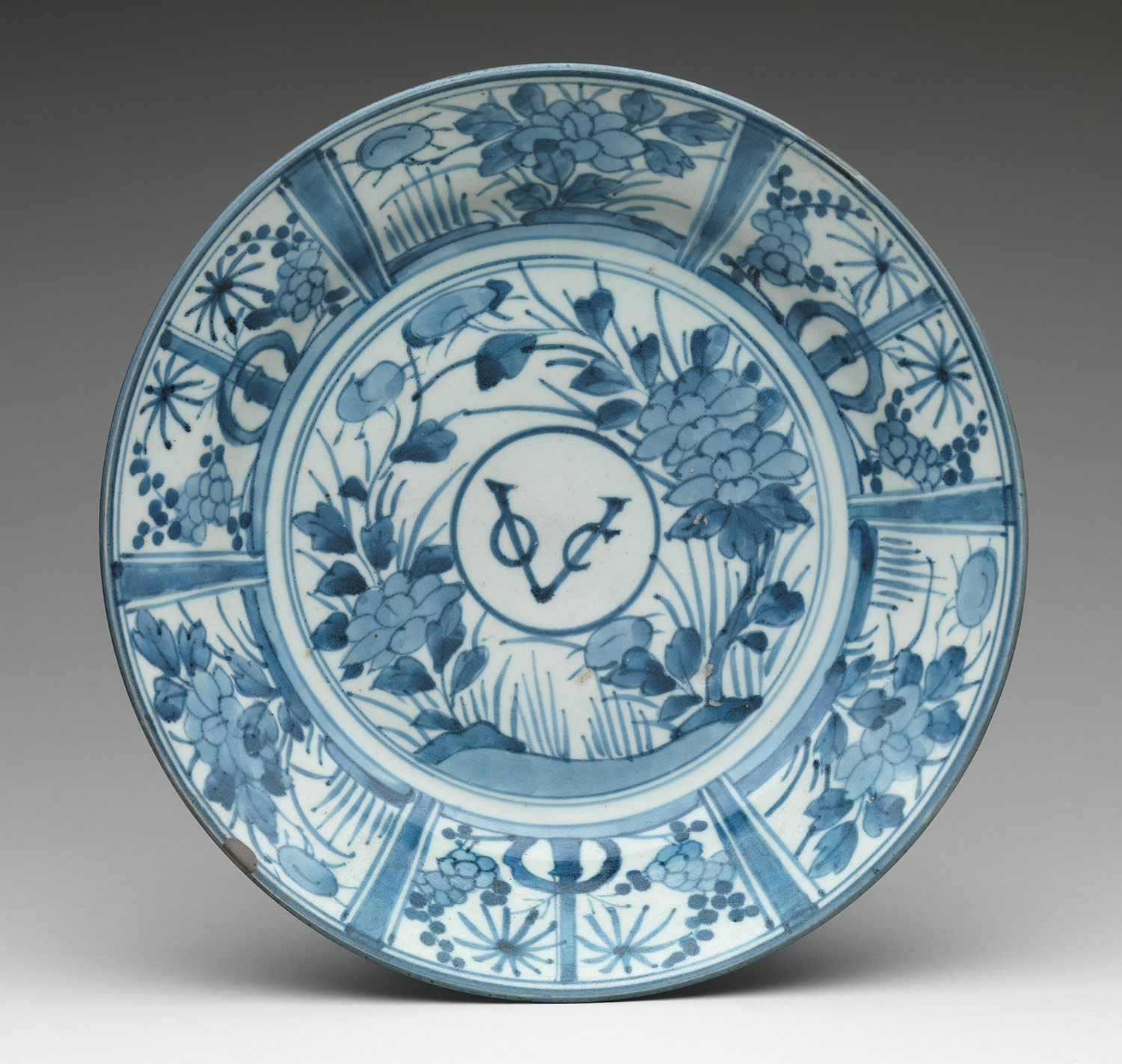
The porcelain of Arita was traded to Europe through the Dutch East India company (Vereenigde Oostindische Compagnie - VOC). Due to Japan's isolationist policy, the Dutch were the only Europeans able to maintain a trading post in Japan from the 1640's to the 1850's. Due to their patronage, quite a few VOC branded lines were produced at the Arita kilns (3, 4, 5, 6, 7) . These items featured both Japanese motifs (8) and the reinterpretation of Mingware patterns. The 8 lobed border of the 1600's Mingware is frequently featured and will often contain images of auspicious items (9, 10). One reoccurring theme on the 8 lobed plates seems to be a pot or vase with a flowering plant (11, 12). As with the export production in China, the Arita kilns also recreated European items and designs such as this reinterpretation of a Delft Albarello (13).

Japan maintained exports via the VOC for at least a century until China established their porcelain kilns and recommenced trade. There can be no doubt, the Japanese interpretation of Chinese designs had an impact on the perception of Asian ceramics in the late 17th century. The significance of this influence will be examined in my examination of the Dutch delft and BoW trade.


Plate with monogram of the Dutch East India Company. 1660. Japan. The Met Museum 2002.447.40


Additional resources:

A good 28 page article on the porcelain trade by the VOC from 1600 - 1660's. Discusses the introduction of Chinese porcelain via captured Portaguse ships in 1602 and 1604
Keel, C. 2007. Early 17th century Chinese Trade Ceramics for the Dutch Market: Distribution, Types and Consumption in Proceedings of the International Symposium: Chinese export ceramics in the 16th and 17th centuries

Sunday, 3 May 2015

Indian garb as pictured at the Ajanta Caves, Cave 1

a) The Ajanta Caves in the 19th century. Photograph by Francis Firth & Co. V&A E.1116-2008

Indian garb as pictured at the Ajanta Caves, Cave 1.

Indian garb, first half of the 6th century

Motivation: Indian garb has appealed to me for many years as I just love the grace of the folded and tucked fabric. I started wearing it as practical garb at Pennsic as the cotton lengths wash and dry easily, and are very suitable for the humidity. The more often I wore Indian garb, the more often I encountered questions/ ignorance and the greater the need to properly document my outfits. I have decided to document Indian garb from the Ajanta caves for two reasons: 1) a majority of SCA folk are aware of two forms of Indian art, the semi-naked Chola bronzes from the south-east which actually aren't intended to be viewed without meters of fabric draped over them and the Islamic, late period Mughul Empire's miniatures, neither of exemplify fit the garb I wear, and 2) the Ajanta caves are reasonably well imaged permitting sufficient arm-chair research.

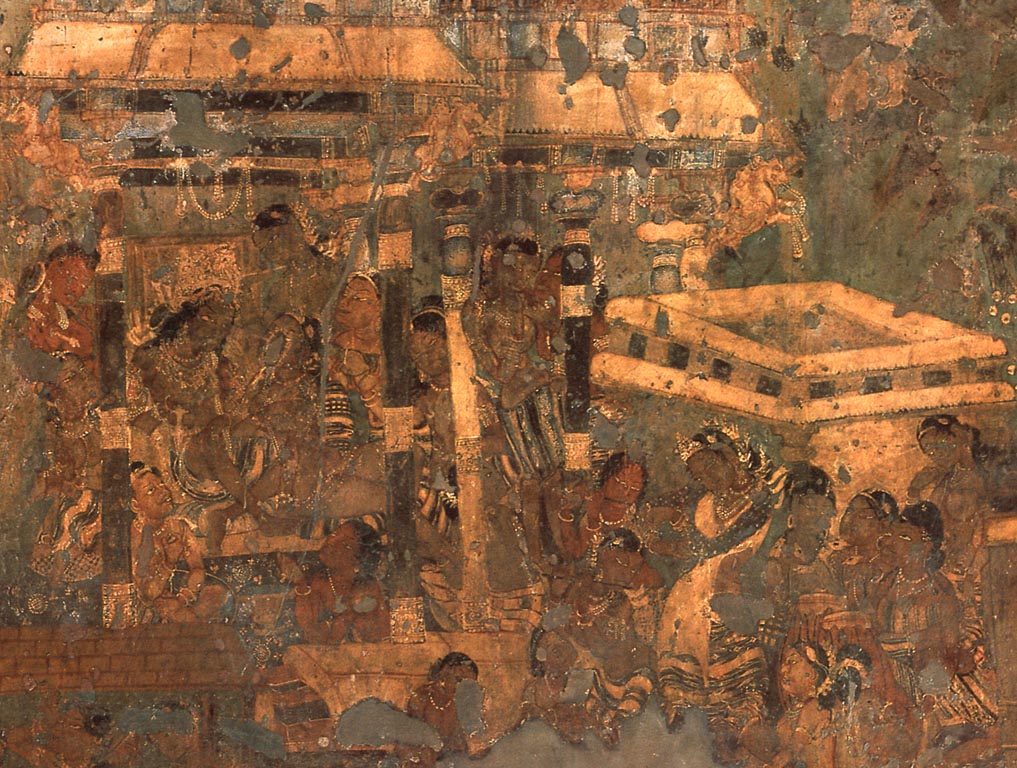
The Ajanta Caves were 're-discovered' by a group of British soldiers in 1819 in a ravine 320km north of Bombay. The 32 caves date from the 2nd to the 7th century and feature beautiful Buddhist paintings and sculptures. Though the caves have deteriorated since discovery, a number of artists have attempted to capture the features of the cave and these paintings are available in many museums. In 1845, Robert Gill started copying the Ajanta murals, shipping the paintings and notes back to England. In 1872, after a fire had burnt many of Gill's originals, John Griffith was contracted to execute another study. Many of John Griffith's works can be found in the Victoria and Albert Museum.

Given the huge amount of material available in the Ajanta Caves, I have chosen to focus on the  Mahajanaka Jataka.

"Mahajanaka, the son of King Aritthajanaka had been banished from the Kindom of Mithila by his uncle Polakanaka. Mahajanaka set out to become a merchant and thus raise the funds to reconquer the kingdom. After many adventures including a shipwreck, he returns. King Polajanaka meanwhile has died leaving behind his only heir, his daughter Sivali. Polajanaka had instructed Sivali to ensure she married a man who could know the head end of a square bed, find the 16 treasurers of the kingdom and string a bow which required the strength of 1000 men. Mahajanaka, so the tale goes, fulfills all of these tasks and thus marries his cousin Sivali. Unfortunately the appeal of royal life begins to wane, and though Sivali attempts to distract her husband, he decides to become an ascetic. Though she tries to persuade him otherwise, he eventually rides into the Himalayas to spend the rest of his life meditating on the Truth."  (The Ajanta Caves, Benoy Behl, 2005).


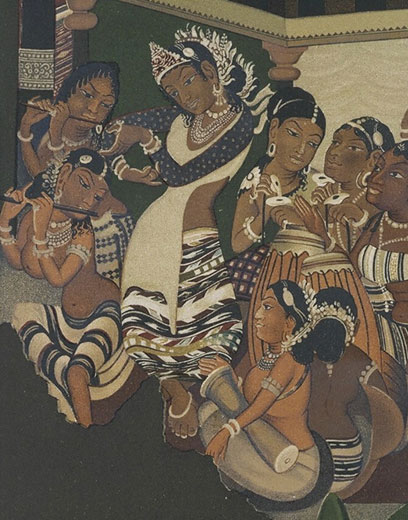
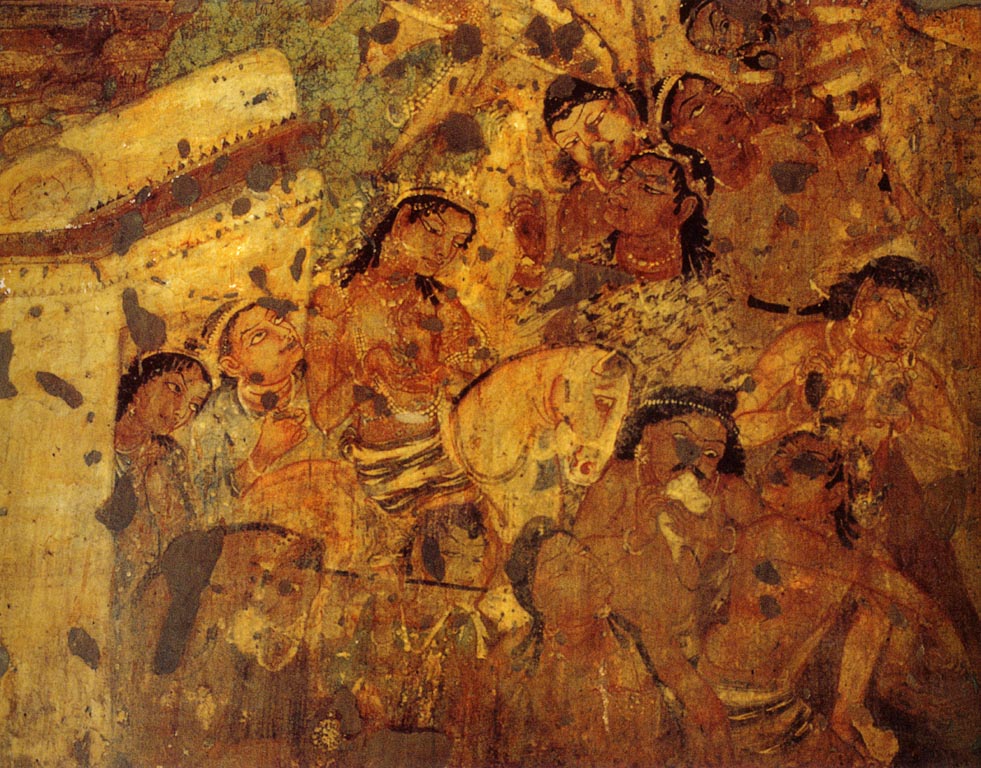
The tale of Sivali and Mahajanaka are one of the stories told in scenes on the left hand wall of Cave 1 (1) which was painted in the first half of the 6th century.  My main focus is on the following scenes; dancing troupe (2, 3 & 4), sermon (5), announcement (6) and departure (7). Together these scenes contain 48 individuals evenly split along the sexes. The religious, royalty, maids and entertainers are shown in a variety of poses permitting a broad analysis of garment and adornment types.

Note: To date, no extant fabric has been found in India due to both the humidity and the tradition of burning the dead. 12th century block printed fabric scraps in browns, greens and blues have been found in Fustat, Egypt and Indonesia and are thought to originate from Gujarat, India (western coast).

Clothing:

Upper - Women

Upper garments depicted in these murals are quite varied. Occasionally women are pictured wearing nothing on their top half. This may be because the original pigment is now indistinguishable from the skin tone used. Other women are surrounded by a translucent drape and the contrast between the pigments makes this difficult to pick out. In other cases, the women (both royal and not) are topless. Given I live in Victoria and don't consider myself an exhibitionist, I tend to focus on the women who are wearing upper garments.

c) Focal dancer from dancing troupe scened) Drummer from dancing troupe scene. e) Lady from announcement scene 

        
f) Lady from sermon scene g) Person from departure scene h) Flautist from dancing troupe scene

Style 1 is the clearest and most unusual, a pinafore top worn by the dancer in the troupe scene (c). The body of the pinafore is plain yellow with purple and white spotted arms. The arms are tightly fitted and the top of the sleeve curves into the yellow body piece. The spots on the arms could either be produced with block printing or tie dye. The body is tightly fitted over and under the bust ending in an apron that drops to knee length. The back of the bodice wraps around the ribs and probably ties shut. There are three whispy white lengths that protrude from the back of the dancer which could be interpreted as veils however I believe these are the ties from the bodice.
Style 2 is also an unusual garment from the dancing troupe scene. The female drummer (d) wears a boob tube with vertical stripes. The stripes don't match the ihkat stripes of her lower garment suggesting this is formed from a separate piece of cloth. The orientation of the stripes indicate the garment isn't cut and fitted in the front. This style can also be seen on a lady in the announcement scene (e). The lady standing behind Mahajanaka's mother wears an ihkat lower garment and a striped upper garment as well as a nearly transparent wrap.
Style 3 is the most common upper garment in this set of murals. A lady depicted in the sermon scene exemplifies the style (f). She wears an upper body wrap of purple and white spotted fabric. Under this she wears a high neck, long sleeve green and white spotted fitted garment. I believe this extends all the way to mid shin and the ihkat fabric pictured near her is a cushion. This garment may be tight or loose as depicted in the departure scene (g).
Style 4 is a short sleeved top (h). Worn by one of the flautists in the dancing troupe, it is a plain light colour, with short sleeves and a rounded neckline. It is fitted to her body and terminates on the floating ribs. The sleeves are either absent or small cap sleeves.

 Upper - Men

Like the women, men are often pictured wearing nothing on their top half in both formal (court) and informal (departure) scenes. King Mahajanaka, while appearing topless in the departure scene, wears a plain coloured fabric wrap in both the announcement scene (i) and the sermon scene (j).
Also in the sermon scene, we also see two figures (monks?) to the upper right. One (k) sports a tight fitting, sleeved plain and pale garment with plain loose fabric looped from the right hip over the left shoulder and arm. The second monk (l) has pale striped fabric looped over his body in a similar fashion. The definition isn't clear enough to determine if he is wearing a tight fighting top as well or just has slightly paler skin tone on his visible arm.
The departure scene features a figure wearing potentially block printed fabric featuring a pattern of geese or ducks (m). Similar fabric produced in Gujarat in the 15th-16th centuries has been recovered from Indonesia (8). At first glance the garment seems to be fitted to the right arm, with similar fabric wrapping over the left however I believe it is the stripes in the fabric that provide this illusion. Instead, the garment is a long sleeved and tightly fitting and extends to beyond the navel. I believe this garment is similar to that of the mustache man in the sermon scene (n). The mustache man wears a knee length garment made out of either spotted fabric or scales tied at the waist with a short belt.

i) King in the announcement scene j) King in the sermon scene k) monk? from sermon scene
l) man from sermon scene m) person from departure scene n) mustache man from the sermon scene

Lower garments


o) A statue of Deedargani Yakshini wearing a dhoti. Sandstone. 1st century. Patna Museum (9)

Both men and women are pictured wearing a dhoti. A dhoti is a long cloth which can be folded, wrapped and tucked in a multitude of ways to create a draped or bifrocated lower garment (o). In the murals, this outfit is typically knee length for men (i) and ankle length (c) for women. For a majority of figures, the dhoti is made out of horizontally patterned ihkat fabric. Ihkat fabric is made from threads that a pre-dyed before being woven. This forms the iconic rhomboidal zigzag lines depicted. This process is time consuming and well made fabric would be expensive. It is possible the artists chose to illustrate the richness of the fabric rather than the drape. As this way of painting fails to show folds it is challenging to determine how the garment is draped on the body. There are a few examples which provide clues to the draping methods utilised.

Though not easily visible in the image provided, one of the flautists of the dancing troupe wears a block printed dhoti (h). Closer examination of this garment shows the drape is pulled diagonally in front of the body and tucked into the left hip (Behl 2005, pg 91). The drummer from this scene (d) has a horizontally striped knee braced against her drum however the pattern of the fabric meets her left hip at a right angle indicating it is tucked in at the side. Examination of the King in the departure scene, shows a thickening of the garment at his waist with a section showing a perpendicular pattern suggesting a loop of fabric has been tucked up on the right (p).


p) King in departure scene q) King Sibi mounts the scales (10, pg 74) r) Naga King Sankhapala and rescuer Alara (10, pg 83)

Examination of a contemporary figure from Cave 1 featured in scenes of the Sibi Jataka illustrate additional methods of folding a dhoti. As King Sibi climbs onto the scale, it is obvious the garment has been draped in such a manner that it is bifurcated with a twisted loop running from the navel and emerging from under the belt in a fan. Another image from Cave 1, from the Sankhapala Jataka, depicts the Naga King and his rescuer Alara. Alara wears an ihkat fabric dhoti which shows a pleat folded and twisted between his legs to create shorts.

A full analysis of all garments featured in the selected scenes of the Mahajanaka Jataka are outlined in Table 1. The data indicates that males and females have similar levels of fitted upper garments and only the ascetic delivering the sermon wears a full drape. For females, tops typically featuring long fitted sleeves are twice as popular as short sleeves.

Sermon Departure Dancers Announcement Total
Male Female Male Female Male Female Male Female Male Female
Dhoti horizontal 4 1 3 3 1 6 8 10
Dhoti angled

1 1 0 2
Dhoti unknown 2 1 1 1 3 2
Upper Wrap 2 1 2 1 5 5 6
Upper N/A 4 1 5 4 4 9 9
Fitted upper 5 1 4 1 6 2 9 10
Sleeves long 5 1 4 1 3 9 5
Sleeves short 2 1 0 3
Boob tube 1 1 0 2
Shoulder drape 2 1 1 3 1
Full drape 1 1 0
Table 1: Analysis of clothing styles in scenes from the Mahajanaka Jataka, Ajanta, Cave 1.

Fabric

I have categorised the fabrics worn by the figures in the 4 scenes examined and compared the trends between the sexes (table 1). While I have tried to list every item worn in the murals, severely damaged or indistinguishable items were excluded due to their ambiguity. Ihkat is by far the most common pattern worn, simply because a majority of the dhotis are of this fabric type. Plain colours are the next most common, however a number of the indistinguishable garments may fall into this category. Spots are a close third. Excluding the mustache man with the scaled spots (n), all other spotted fabric seems to be white on a darker color. They also typically  feature spots that have a void in the center, like a sequin might. Stripes and checks may also be simpler ihkat fabrics but have been individually categorized due to their uniqueness. There are two instances of block printing, on the flautists dhoti (h) and the garment with the ducks (m).


Sermon Departure Dancers Announcement Total
Male Female Male Female Male Female Male Female Male Female
Figures in scene 12 2 11 1 0 10 1 11 24 24
Ihkat 6 2 3 1 4 9 7
Stripes 3 1 2 3 4 5
Plain 5 2 3 1 2 8 5
Spots 2 2 4 1 1 1 6 5
Checks 1 1 1 1
Hamsa (geese) 1 1 0
Block print 1 0 1
Table 2: Analysis of fabrics displayed in scenes from the Mahajanaka Jataka, Ajanta, Cave 1.

The Outfit


After all the research and analysis, I decided to recreate elements from the flautists outfit. Though the short sleeve top she wears is unusual among the 24 women in these scenes, it is frequently depicted in art dating as far back as the 2nd century. I have chosen to combine her outfit with jewellery and hair elements from other women of a similar status from these murals.


s) Front of my new outfit t) Back of my new outfit

My top

I have constructed my top out of cream cotton with a white cotton lining as this is both a period fabric and it breathes well. The fabric was part of a blouse piece that came with a sari so the salvage terminated in lovely red and gold trim which I decided to keep. Unlike the square cut Coptic garb being produced in Egypt at this time, the sleeves depicted on the dancer are clearly inset into the body of the top. I decided to copy this style in my top to avoid overhanging fabric on the shoulders.
Seams are rarely depicted in Indian art and the Ajanta cave murals are no exception. I suspect that it is unlikely darts were used at this time however I needed to take some liberties. Though the side and center seams curve to provide shape to the top, I had to add in bust darts (u). I am an 8GG so my breasts overhang my ribcage and require the additional shaping and support provided by the darts.
The back of the garment (t) is closed with four ties. Originally I was going to use three as depicted on the dancers outfit (c) however I decided to make the back of the neckline higher to provide more support and sun protection. I've noticed the middle ties at the back of the top (t) tend to gape. This is because they're very challenging to tie closed by yourself! If I were to make another one of these I'd cut the fabric back inline with the back bottom darts (v). This would remove the darts and give me the flexibility to lose and gain weight.
I decided to machine sew this entire top for added durability. When I patterned this top I was wearing an older bra. My newer bra has a larger underwire and would poke out the armhole if I sewed the outershell and lining together to seal the armholes. Instead I made bias binding out of leftover scraps from the cream fabric and used them on both arm holes and the neckline for symmetry. This gained me 1.5cm of fabric in the underarm, sufficient to cover a bra should I chose to wear one.

u) top front with darts v) top back with ties and darts

The Bottom

The dhoti of this outfit is made from 2.5m of white cotton block printed in simple red geometric stripes (w). I purchased this from an American returning from India and intended to use it as a wrap. 2.5m is a little too long for a wrap but is a perfect length for this dhhoti! The fabric is tied on my left hip, wrapped in front of my body and returned to my left hip where it is tucked in securely. This results in minimal distortion of the horizontal pattern and resembles the tucking seen in the flautists dhoti.

w) white dhoti block printed with red

Jewellery

Table 3 shows my analysis of the jewellery shown in the mural scenes. This data suggests that a majority of women wear a short pearl necklace and a quarter wear multiple chains on top of this. Nearly all the women wear earrings. Some are ear stretches (e) while others are simple loops (d). The flautist wears a golden hoop from which depend three pearls (h). Men and women who have stretched their ears will also wear tight golden loops depending from their lobe (l). A majority of women will also wear one or two bracelets on each wrist, while half will also wear complicated upper arm jewellery (h). Rings are often worn on the index or pinkie finger or both.

Sermon Departure Dancers Announcement Total
Male Female Male Female Male Female Male Female Male Female
Jewellery

Earrings 7 2 7 1 10 1 9 15 22
Short pearl necklace 6 1 2 6 1 7 9 14
Neck chain 1 1 3 1 2 1 4 5
Multiple chains 4 2 0 6
Plain anklet 0 0 0
Rings 3 2 5 1 4 6 9
Upper arm band 3 1 3 1 8 5 11
Bracelet 6 2 6 5 1 7 13 14
Head/Hair
Crown 1 0 1 0 1 2 3 2
Coronet 6 2 3 1 1 1 9 5
Tiara 0 0 1 1 1 1 2
Flowers 1 1 2 1 4 3 6
Linked ornaments 3 0 2 5 5 5
None 1 0 3 1 4 1
Tikka 3 4 0 7
Table 3: Jewellery and hair ornamentation in scenes from Mahajanaka Jataka, Ajanta, Cave 1.

I accessorized this outfit with two bracelets per wrist and a short pearl necklace. As I don't and won't stretch my ears, I wear simple pearl french hooks. I am hoping to invest in earrings closer to the flautists soon but at this point cannot afford 24ct gold. In my hair I wear a tikka and additional ornaments (x). 9 women were depicted wearing rings however I own no gold rings so I have chosen not to wear any rings (even silver).
The women of the mural wear their hair in a variety of ways, buns, braids, ponytails and gathered at the nape of their neck. My hair is waist length when loose but does not have the volume to replicate most of these styles. I would assume that generally the women pictured have knee length hair. My hair has been trussed up in a bun and decorated with flowers.

 x) Hair and jewellery for the Mahajanaka Jataka outfit.

Resources:


1 - Scenes from Ajanta cave 1 hosted by Columbia University. Accessed 10/2/2015
http://learn.columbia.edu/indianart/ajanta/

The dancing troupe scene
2 - A detail of the dancing troup of Cave 1 as part of a treatise on Ajanta. Accessed 24/4/15
http://saigan.com/heritage/painting/ajanta/dance4.html

3 - Detail from Ajanta painting by Robert Gill. Museum no. IS.53-1885. Accessed 24/4/15
http://media.vam.ac.uk/vamembed/media/uploads/rx_images/image/27001-28000/27160-large.jpg

4 - A broader view of the court scene featuring the dancing troupe hosted by the Columbia University, accessed 10/2/2015
http://learn.columbia.edu/indianart/ajanta/images/courtscenedetail.jpg

The sermon scene
5 - A detailed image hosted by the Columbia University, accessed 10/2/2015
http://learn.columbia.edu/indianart/ajanta/images/listeningtothesage.jpg

The announcement scene
6 - High definition image of the announcement, hosted on Wikimedia accessed 25/4/15
http://commons.wikimedia.org/wiki/File:Meister_des_Mah%C3%A2janaka_J%C3%A2taka_001.jpg

The departure scene
7- A detailed image hosted by the Columbia University, accessed 10/2/2015
http://learn.columbia.edu/indianart/ajanta/images/kingmahajanakaonhorse.jpg

8- Ceremonial cloth and sacred heirloom depicting hamsa geese. 15th - 16th century, Gujarat. Cotton, block printed resist and mordant dye. Art Gallery of South Australia. Item 20083A30http://www.artgallery.sa.gov.au/agsa/home/Collection/detail.jsp?ecatKey=5253

9 - A statue of Deedargani Yakshini wearing a dhoti. Sandstone. 1st century. Patna Museum. Accessed 24/4/2015
http://commons.wikimedia.org/wiki/File:Yakshini.jpg

10 - Behl, B. (2005) The Ajanta Caves, Ancient Paintings of Buddhist India. Thames & Hudson Inc, New York.


Additional resources

An article on the restoration of 81 of Robert Gill's paintings by the Victoria and Albert Museum.
http://www.vam.ac.uk/content/journals/conservation-journal/issue-52/conserving-the-copies-of-the-ajanta-cave-paintings-at-the-v-and-a/