Last year I was on a secondment to a new team. They're all lovely people and continue to be very supportive of my learning curve. One of the benefits of being part of this team is unrivaled access to spare B bags. B bags are used to house the secondary chip samples from RC drilling. These samples are stored in large barrels in the event that an error occurs at the labrartory when assaying the A sample. Every so often, we make a duplicate sample to validate the lab process. This creates spare B bags. As a result, they are used for all sorts of things, from wiping the mud of vehicles, to temporary sun shades. The B bags are made of calico and sized with a water-resistant starch of some kind.
Thursday, 1 March 2018

Friday, 16 February 2018
Some Sancai things I really like

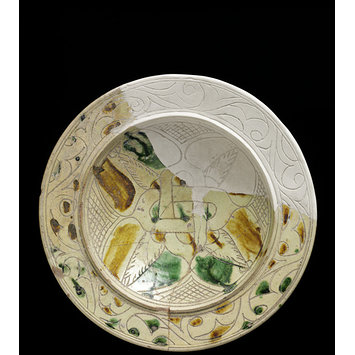
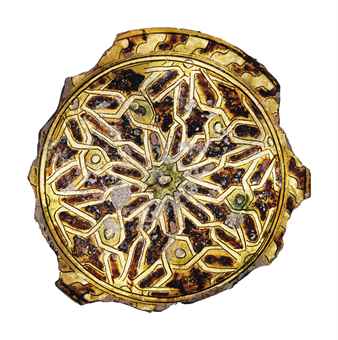
Sancai refers to a glazing tradition from China's Tang dynesty (~600-900 CE) which utilises green, purple and brown glaze. The glaze is lead based laid on white earthenware items. Due to the mobile nature of the glaze, if often has carved borders to assist in retaining the glaze. Some scholars suggest the Chinese dishes influenced the sgraffito work of Europe.
The final image in this post indicates that even when the art forms of glazing was highly refined, the translucent green was utilized despite it's dubious nature.

Sunday, 28 January 2018
UFO - Mr. Men dress upgrade
I've just finished upgrading this UFO. I made this dress from a tennis dress pattern in 2004/5 (specifics are faint). The fabric came from a reclaimed bedsheet and as you can see, I was more concerned with conserving fabric than matching the print.
I love this dress but I had made the hem a little short. Luckily, in my fabric conserving spirit I had made the hem very wide. So, I was able to unpick it and lengthen the dress by a good 10cm. Unfortunately, wear on the hem had left pale lines in the print. I solved that through the application of trim (which probably cost more than the original fabric). The green trim covers the original hem line and the blue covers the fold.
If I had a do-over, I'd pattern match and maybe flare the skirt a bit more. That said, I still have the other bed sheet in the set, I could make another once my UFO stack is down to a more manageable size. It'll have to wait though, my two UFO complete per one new project is going well and I'm looking forward to tackling some ceramics next.

Thursday, 18 January 2018
Yellow bugs in Western Australia

Fuzzy yellow caterpillar photographed around Leederville, Perth.
Cleaning up images my phone and I found this critter - a Trichiocercus sparshalli. This fuzzy caterpillar turns into a white / silver moth. Apparently they can be found across Australia but the eastern states are more likely to have the red sub-species.

A bee drinking goerthite stained water - tiny tongue (proboscis)!
With water in the Pilbara being so scarce, if the local hive finds a readily available source, they all turn up for a drink. I strongly advise capping all drinks and using sippy straws to avoid the bee-in-the-mouth issue.
Tuesday, 26 December 2017
Purple flowers in the Pilbara

I'm pretty confident this is a Solanum variety. Possibly Solanum lasiophyllum as it's leaves are more fuzzy than the orbiculatum.
Wednesday, 1 November 2017
Crafting with paper lanterns
Every steampunk party requires appropriate decorations. My lovely hosts had everything covered which meant I could spend an hour or so modifying a bunch of paper lanterns to create dirigibles. The annoying thing about the lanterns is the wire frame is a spiral, so the supporting 'rope' always looked a little wrong on one side.

No boat? DUPLO to the rescue!

Tea-light holder, wrapped in twine with some tiny weight out of sackcloth

Left over wedding jar and a Death Star that just happened to be lying around. The lines of the 'ropes' aren't quite right but my resources were limited.
The party was fantastic and the company delightful. I especially liked the colour-coded cocktails in their lovely teapots and the test tube glasses. The propaganda posters were also most excellent.
Thursday, 14 September 2017
Pilbara wildflowers

I have no idea what species these flowers are, but they are a beautiful splash of colour in an otherwise red and dusty environment.
Monday, 28 August 2017
Pennsic block printing haul - follow up
Remember my block printing haul from Joann's? I've started experimenting with them. The blocks are carved wood with the print surface sealed in a white (oil?) based paint. I had assumed this was the make the carving on the block easier to see for potential buyers but now I've experimented, I can see this has an interesting application. The white paints stops the wood from absorbing any of the paint so it doesn't dry out too quickly. Only a certain amount of paint will adhere to the shiny block reducing buildup concerns. Additionally, with my paintbrush-paint application method, paint collects around the edges of the block resulting in a darker outline for the shape. It could be quite effective if utilised properly.


Experimenting with design layout.
Sunday, 20 August 2017
First time using a pottery wheel
At Pennsic, I made a thing!!
Under the expert direction of Master Simon I made a howl. I threw it using a foot powered wheel and then it was fired onsite at Pennsic. I tried to decorate it like a 14th Spanish example but the glaze was not really cooperating. So proud of myself. It did develop a crack because the base was a little too thick and it dried slower than the rest of the pot.

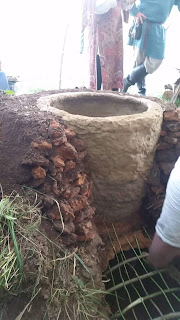
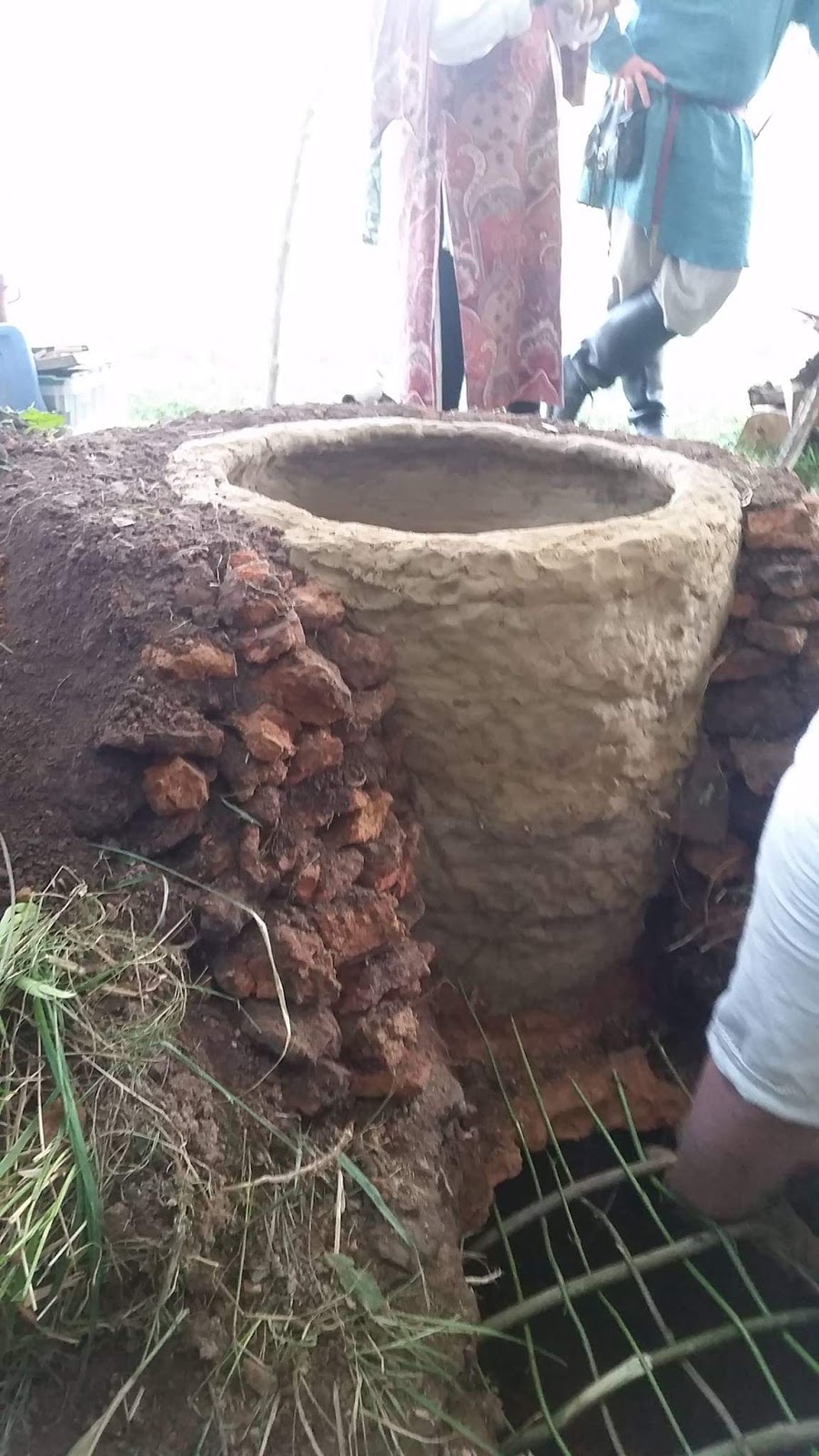
This is the half built woodfired kiln which is constructed onsite from Pennsic clay to fire all the things. :)
Under the expert direction of Master Simon I made a howl. I threw it using a foot powered wheel and then it was fired onsite at Pennsic. I tried to decorate it like a 14th Spanish example but the glaze was not really cooperating. So proud of myself. It did develop a crack because the base was a little too thick and it dried slower than the rest of the pot.

Bottom right - Post throwing; top right - post glazing; left - post firing.
This is the half built woodfired kiln which is constructed onsite from Pennsic clay to fire all the things. :)
Thursday, 10 August 2017
Pennsic block printing haul
As you can tell from the recent flurry of posts, I attended Pennsic again this year. I also took the opportunity to goto Joann's. For those, like me, who reside in Australia, think of it as a cross between Spotlight and Bunnings for crafty things. Unlike Spotlight, Joann's store space is mostly taken up by craft supplies rather than home decorating items. I couldn't resist acquiring some cheap supplies for my block printing quest even though I was nearly at my baggage limit.

The haul includes 7 blocks - the three loose ones I got from a stall in Pennsic proper. I'm a little dubious about the pinkish rubber stamp as it's designed for ink/cards. I worry it won't be able to carry enough paint to be able to depict the fine details. If I thin the paint, it's likely to run into the fabric so it'll take some careful experimentation.
I also bought a rainbow of fabric paint colours. These were especially awesome, as I'm finding it hard to source a range of fabric paint colours in Australia. I decided to go with small bottles as the bigger bottles put my weight limit at risk.
Stay tuned for experimental updates!
Wednesday, 9 August 2017
Lino block printing - initial experiments
*NB: this post has been set to publish itself two weeks after writing as it relates to gifts for people.


 This pirate fox fabric is for Ceara. I think it fits nicely with her fencing and love of foxes. I hope she likes it.
More details, and early learnings on my next update!

This week I've been teaching myself how to carve lino and block print fabric. I've been using 15x15cm pseudo-lino squares for my initial trials. My local art store didn't stock lino or lino substitutes however Officeworks will allow you to order them for next day pick up. Each square costs $6.50 which isn't too bad. I've also bought a 5 pack of basic carving tools, a V, two U shapes and two different straight blades for $10 from the craft-store.

I started with flowers because a) organic shapes are easier to hide mistakes on and b) i needed a Hawaiian print viking dress and had no Hawaiian fabric.
The blue rubber is pretty easy to carve and doesn't have a grain so you can make smooth circular shapes quite easily. I've mostly used the V tool for the lines, and the U tools for carving away waste. I quickly realised that since I hadn't bought a roller and my previous sponge experiments didn't work well, I was going to have to paint the paint onto the lino before printing. It's a bit tedious and can be stripy but in a pinch, it works. I also learned to cut away as much of the waste as I could to remove the possibility of accidental printing around the edges.

More details, and early learnings on my next update!
Monday, 24 July 2017
Printing with rubber stamps - follow up
I've continued my experiments with printing with rubber stamps. In the original post I mentioned some learnings from the experiment. One of my annoyances with the initial experiment was the variability of paint thickness. I pretty much had to re-ink my stamp every time I wanted to stamp it. It was tedious to say the least.
I wondered if changing the paint thickness might help with resolution and repetition. The results of my experiments are as follows:


I wondered if changing the paint thickness might help with resolution and repetition. The results of my experiments are as follows:

Same rubber stamp as used in the original experiment. The paint used is marketed for screen printing and is much stiffer / thicker than the Pebeo paint. Due to the thickness, this paint can create unslightly blobs when excess paint isn't fully removed from the stamp. Not idea for this application but could potentially if watered down 3/5

Same rubber stamp as original experiment, red silk paint used. This paint is much thinner than the Pebeo fabric paint. While it's overall application is more even, in terms of amount applied, the thinness results in bleeding in the calico bags which gives the print a slightly unfocussed look. Not good for this application but an even fast colour nonetheless - consider usage for bulk dying background colours 1/5.

In the last post I mentioned experimenting with plastic backed scrapbook stamps. This stamp has a very fine, shallow complicated design which 'glugged' up with the Pebeo and Screen printing dyes. The red Silk Paint worked well to convey the details however the bleeding continues to be a problem. I doubt this stamp will work for block printing applications and I'll keep clear of detailed scrapbooking stamps in the future.
Monday, 17 July 2017
Qasam and the Kashani cobalt
As outlined in previously, Kashan, Iran seems to be the initial production site of Blue on White ceramics. This is due to Kashan's proximity to a source of cobalt and other minerals useful in creating glazes. The Kashani cobalt originates from Qamsar aka Ghamsar which is located in the hills south of Kashan. Ghamsar is located proximal the the boundary between the Sanandaj-Sirjan Zone (1) (associated with the subduction of the Neo-Tethys Ocean) and the Urumieh-Dokhtar Arc. The U-D Arc hosts porphyry copper-gold deposits (2) as well as epithermal lead-zinc deposit (3).

Figure1: Geology
of Iran - adapted from Geology of the Sari Gunay Epithermal Gold Deposit (4). The blue star marks the location of Kashan and to the south,
Ghamsar (aka Qamsar).
The cobalt in Ghamsar is formed as part of a skarn deposit (5) resulting from the intrusion of a microdiorite into the Qom Formation. For non-geologists, the limestone in the Qom Formation is dissolved by the hot hydro-thermal fluids originating from intrusion of diorite, a volcanic rock. The contact between these two rock types metamorphises and recrystalises becoming the skarn deposit. The mineralology of a skarn is determined by the composition of the hydrothermal fluids and the limestone. The Ghamsar deposit appears to be structurally controlled, with the mineralising fluids travelling through faults. The cobalt is spatially associated with magnetite veins in the faults however the cobalt may precede the magnetite ore. The cobalt (smaltite) likely took the form of a silvery metal and would have been locally processed and washed before transport. Cobalt glaze requires less than 5% cobalt to achieve a rich blue colour. Thus it is a valuable and highly transportable product. Given the comparative weights, the washed cobalt, and other metals, would have been transported to markets in nearby cities.
Summary: Due to the unique geological processes and structures involved, precitipation of cobalt ore is rare and unlikely to be accessible at surface in a form useful for glaze production.
As a side note, the presence of copper-gold in the area would have provided minerals for glaze and lustre while the nearby lead-zinc deposits allowed for the transparent lead glaze that resulted the beautiful underglaze ceramics (6).
As a side note, the presence of copper-gold in the area would have provided minerals for glaze and lustre while the nearby lead-zinc deposits allowed for the transparent lead glaze that resulted the beautiful underglaze ceramics (6).
Why Kashan rather than Ghamsar?

We can see why ceramics are produced at Kashan instead of Ghamsar, the source of the ore, by consulting a soils map. Figure 2 indicates that the soils around Ghamsar are calcareous lithosols which are calcium rich, and often contain chunks of partly or fully unweathered rock. They are calcareous (calcium rich) as their parent rock is likely the limestones of the Qom Formation. Kashan, on the other hand, has a source of salt marsh soils. Salt marshes are a low energy environment which accumulate sediment over long periods of time. Marsh soils are typically fine grain and well sorted, these appear to be grey and low in organic matter. Small grain clays require less work for the potter to purify and create into fine earthenware. The clay would likely have been dried, ground and sifted before being utilised.
When creating blue glaze, cobalt commonly composes <5% of the overall blend (8). The low concentrations required make transporting the washed cobalt the short distance to the source of clay highly viable.
When creating blue glaze, cobalt commonly composes <5% of the overall blend (8). The low concentrations required make transporting the washed cobalt the short distance to the source of clay highly viable.

Figure 2: A map of the soils of Iran indicates which medieval towns would have superior clay. (7)
1: A new tectonic scenario for the Sanandaj–Sirjan Zone (Iran) 2005 A. Ghasemia, C.J. Talbotb Journal of Asian Earth Sciences.
2: Porphyry Copper Deposits of the Urumieh-Dokhtar Magmatic Arc, Iran. 2005. A. Zarasvandi, M. Zentilli, S. Liaghat.
3: The Ay Qalasi deposit: An epithermal Pb-Zn (Ag) mineralisation in the Urumineh-Dokhtar Volcanic Belt of northwestern Iran. DOI: 10.1127/njma/2015/0284
4: Geology of the Sari Gunay Epithermal Gold Deposit 2006 Northwest Iran. by J.P Richards, D. Wilkinson and T. Ulrich. Economic Geology. DOI:.
5: Ore Mineralization at Qamsar Cobalt Deposit:Skarn and Metasomatism Evidences . Hadi Mohammaddoost, Majid Ghaderi, Nematollah Rashidnejad-Omran The 1st International Applied Geological Congress
6: Islamic pottery, a brief history. Metropolitan Museum of Art.
7: Soils of Iran 1961. M.L Dewan, J. Famouri. Food and Agriculture Organisation of the United Nations.
8: Ceramic Arts Network, accessed 31/12/2018.
Saturday, 1 July 2017
block printing with rubber stamps

Not this blog post! Nope.
Today my criteria for a craft activity required not leaving the house and the ability to stay in my PJ's all day. So I had to come up with a project that used supplies already on hand. Rather than teach you how to block print, I'm going to discuss different methods I'm trying over the next couple of posts.
Block printing with rubber stamps.

You will need to:
1 - acquire a friend who sends you rubber stamp when she thinks you'll like them. Alternatively, head to Art Riot or your local scrapbooking store and buy up some rubber stamps sold for embossing card and whatnot.
2 - acquire some fabric. (Or save some from being thrown out). Wash, dry and iron it flat.
3 - scrounge up some paint. I'm using left over Pebeo fabric paint from a previous project. You can also blend JoSonya's fabric medium 50x50 with acrylic paint.
4 - grab a foam brush or sponge. You need to apply a thin even coat of paint to the block. Having no sponge, I cut down one of my silk painting brushes. Apparently you can use a paint roller and paint pallet too.
Place your fabric on a towel or wool blanket covered table. Back it with newspaper to prevent bleed through. Dab a thin coat of paint on the block. Press firmly to the fabric and peel off carefully. Repeat many many times. Rinse all tools. Iron as directed by your paint. Done!
Learnings:


Next I'll try a clear plastic stamp kit I found at Kmart to see if that fixes my alignment issues.
Tuesday, 13 June 2017
Squwark plate
I made a plate for my friend Phillipa. She's pretty awesome and loves her chickens so when I found the following image I couldn't help but modify it. I believe the original is supposed to be peacocks, but their little bug eyes and beaks made me think of chickens. So they became chickens.
 |
| Bowl. Iran, Nishapur 10th century. Earthenware, buff slip, underglaze slip-painted,. LACMA M.73.5.289. (No direct link is possible, check out items 30 and 52 of 99) |
The LACMA have two bowls in this style. The other one (M.73.5.266) has a lot more intricate detail but a similar peacock shape. The buffware with this figerative style is specific to Nishapur, Iran. The Meteropolitian Museum of Art conducted a number of digs in the city in the early 20th century and recovered numerous artifacts (1). The style is closely linked to sgraffito but lacks the incised decorations (2). A good example of sgraffito ware can be found here for those curious as to it's styling.
 |
| The finished plate complete with a variety of personalized chickens. |
I'm really happy with how this turned out. The green/yellow/white/black contrast looks great and is appealing to modern tastes as well. I only hope Phillipa likes it as much as I do.
1) The Met at Nishapur. http://www.metmuseum.org/toah/hd/nish/hd_nish.htm
2) Sgraffito from Nishapur. http://www.metmuseum.org/blogs/ruminations/2015/production-history-of-sgraffito-ware-from-nishapur
3) The extant plate - http://islamic-arts.org/2011/ceramic-vessel-collection-at-lacma/
Friday, 9 June 2017
Pelican outfit #7: The completed outfit

Testing the outfit the night before - who wore it better?
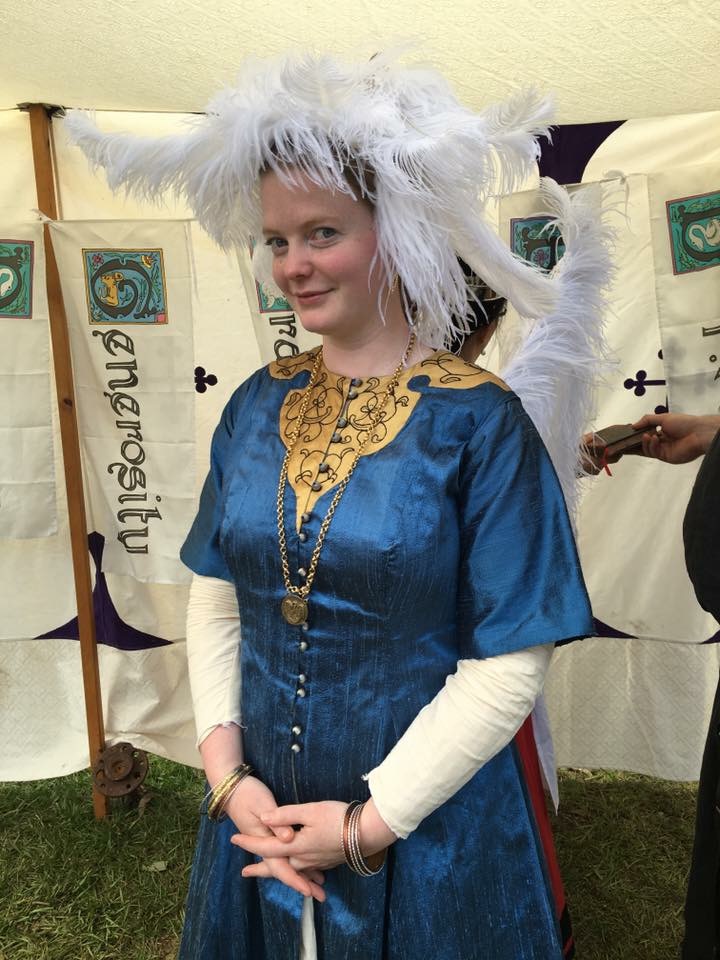
I'm really happy with how my Pelican outfit turned out. It's by far, the best thing in my closet at the moment. I'll wear it at other peoples special occasions. HUGE thanks to everyone who took photos for me, the Peers who spoke of the virtues. My crazy friends who helped me sew the hems, and make the hats and wings and were generally supportive of my ideas. Massive thanks to THL Elizabet Hunter who painted some lovely silk banners of key virtues I believe any peer should uphold and Sharon of Elizabet's Handspun who handspun the black silk thread I used to embroider the golden cloud collar. I love you all!
Thursday, 8 June 2017
Pelican Outfil #6 - The hat and wings

The hat (and wings) on a Peri. The hat often has the same texture as the wings.
The hat has been viewed in passing but was the best part of the whole outfit (in my opinion). The hat came about when discussing my vision with Iglasia. She and Ciara encouraged me aim high and ignore my doubts about allegorical hats. While I was in my home town, frantically embroidering, Iglasia and her husband Edmund whipped up a base for the hat and wings because they're amazing and creative.

Not being hatters we went with a theatre style base - coat hangers with a stocking stretched over it.
Once I reached Brisbane, we created a knob out of polymer clay which we baked in the oven and painted gold. I had originally considered making leaves of silk with lightweight wire to support the flare. After long discussions with a variety of people, I decided to use ostrich feathers instead. So we went on a mad dash through Brisbane to buy some large white ostrich feathers before the event. Norm from the Feather Duster Superstore was amazing and provided us with some lovely quality feathers! (Check them out here - their website has had a makeover since last year and is MUCH easier to find what you might need). We got enough to make the hat AND a set of wings.


Late that night, the night before the ceremony, Ciara sewed the feathers to the hat by whip stitching their stems to the frame. Helen and Iglasia helped me with embroidery and finishing the hems on the dress while everyone helped make the wings happen. I'm so appreciative of my friends staying up late to help me when I had underestimate the amount of time this project would take - and then added the Hat and Wings on top!
If I had of given myself more time, I might have decorated the feather stems with gold sequins or something. Still, I love how it turned out and can't wait for a chance to wear it again.
Wednesday, 7 June 2017
Pelican Outfil #5 - Test collar & dress
I got so heavily involved in making the outfit, I never actually completed the outfit diary. The 1st anniversary of my Pelicaning is fast approaching, so here it is:
I made another test piece with a dark blue brocade (with modern roses). I designed a collar of silver silk with red and blue silk embroidery. The intent of this was to test our my patterning skills, my embroidery skills and to create a backup outfit just in case I didn't get the final one done in time. In the end, the Lovely Iglasia wore the backup and we looked fantastic!
The embroidery was a simple design based on some of the pottery I'd been working on. I started by tracing my collar pattern onto the silk using a washable marker pen. I included a seam allowance and then free-handed the design. Once I was happy with the design, I simply tensioned it using a cane hoop and split stitched my way around each of the symbols and created


I made another test piece with a dark blue brocade (with modern roses). I designed a collar of silver silk with red and blue silk embroidery. The intent of this was to test our my patterning skills, my embroidery skills and to create a backup outfit just in case I didn't get the final one done in time. In the end, the Lovely Iglasia wore the backup and we looked fantastic!
The embroidery was a simple design based on some of the pottery I'd been working on. I started by tracing my collar pattern onto the silk using a washable marker pen. I included a seam allowance and then free-handed the design. Once I was happy with the design, I simply tensioned it using a cane hoop and split stitched my way around each of the symbols and created

Once the embroidery was complete. I cut out the pattern with my sharpest scissors and sealed the edges very carefully with Fray Blocker. This made the edges a little crispy but it was worth the effort to ensure that the applique doesn't fray and lift of the dress.

I'm aware that many of the extant images show the collar crossing the shoulder tip however I'm not very good with attaching sleeves so wanted to leave my options open. As a result, the collar just kisses the sleeve seam. I pinned it down and then sewed in the lining. The meant the collar and front opening would be as tidy as possible. I then folded the rest of the seam allowance under, and invisi-stitched the whole thing down.

Buttons for the dress were created by wrapping silver coloured ripple beads in the same colour silk thread. A small bead was used as an anchor and I created a pin with my trusty long nose pliers.
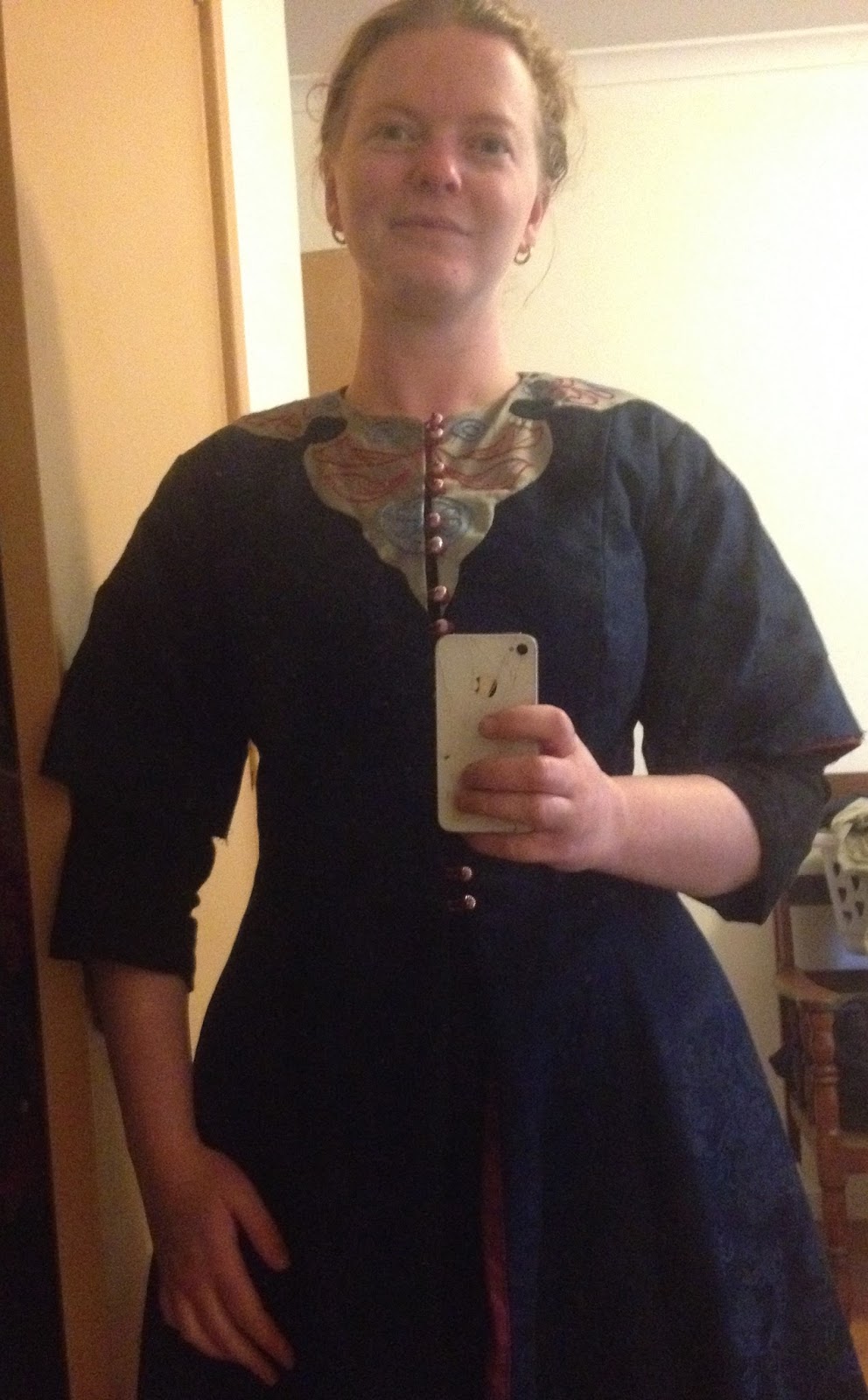
Here I am in the finished dress feeling quite smug about what my limited sewing skills can produce. I quite like how fitted this dress is to my bust without being restrictive. These photos also made me decide to wear a lighter coloured under-tunic on the day as the black sleeves don't contrast well.
The key challenges with this collar revolved around finding a way to stop the silk from fraying. Fray Blocker works but needs to be applied with a brush or toothpick otherwise too much and it'll leech into the silk and darken / stiffen it. Silk that's been saturated in Fraw-blocker won't be easy to puncture with a sewing needle so it's importing to ensure it doesn't take up all of your seam allowance.
Saturday, 3 June 2017
Names from Kalhana's Rajatarangint, a Chronicle of the Kings of Kasmir, Translated by M.A.Stein
SCA reference names for the indian sub-continent.
In the format of NAME, Occupation, sex, date, caste (where possible)
Out of order and not quite secondary (i.e mentioned in introductory sections)
Kalhana, author, male, 1148-49 (meaning 'happy' or 'blessed')
Canpaka, minister, male
Harsa, king, male, 1089-1101
Prayaga, chamberlain,male
Mukta, menial servant, ?
Kanaka, Canpakas son, male
Jonaraja, commentator, male, ~1400
Asoka, king, male
Kumarapala, king, male
Bilhana, poet, male, 1080
Bana, author of Harsacarita (historical romance)
Harsavardhana, king, male
Yasovarman, king, male
Mankha, poet, male, 1128-1144
Alamkara, poet, male (Mankha's brother)
Kalyana, poet, male (possible alternative to Kalhana)
Sussals, king, male
Alakadatta, patron and minister, male
Kalyana, queen, female
Kallana, queen, female (alternative spelling to Kalyana)
Sussala, king, male, 1121
Uccala, rebel brother to Sussala, male
Gargacandra, Lord of Lahara, male
Radda, official then King (for a day), male
Salhana, half brother to Uccala, male
Bhiksacara, grandson of Harsa, male
Jayasimha, king, son of Sussala, male
Lothana, brother of Salhana, male
Salhana, ?
Mallarjuna, nephew of Lothana, male
Bhoja, son of Salhana, male, 1143-1145
Rilhana, minister, male
Alamkara, scholar, male
Mankha, minister, male
Udaya, lord of the gate, male
Ksemendra, poet and historian, male, ~1000
Padmamihira, chronicler, male
Helaraja, ascetic and chronicler, male
Chavillakara, chronicler, male
Meghavahana, king, male
Tunga
Ananta, male
Suryamati, queen, female
Cippata-Jayapida, ?, 813
Lalitaditya, king, male
Yudhisthira
Cakravarman
Jayapida, Brahman, male
Gargacandra/Garga/Gaggacandra/Gagga
Losthaka/Lothaka/Lothana
Rajavadana/Balahara
Ghatotkaca, prince, male
Jayasimha, king, male
Rajavadana, rebel, male
Yudhisthira, Pandava hero, male, 653
Gonanda, king, male
Section II
Hiranyakula, king, male
Vasukula, king, male
Mihirakula, king, male
Baka, king, male
Ranaditya, king, male
Durlabhavardhana, Karkota king, male, 600-636 CE
As'oka, king, male
Gonanda, king(s), male
Huska, Turuska King, male
Juska, Turuska king, male
Kaniska, Turuska king, male
Kaniska, Kusana prnce, male
Huviska, Kusana prince, male
Abhimanyu, king, male
Mihirakula, king, male, ~500-550
Narendraditya, king, male
Khinkbila, king, male
Hiranya, king, male
Toramana, brother to Hiranya and regent, male
Siladitya-Pratapasila, ruler of Malava (Ujjain), male, 580 CE
Pravarasena, king, male
Toramana, ?, male
Matrgupta, king, male
Lahkhana-Udayaditya / Lahkhana-Narendraditya, king, 209-222 CE
Khinkhila-Narendraditya, king, male, 250-214 BCE
Candrapida, king, male (also known as Tchentolopili of Kasmir), 713 CE
Tarapida, king, male, brother to Candrapida, 720
Muktapida-Lalitaditya, king, male 699-735 CE
Mu-to-pi, King of Kasmir, male, 736-747 (aka Muktapida - chineese spelling)
Durlabhavardhana, King and founder of the Karkota dynasty, male, 600-636
Tu-lo-pa, King, male, 627-647 (chinese spelling)
Mihirakula
Toramana
Pravarasena
Lahkhana
(anything pre 7th century has dodgy dates except those above which are corrected by Chinese accounts and artifacts such as coins)
Gonanda, King of Kasmir
Jarasamdha, King of Magadha
Krsna
Balabhadra
Damodara, Son Of Gonanda I
Yasovati, Gonanda's widow, female
Lava, founder of the Agrahara of Levara, male
Kusa, founder of Kuruhura, male
Khagendra,founder of Khagi and Khonamusa
Godhara, founder of Godhara
Asoka, king, male
Sacinara, king, male
Sakuni, Asoka's great-grandfather
Jalauka, King and son of Asoka, male
Avadhuta, saint, male
Isanadevi, Jalauka's queen, female
Damondara, king, male
Huska, Turuska prince, male (Turuska - Turkish buddhist sovereigns)
Jusja, Turuska prince, male
Kaniska, Turuska prince, male
Abhimanyu, king, male
Vibhisana, king, male
Indrajit, king male
Ravana, king, male
Vibhisana, King, male
Nara, king, male
Kimnara, king (aka Nara), male
Siddha, king and son of Nara, male
Utpalaksa, king, male
Hiranyaksa, king, male
Hiranyakula, King, male
Vasukula, king, male
Mihirakula, king and son of Vasukula, male, 515 CE
Toramana, king, male
107, 77
In the format of NAME, Occupation, sex, date, caste (where possible)
Out of order and not quite secondary (i.e mentioned in introductory sections)
Kalhana, author, male, 1148-49 (meaning 'happy' or 'blessed')
Canpaka, minister, male
Harsa, king, male, 1089-1101
Prayaga, chamberlain,male
Mukta, menial servant, ?
Kanaka, Canpakas son, male
Jonaraja, commentator, male, ~1400
Asoka, king, male
Kumarapala, king, male
Bilhana, poet, male, 1080
Bana, author of Harsacarita (historical romance)
Harsavardhana, king, male
Yasovarman, king, male
Mankha, poet, male, 1128-1144
Alamkara, poet, male (Mankha's brother)
Kalyana, poet, male (possible alternative to Kalhana)
Sussals, king, male
Alakadatta, patron and minister, male
Kalyana, queen, female
Kallana, queen, female (alternative spelling to Kalyana)
Sussala, king, male, 1121
Uccala, rebel brother to Sussala, male
Gargacandra, Lord of Lahara, male
Radda, official then King (for a day), male
Salhana, half brother to Uccala, male
Bhiksacara, grandson of Harsa, male
Jayasimha, king, son of Sussala, male
Lothana, brother of Salhana, male
Salhana, ?
Mallarjuna, nephew of Lothana, male
Bhoja, son of Salhana, male, 1143-1145
Rilhana, minister, male
Alamkara, scholar, male
Mankha, minister, male
Udaya, lord of the gate, male
Ksemendra, poet and historian, male, ~1000
Padmamihira, chronicler, male
Helaraja, ascetic and chronicler, male
Chavillakara, chronicler, male
Meghavahana, king, male
Tunga
Ananta, male
Suryamati, queen, female
Cippata-Jayapida, ?, 813
Lalitaditya, king, male
Yudhisthira
Cakravarman
Jayapida, Brahman, male
Gargacandra/Garga/Gaggacandra/Gagga
Losthaka/Lothaka/Lothana
Rajavadana/Balahara
Ghatotkaca, prince, male
Jayasimha, king, male
Rajavadana, rebel, male
Yudhisthira, Pandava hero, male, 653
Gonanda, king, male
Section II
Hiranyakula, king, male
Vasukula, king, male
Mihirakula, king, male
Baka, king, male
Ranaditya, king, male
Durlabhavardhana, Karkota king, male, 600-636 CE
As'oka, king, male
Gonanda, king(s), male
Huska, Turuska King, male
Juska, Turuska king, male
Kaniska, Turuska king, male
Kaniska, Kusana prnce, male
Huviska, Kusana prince, male
Abhimanyu, king, male
Mihirakula, king, male, ~500-550
Narendraditya, king, male
Khinkbila, king, male
Hiranya, king, male
Toramana, brother to Hiranya and regent, male
Siladitya-Pratapasila, ruler of Malava (Ujjain), male, 580 CE
Pravarasena, king, male
Toramana, ?, male
Matrgupta, king, male
Lahkhana-Udayaditya / Lahkhana-Narendraditya, king, 209-222 CE
Khinkhila-Narendraditya, king, male, 250-214 BCE
Candrapida, king, male (also known as Tchentolopili of Kasmir), 713 CE
Tarapida, king, male, brother to Candrapida, 720
Muktapida-Lalitaditya, king, male 699-735 CE
Mu-to-pi, King of Kasmir, male, 736-747 (aka Muktapida - chineese spelling)
Durlabhavardhana, King and founder of the Karkota dynasty, male, 600-636
Tu-lo-pa, King, male, 627-647 (chinese spelling)
Mihirakula
Toramana
Pravarasena
Lahkhana
(anything pre 7th century has dodgy dates except those above which are corrected by Chinese accounts and artifacts such as coins)
Gonanda, King of Kasmir
Jarasamdha, King of Magadha
Krsna
Balabhadra
Damodara, Son Of Gonanda I
Yasovati, Gonanda's widow, female
Lava, founder of the Agrahara of Levara, male
Kusa, founder of Kuruhura, male
Khagendra,founder of Khagi and Khonamusa
Godhara, founder of Godhara
Asoka, king, male
Sacinara, king, male
Sakuni, Asoka's great-grandfather
Jalauka, King and son of Asoka, male
Avadhuta, saint, male
Isanadevi, Jalauka's queen, female
Damondara, king, male
Huska, Turuska prince, male (Turuska - Turkish buddhist sovereigns)
Jusja, Turuska prince, male
Kaniska, Turuska prince, male
Abhimanyu, king, male
Vibhisana, king, male
Indrajit, king male
Ravana, king, male
Vibhisana, King, male
Nara, king, male
Kimnara, king (aka Nara), male
Siddha, king and son of Nara, male
Utpalaksa, king, male
Hiranyaksa, king, male
Hiranyakula, King, male
Vasukula, king, male
Mihirakula, king and son of Vasukula, male, 515 CE
Toramana, king, male
107, 77
Saturday, 27 May 2017
Star tile lineup from the A&S 50 challenge
No.
|
Star Tile
|
Original tile
|
Time / Place
|
1
|
 |
 |
Kashan 1262
|
2
|
 |
 |
|
3
|
 |
 |
|
4
|
 |
 |
|
5
|
 |
 |
Kashan 12th/13th C
|
6
|
 |
 |
|
7
|
 |
 |
13th century, Iran.
|
8
|
 |
||
9
|
 |
 |
|
10
|
 |
 |
|
11
|
 |
||
12
|
|||
13
|
|||
14
|
|||
15
|
|||
16
|
|||
17
|
|||
18
|
|||
19
|
|||
20
|
|||
21
|
|||
22
|
|||
23
|
|||
24
|
|||
25
|
Future tiles are hiding here.
Subscribe to:
Posts (Atom)