Showing posts with label AandS 50. Show all posts

Monday, 20 January 2020

Blue on White ceramics - an ongoing bibliography

I should have posted this a while ago, please note, this page is updated as I find more gems. My collection of Blue on White ceramic images mapped to location of creation. Note: only 80 items initially load, you need to scroll to the end of the collection before they'll all show up on the map. Zoom into your area of interest to see clusters around centers of production.

(Japan and The Netherlands) A good 28 page article on the porcelain trade by the VOC from 1600 - 1660's. Discusses the introduction of Chinese porcelain via captured Portaguse ships in 1602 and 1604
Keel, C. 2007. Early 17th century Chinese Trade Ceramics for the Dutch Market: Distribution, Types and Consumption in Proceedings of the International Symposium: Chinese export ceramics in the 16th and 17th centuries

(Iraq, Iran and Egypt) A section on the Abbasiddian potters from a web based teaching course on islamic ceramics hosted by the Ashmolean Museum. http://islamicceramics.ashmolean.org/Abbasid/pottery.htm 

(Iraq, Iran and Egypt) A PDF article on the Abbasid perception of Chinese Ceramics.
Hallet, J. 2010 Pearl Cups like the Moon, The Abbasid perception of Chinese Ceramics. Shipwrecked: Tang Treasures and Monsoon Winds.. eds Krahl, R. Guy, J. Wilson, J.K. Raby, J. Arthur M. Sackler Gallery, Smithsonian Institution, pp 75-81
(Iraq and Egypt) A great scientific paper PDF on the reciprocal influence of Tang China and Abbasid Iraq ceramics.


Wood, N., and Tite, M., (2009), ‘Blue and White – the Early Years : Tang China and Abbasid Iraq compared.’ Transfer : The Influence of China on World Ceramics. (Colloquies on Art & Archaeology in Asia No. 24. Percival David Foundation of Chinese Art. ed. Stacey Person, ed. London University, pp 21-45

(Iraq) A short article on Basra's Potters and their developments
Attwood, R. 2005 Basra's Inventive Potters. Archeology Reviews. Vol 58, 2.

(Iraq, Iran, Egypt, China, Turkey) A PhD thesis I'd really like to get my hands on, scientific analysis of the origins of cobalt.


Wen, R. 2012. The cobalt blue pigment used on Islamic ceramics and chinese blue-and-white porcelain. PhD Thesis, University of Oxford.

(China) A nice summary of political China and some great post-period items. http://gotheborg.com/chronology/index-chronology.htm

(Iran - Timurid) Golombek, L. Mason, R.B. Bailey, A. 1996 Tamerlane's tableware: A new approach to the chinoiserie ceramics of fifteenth-sixteenth century Iran. Mazda Publishers  ISBN 10: 1568590431

(Iran - Safavid) Golombek, L. Mason, R.B. Bailey, A. 2013 Persian pottery in the first global age: The sizteenth and Seventeenth Centuries. Brill. ISBN 10: 9004260927

(Iran - Ayyubid) Milwright, M. 1999. Pottery in the written sources of the Ayyubid-Mamluk period (c. 567-923 / 1171-1517). Bulletin of the School of Oriental and African Studies, University of London. Vol 62, No 3. pp 504-518.
 

Sunday, 30 December 2018

Blue and White ceramics - China

Blue on White ceramics: the reciprocal influence of Chinese porcelain on European and Middle Eastern ceramics - China

Other essays on the history of BoW in IraqEgyptearly Iranlate Iran, Japan, Turkey, Spain, The Netherlands, Italy and England.

China

Tang Dynasty (7th - 10th century)
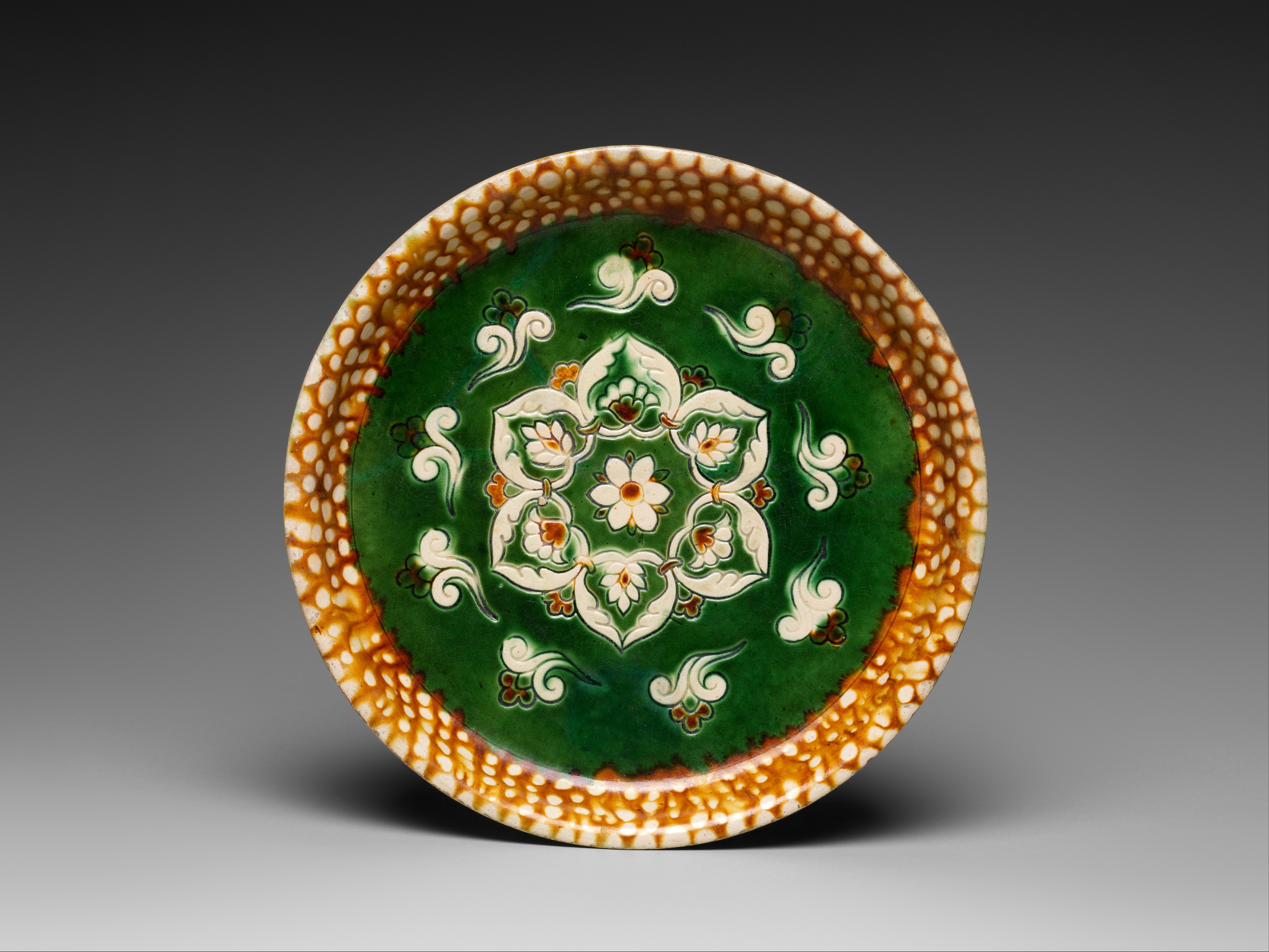
Like many countries, some of the earliest examples of cobalt glaze in China are dipped earthenware items (1). This later developed into earthenware covered in white slip and painted with blue designs (2). These items were produced during the Tang Dynasty and may have been inspired by simple figurative bowls imported from Iraq.  From the 9th century China started to develop "Porcelaneous ware" the precursor and bridge between earthenware and porcelain. Similar to earthenware, these items utilise a fine white clay, kaolin, which is an alumina-silicate (3). Fired at higher temperatures, the quartz (silica) fuzes creating the product often known as Mingware. Many glazes aren't stable at the higher temperatures required to create Mingware thus the decoration on the porcelaneous items remained simpler while earthenware items produced at the same time could be coated in a riot of colours like this yellow and blue phoenix headed jug (4) or this blue, green and brown box (5). These green, yellow/brown and blues items are often referred to as sancai-ware and would occasionally feature cobalt glaze (6, 7, 8, 9, 10). The sancai-ware became highly developed, with potters incising their designs to prevent the glazes from running together (11). Alongside the sancai-ware, the potters of the Tang Dynasty start to produced painted items such as this bird bowl (12) setting the stage for the development of the finely painted BoW items associated with China.
(As a side note, the Tang Dynasty also produced lovely earthenware of marbled clay, which I'm quite enamored of (13) )
Item 11 - An incised sancai-ware tray. China, 8th century. The Met Museum item 1994.605.47

Song Dynasty (10th - 13th century)
The Song Dynasty further developed the Sancai style producing complicated green and yellow motifs on incised earthenware such as Ganwa-ware from Mongolia (14) and Cizhou-ware from northern China (15, 16). These items however, do not seem to feature cobalt as the earlier style did. This was likely due to the difficulty of sourcing the cobalt for the glaze at the time.

In addition to lovely plain white porcelaneous objects, the Song Dynasty also produced distinctive items dipped in a light green / celadon glaze (17). Following the seemingly standard path of pottery development, the Chinese potters also experimented with under-glazing such as this light blue example with purple splashes dated to the 13th century (18).

Ming Dynasty (13th - 17th century)

It is generally accepted that the methods of creating porcelain had been well established by the 14th century in China. Porcelain had been endorsed by the Emperor who theoretically controlled all production and the export of porcelain items. The kilns of Jingdezhen produced all the imperial porcelain however there were private kilns creating imitations concurrently. For a good rundown with comparison images check out the Imperial Palace Museum's website here.

The kilns at Jingdezhen produced items both for export and domestic use. To appeal to the export market, the Chinese artists imitated design motifs from a variety of sources. A 1520's jug (20) is the earliest item identified as being deliberately created for export. It features the classic key design around it's rim seen on earlier porcelain items (21) as well as an upside down copy of the Portaguese arms. This plate from 1580-1600 featuring a Portuguese coat of arms for Captain Don Joao de Almeida (22) exemplifies the early attempts at leveraging the export market. The tiny coat of arms featured is framed by plumes and crested by a very awkward attempt at a helmet suggesting the artists had a weak grasp of the subject matter.
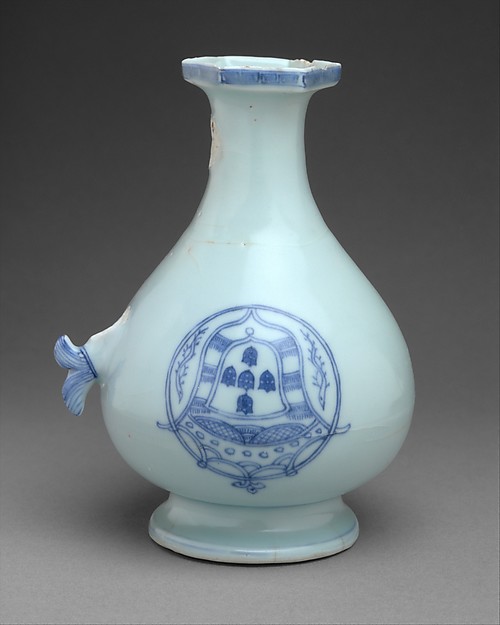

Item 21 - Ming-ware made for export featuring an upside down Portuguese coat of arms.

As trade along the silk road flourished and the European market increased, the export designs become significantly more refined and targeted. For example, this bottle made between 1662-1722 is very Persian with it's use of void space and stylised floral geometric patterns (24). The shape is also reminiscent of Iranian bottles popular at the time.. The imitation wasn't one sided, with the European and Middle Eastern ceramic centers creating their own imitations of Ming-ware. For example, these porcelain bowls created in 1600-1620 (25) spawned Iranian fritware copies (26). in the 16th-17th century, Chinese artists appear to have started adopting the Middle Eastern and European penchant for inscriptions in their work (27)


European countries weren't the only market or stylistic influence on the Chinese export trade. number of Ming-ware items also feature Mongolian style cloud designs which are a dominant feature in Turkey's Iznik design style (15th - 17th century) 28293031. It seems that the Mongolian / Persian influence was quite extensive. This jar features archers wearing Persian style garments and is decorated with various vegetable motifs as well as images of European houses (32). This 17th century asymmetric dish shows the Chinese artists were also incorporating Japanese styles into their work (33).

Identifiable Chinese Design elements
The number 8 is considered lucky and linked to prosperity and wealth. This may be the reason why there is a distinct subset of Mingware incorporating 8 lobes of panels around the main decorative element (34353637). The lobes very often feature auspicious symbols like a double gourd, a fan, a drum or a scroll. This subset of Chinese porcelain is occasionally referred to as Kraak after the carrak's of the Portguese traders who brought the goods to Europe. Porcelain is light and significantly stronger than the earthernware available that was available in Europe. This, in addition to it's link to the Chinese emperor, increased it's appeal as a status symbol. A number of renaissance paintings contain a blue and white porcelain bowl or ewer as a background feature. Rarer are those that celebrate the porcelain itself. The bowl featured in Treck Jan Jansz's (38) painting can be identified as Chinese in manufacture due to a combination of it's thinness, the sheen captured by the artist and the decorative lobes in the glazing.

The production and export of porcelain by the Chinese was the most significant factor in perpetuating the blue on white colour scheme as ceramic art became more sophisticated through the Renaissance and the range of colours available increased. Cultures which had well developed ceramic industries either renewed or built thriving local markets for the BoW goods. Chinese Kraak items were imitated by the Dutch (39), the Japanese (40), the Portuguese (41) and the Japanese (42). BY the 17th century, even the Spanish, who had several manufacturing hubs and a number of celebrated artistic trends were producing blue on white items for local consumption.


Item 38 - Detail, Still life with pewter flagon and two ming bowls. Treck Jan Jansz, 1651, National Gallery, NG4562


Additional references:

Valenstein, S.G, 1989. A handbook of Chinese ceramics. Metropolitan Museum of Art.


Friday, 16 February 2018

Some Sancai things I really like


Sancai refers to a glazing tradition from China's Tang dynesty (~600-900 CE) which utilises green, purple and brown glaze. The glaze is lead based laid on white earthenware items. Due to the mobile nature of the glaze, if often has carved borders to assist in retaining the glaze. Some scholars suggest the Chinese dishes influenced the sgraffito work of Europe.
The final image in this post indicates that even when the art forms of glazing was highly refined, the translucent green was utilized despite it's dubious nature.

Monday, 17 July 2017

Qasam and the Kashani cobalt

As outlined in previously, Kashan, Iran seems to be the initial production site of Blue on White ceramics. This is due to Kashan's proximity to a source of cobalt and other minerals useful in creating glazes. The Kashani cobalt originates from Qamsar aka Ghamsar which is located in the hills south of Kashan. Ghamsar is located proximal the the boundary between the Sanandaj-Sirjan Zone (1) (associated with the subduction of the Neo-Tethys Ocean) and the Urumieh-Dokhtar Arc. The U-D Arc hosts porphyry copper-gold deposits (2) as well as epithermal lead-zinc deposit (3).

Figure1: Geology of Iran - adapted from Geology of the Sari Gunay Epithermal Gold Deposit (4). The blue star marks the location of Kashan and to the south, Ghamsar (aka Qamsar).

The cobalt in Ghamsar is formed as part of a skarn deposit (5) resulting from the intrusion of a microdiorite into the Qom Formation. For non-geologists, the limestone in the Qom Formation is dissolved by the hot hydro-thermal fluids originating from intrusion of diorite, a volcanic rock. The contact between these two rock types metamorphises and recrystalises becoming the skarn deposit. The mineralology of a skarn is determined by the composition of the hydrothermal fluids and the limestone. The Ghamsar deposit appears to be structurally controlled, with the mineralising fluids travelling through faults. The cobalt is spatially associated with magnetite veins in the faults however the cobalt may precede the magnetite ore. The cobalt (smaltite) likely took the form of a silvery metal and would have been locally processed and washed before transport. Cobalt glaze requires less than 5% cobalt to achieve a rich blue colour. Thus it is a valuable and highly transportable product. Given the comparative weights, the washed cobalt, and other metals, would have been transported to markets in nearby cities.

Summary: Due to the unique geological processes and structures involved, precitipation of cobalt ore is rare and unlikely to be accessible at surface in a form useful for glaze production.

As a side note, the presence of copper-gold in the area would have provided minerals for glaze and lustre while the nearby lead-zinc deposits allowed for the transparent lead glaze that resulted the beautiful underglaze ceramics (6).

Why Kashan rather than Ghamsar?


We can see why ceramics are produced at Kashan instead of Ghamsar, the source of the ore, by consulting a soils map. Figure 2 indicates that the soils around Ghamsar are calcareous lithosols which are calcium rich, and often contain chunks of partly or fully unweathered rock. They are calcareous (calcium rich) as their parent rock is likely the limestones of the Qom Formation. Kashan, on the other hand, has a source of salt marsh soils. Salt marshes are a low energy environment which accumulate sediment over long periods of time. Marsh soils are typically fine grain and well sorted, these appear to be grey and low in organic matter. Small grain clays require less work for the potter to purify and create into fine earthenware. The clay would likely have been dried, ground and sifted before being utilised.

When creating blue glaze, cobalt commonly composes <5% of the overall blend (8). The low concentrations required make transporting the washed cobalt the short distance to the source of clay highly viable.


Figure 2: A map of the soils of Iran indicates which medieval towns would have superior clay. (7)


1: A new tectonic scenario for the Sanandaj–Sirjan Zone (Iran) 2005 A. Ghasemia, C.J. Talbotb Journal of Asian Earth Sciences.

2: Porphyry Copper Deposits of the Urumieh-Dokhtar Magmatic Arc, Iran. 2005. A. Zarasvandi, M. Zentilli, S. Liaghat. PGS Publishing, Linden Park, 2005. pg 441-452

3: The Ay Qalasi deposit: An epithermal Pb-Zn (Ag) mineralisation in the Urumineh-Dokhtar Volcanic Belt of northwestern Iran. DOI: 10.1127/njma/2015/0284

4: Geology of the Sari Gunay Epithermal Gold Deposit 2006 Northwest Iran. by J.P Richards, D. Wilkinson and T. Ulrich. Economic Geology. DOI:

5: Ore Mineralization at Qamsar Cobalt Deposit:Skarn and Metasomatism Evidences .  Hadi Mohammaddoost, Majid Ghaderi, Nematollah Rashidnejad-Omran  The 1st International Applied Geological Congress

6: Islamic pottery, a brief history. Metropolitan Museum of Art.

7: Soils of Iran 1961. M.L Dewan, J. Famouri. Food and Agriculture Organisation of the United Nations. 

8: Ceramic Arts Network, accessed 31/12/2018.

Tuesday, 13 June 2017

Squwark plate

I made a plate for my friend Phillipa. She's pretty awesome and loves her chickens so when I found the following image I couldn't help but modify it. I believe the original is supposed to be peacocks, but their little bug eyes and beaks made me think of chickens. So they became chickens.

Bowl. Iran, Nishapur 10th century. Earthenware, buff slip, underglaze slip-painted,. LACMA M.73.5.289. (No direct link is possible, check out items 30 and 52 of 99)

The LACMA have two bowls in this style. The other one (M.73.5.266) has a lot more intricate detail but a similar peacock shape. The buffware with this figerative style is specific to Nishapur, Iran. The Meteropolitian Museum of Art conducted a number of digs in the city in the early 20th century and recovered numerous artifacts (1). The style is closely linked to sgraffito but lacks the incised decorations (2). A good example of sgraffito ware can be found here for those curious as to it's styling.


The finished plate complete with a variety of personalized chickens.
I've been doing a number of yellow and green items recently. I quite like the colour combination, but I'm also aware there a much more experienced artist who produces sgraffito in my Kingdom, Alex the Potter. Since I don't make my own bisque yet, I'll be steering clear of sgraffito and limiting my emulation of buff ware.

I'm really happy with how this turned out. The green/yellow/white/black contrast looks great and is appealing to modern tastes as well. I only hope Phillipa likes it as much as I do.

1) The Met at Nishapur. http://www.metmuseum.org/toah/hd/nish/hd_nish.htm
2) Sgraffito from Nishapur. http://www.metmuseum.org/blogs/ruminations/2015/production-history-of-sgraffito-ware-from-nishapur

3) The extant plate - http://islamic-arts.org/2011/ceramic-vessel-collection-at-lacma/

Saturday, 20 May 2017

Belated ceramic 48 & 49 - Tiles 12, 13, 14, 15 & 16

The tile project is ongoing! I collected four new tiles this April and I'm so happy with how the design is going. I'm going to start posting my reference chart as well as boast about my project. Forgive the not so amazing picture but it's the best I have.

One of the small 1/4 cross tiles isn't show here as it doesn't have it's matching stars yet. The key (belated) tiles are the three in the bottom left of the image.


Two of the tiles are from one reference panel, the third on the panel is already featured on the right of the middle row.

Lustre tiles. 14th Century. Kashan, Iran. The British Museum. 1888.0109.4

Monday, 23 January 2017

Ceramic 53 - Montjoye jug

I acquired a bisque jug a while back and have been stuck for an appropriate design to place upon it. I trolled the internet for reference images of extant items that had the right shape. Originally I was thinking of converting the central image on the jug (Figure 1) into a household of fighting badgers but in every trial sketch they ended up looking like teddy bears.

Figure 1: Jug, Montelupo, 1480, Tin glazed earthenware painted with metal based colours. V&A, no. 1568-1855

Inspiration:
So I decided to go looking for more inspiration. I found it. A friend of mine, Montjoye, who I admire quite a bit, posted a flurry of things on her blog. One post caught my eye because it was regarding the recent acquisition of some blue and white ceramic item for her kitchen. Given my enjoyment of blue and white, I decided to make her a blue and white jug because she brews some very tasty stuff.

So, many museum collections later I amassed a number of pinterest images I found inspiring, nothing was a 100% match for the jug shape that I had, but there were quite a few jugs, drug jars and miscellaneous items that were in the ball park. I also had a time frame restriction as Montjoye camps with a group that try to be mid-medieval in every way.

There are a number of drug bottles, jugs and vases that do feature blue and white, but the designs just didn't appeal to me. The key inspiration (figure 2) was chosen due to it's simple 2 colour motif which would convert well to blue, black and white.
Figure 2: Drug bottle, Italy, Tin glazed earthenware, date unknown. V&A no. 629-1902

Timeframe:
The inspiration jug has no date, but appears to date between late 14th century and early 16th century. That is a rather large time frame but I believe it's closer to the 14th century for the following reasons: The late 14th century examples have a similar pallet of colours and a similar consistancy for application (layers can be seen in the green leaves above). The early 16th century example, is much more ornate in it's design with multiple shades of blue, yellows and oranges (i really like the wyvyrn in this one). It also features a neat little twisted spout holder which gives it a cute flare. One final reason I believe it's closer to the 14th century than the 16th is shown in Figure 3. This jug has the right shape however it seems to be one of the earlier examples of the high firing colour pallet. The yellow, blue, green and manganese brown/purple suggest  this jug is the mid point between the early 16th century highly crafted majolica and the reference jug. So I give the jug in Figure 2 a date range of 1400-1450 ish.
Figure 3: Drug jar, Italy. Tin glazed earthenware with high-firing oxides. 1450. V&A no. 1222-1901

Motif:
Many of jugs I examined feature writing around them. The text usually designates what the contents of the drug jar is, for example - SYo DI PAPAVARI = syrup of poppies, SYo DE FARFARE = syrup of coltsfoot (tussilago). I considered translating alcoholic beverage, or spirit of grain or some such into Italian but that would sort of lock down the use of the jar. This was the intention of the original jars as a measure to prevent residue of one drug mixed with another but not required for this project. I could have removed the text, but that would have done away with the key feature of the jar. Instead, I decided upon labeling the jug with her name, Montjoye, as she does with her alcohol bottles..

The next challenge was getting the characters in the text right. I downloaded image after image and copied all the writing forms as Master Piers taught me years ago. I wasn't able to amass an entire alphabet and there was a huge variation in character forms between the jugs I was able to find. So I could either use a mishmash alphabet which spanned about 100 years (badbad), pick one and try and fit the missing letters in, find an extant alphabet from the right time and use that, or come up with something else.
I decided to copy the text form that Montjoye uses on her bottles (and had on her website at the time). I was able to download a copy of a picture of one of her successful brews and figure out the lettering from the computer screen. I'm pretty happy with how the kerning turned out.

I also placed three trefoils on the jug, as they are a key feature of her device. I think the motif came out less crowded than the Italian-ware and strikes me as more of a spanish take on an Italian jug.

All in all, I'm happy with this project and I hope Montjoye gets much use out of it as a jug or a vase or whatever. The best thing about gifting ceramics is if the recipient doesn't like it, they can accidentally smash it and I'd be none the wiser. My general dislike of repetition means they're unlikely to get an exact replacement anyway and I'm always open to suggestions!

Wednesday, 5 October 2016

Ceramic 47 - Tile 11

This one collected dust for a while. That is to say, the plastic I wrapped it in after it was glazed and dry collected dust as I didn't have an opportunity to drop it off to get glazed for months. This is the start of the top corner. I'm not sure if I'm going to finish the entire square but I do hope to finish at least the top half.


Ceramic 52 - Nyssa's household plate


 Sketches of wolf anatomy by J.C. Amberlyn

This plate has been on the go since I completed Vandels plate in 2013!. I started the two at the same time but Nyssa hadn't registered her device yet so I didn't want to make the plate until she had. After registration, I'd sort of lost interest in this project because it was at the time consuming central blue bits stage and I'd already done two of these. I have a very short attention span. This plate, in it's half finished form, moved house with me three times before finally ending up in Perth. I decided Nyssa's birthday was the perfect reason to finally complete this thing so I could stop worrying about scratching the underglaze and give my friend something she'll hopefully use at every future event. I like the fact she and Ro have a matching set now.

 Nyssa's banner by Lasy Elizabet Hunter.

Nyssa  device is, quarterly purpure and sable, a wolf statant and a bordure argent. I had a bit of trouble with the device as heraldic wolves tend to be a little too dog like. I was tempted to copy the wolf that Lady Elizabet had used for Nyssa's heraldic banner but I didn't think the outlines would work as well in the size I was working on. I was also worried that the underglaze wouldn't allow me to make the fine shapes I needed to do. After much googling and a number of sketches, I decided to go with a smidge of viking knot work to tie in where her Norse name.


I also received some great advice at the Laurel Prize Tourney this year which was to investigate the skeleton of any animal I plan on drawing to work out the most realistic body shapes. This was specifically for jaw lines so my badgers would stop looking like racoons but the same concept apples to any animal. I purchased Drawing Wildlife by J.C. Amberlyn. It's a great book which shows skulls and skeletons of many creatures as well as fur patterns and postures. It takes you through how to draw particular animals step by step. I found it amazingly useful!


I wanted to honour Nyssa's viking persona and have a wolf that looks more wolfy than the typical heraldic wolf so I did some sketches and practiced and practiced.

Finally, I was able to paint the plate and drop it off at the team at Glaze It for firing. Of the three plates in this series so far, I am most happy with this one! I'm also pleased that Nyssa and Rohan have matching couples plates. I don't often make sets but when I do the satisfaction is -almost- work the tedium.


Sunday, 17 January 2016

Plate - 14th century Sultanabad

I've been rather quiet these last three months as I've been moving across the country and am still finding my feet in this new city. I have now found a place to rent and my furniture gets delivered in three days! I am enjoying finding all sorts of new things but last weekend I thought I'd try something new and old at the same time. I had passed through a homewares and overpriced duct collectors shop and found the sales lady painting white plates with some sort of commercial poly-paint. I've seen this stuff before, you paint it on, put the item in the oven and ta da - customized item. Unfortunately, the paint doesn't really stand up to wear and tear, the Stormhold Baronial plates haven't really withstood knives, forks and hand washing by people not told about their special needs. This is why I prefer to glaze my plates rather than buy the ceramic paint from spotlight. True, this restricts me in size, shape and I need people to fire it for me but the end product is much more durable. I've decided that finishing the A&S 50 challenge was enjolyable but I'm not done with the ceramic painting yet. So, I need to find someone in my new city who can supply the bisque and fire the finished products for me. Or make arrangements to get the my bisque to Melbourne for firing and collection by a friend.

So last weekend, off I went to All Fired Up in Joondalup. I've mentioned this place on my 'where to make your own ceramics' list for a while now so I thought it was the perfect first candidate for a replacement ceramics facilitator (i only have two candidates). So I saved a number of reference images from the Met Museum on my iPhone and off I rode (image 1). I arrived at noon, spent half an hour browsing their limited stock of bisque before settling down to another project. When I went I had no real plan in mind as I wasn't sure what sort of bisque range they'd have (small). I was there until closing (5pm) and finished the front of a plate and made an attempt at the back.

The blackwork outlines complete. I was tempted to finish here because the grey and white looked so lovely and balanced just by themselves but I knew it'd fire to black and throw the look off.

The blue is complete. Note the solid look of the blue over the black. The original used transparent glazes in blue and turquoise of the Saltanabad style. This is really hard to replicate using opaque glazes so I aimed for a wash and hoped the fired results would be satisfactory.
Finished! Well balanced and really happy with the front.

 The center of the design - surprisingly balanced for a free hand experiment.


Replicate or create original designs?
This is always a question I ask myself when creating something new. Should I replicate an original extant item I'm really taken with, or should I use design elements from a specific time/place and design my own items? I think every SCA artisan asks themselves this same question and I believe the answer comes down to, will the item be fit for purpose? SCA items seem to fit into two categories, 1) cheap make do items for a single or short term use or 2) expensive or hand made items design to hopefully last an SCA lifetime. The items in the second group are not used on a daily basis and are often expected to last for years beyond their more often used modern counterparts. For many people in the SCA, a ceramic item that is fit for use must look medieval. For some people this means old, worn or clearly handmade (see previous rants), others want ceramic items that fit their game, either referencing their personas storyline or featuring their heraldry. The final group of SCA users want items that completely replicate medieval items.

I feel that I make items that generally fit into five categories.
a) appropriation, the grotesques are an example of this. I copied images from manuscripts into a new medium. They are the least medieval ceramic thing I've made (let's not count the escher plate).
b) adaption, I count my early household plates in this category. The elements came from a number of related sources but the combination was created to meet a specific need.
c) insertion, Into this category I fit the Gabs & Stanzi plates. The design and a majority of the plate were period replicas with small elements of heraldric symbols to craft something appropriate for the leaders of my other household.
d) replication, I have replicated the designs on many of my A&S items straight from the originals adapting them only slightly so they'd fit on the bisque available. This Sultanabad item is one such item.
e) creation, the items I'm often most proud of, the Dr Suess bowl and plate fit into this category. These items are inspired by their medieval counterpart but the design is very much original.

Extant reference - Bowl, Il-Khanid, Iran, Sultanabad. 14th century. Freer Slacker, S1997.129.

Thursday, 31 December 2015

A&S 50 wrap up, tables and factoids - oh joy!

A&S 50 has come (by far) and I have completed my challenge. There are still a few items in the queue for firing, and some individual items for 33 are still waiting completion but on the whole I believe I have successfully met this challenge. I have taught myself how to paint ceramics. I have learned a variety of techniques and tools. I have also reached a great many individual items and cultures. I entered two Fields of Gold A&S competitions and one Kingdom competition, placing first in one FoG and one Kingdom competition. I have given away the vast majority of items or donated them as fighter auction prizes. I have learned a significant amount about blue on white ceramic objects and have applied this knowledge not only to my ceramics work but also to deducing time periods depicted in medieval art. I still have at least three more essays on BoW items to go with Uzbekistan, Italy and China still in draft form.

Below I have summarised my projects in a handy dandy table but for those who don't like tables as much as I do, some reflections.
  • I'm still in love with Sultanabad, mostly because of the blue and turquoise colours.
  • I love Kashan tiles but this project is probably too big for me.
  • I've made a lot of Italian and I believe this is because the opaque palette I have to work with fits the maiolica style best
  • Pretty much everything is after the 1300's because this is when ways to fire polychrome items in a stable manner were invented.


Plate Item Style Culture Age
1 My household plate Lusterware Spanish 15th C
2 Gabriel's Plate Tin Glazed earthenware Spanish, Seville or Valencia 1525-1550
3 Constanzia's Plate Tin Glazed earthenware Spanish, Seville or Valencia 1550-1600
4 Relief experiment Lusterware Spanish, Reus 1575-1600
5 Ibis plate Luserware Spanish, Manises 1525-1575
6 Drollery plate 1 Illumination N/A  N/A
7 Drollery plate 1 Illumination N/A  N/A
8 Peacock plate Stonepaste with under-glaze decoration Syrian 12th C
9 Dove plate Earthenware Iran 14th C
10 Rohans household plate Lusterware Spanish 15th C
11 Hare and artichoke bowl Tin Glazed earthenware Italy, Florence 1450
12 Mirriams serving plate Tin Glazed earthenware Spanish, Manises 1400-1450
13 Tile 1 Stonepaste with lustre over white underglaze Kashan, Iran 1263
14 Tile 2 Stonepaste with lustre over white underglaze Kashan, Iran 14th C
15 Tile 3 Stonepaste with lustre over white underglaze Kashan, Iran 1260-1270
16 Tile 4 Stonepaste with lustre over white underglaze Kashan Iran 13th C
17 Tile 5 Stonepaste with lustre over white underglaze Kashan, Iran 14th C
18 Tile 6 Stonepaste with lustre over white underglaze Kashan, Iran 13th C
19 Tile 7 Stonepaste with lustre over white underglaze Iran 13th C
20 Pheasant Plate Stonepaste with overglaze lustre Kashan, Iran 12th C
21 Escher Plate Geometrical line drawing with  pigment Modern Modern-ish
22 Tile 8 Stonepaste with lustre over white underglaze Iran 13th C
23 Fox Plate Wooden plate with gesso and varnish Egypt 13-14th C
24 Tile 9 Stonepaste with lustre over white underglaze Iran 13th C
25 Tile 10 Stonepaste with lustre over white underglaze Iran 1262
26 Iznik Plate Polychrome underglaze Iznik 1575
27 Janet's Plate Lustreware Manises, Spain 1400-1450
28 Cat Cup 1 Lustreware Manises, Spain 1400-1450
29 Cat Cup 2 Lustreware Manises, Spain 1400-1450
30 Stromhold Fidchel board Carved wood Isle of Man 10th C
31 Peacock cup Polychrome underglaze Italy, Florence 1515
32 Janets Bowl Lustreware Manises, Spain 1400-1450
33 cups* Polychrome underglaze N/A N/A
34 Krae Glas Baronial platter Polychrome underglaze Italy 1525
35 Aneala cups Polychrome underglaze N/A N/A
36 Aneala plates Polychrome underglaze Italy 1525-1530
37 Dr Suess bowl and Plate Cobalt underglaze Italy 15th C
38 BoW Iranian cup Cobalt underglaze Iran 1450-1500
39 BoW Turkey cup Cobalt underglaze Iznik, Turkey 1550's
40 BoW Spanish cup Cobalt underglaze Spain 1550's
41 BoW Italian cup Cobalt underglaze Tuscany, Italy 1575-1625
42 Bowl for Tamar Polychrome underglaze  Italy  16th C
43 Plate for Tamar Polychrome underglaze  Italy  16th C
44 V's cup Cobalt underglaze Valencia, Italy 15th C
45 Foxy bowl Lustreware Sultanabad, Iran 13th C
46 Plate of love Polychrome underglaze Italy 1550's
47 Tile 11* Stonepaste with lustre over white underglaze Kashan, Iran 13th - 14th C
48 Tile 12* Stonepaste with lustre over white underglaze Kashan, Iran 13th - 14th C
49 Tile 13* Stonepaste with lustre over white underglaze Kashan, Iran 13th - 14th C
50 Starwars maiolica Polychrome underglaze Deruta, Italy 1525
         
* Items 47, 48 and 49 still to be fired
* Collection of items for 33 half way completed & delivered