Showing posts with label Patterns. Show all posts

Thursday, 3 October 2013

Embroidered cushion Mk II - Complete


I finished the embroidery on this cushion a couple of weeks ago, it just took me a while to get the zip in and finish the sewing. I've completed this just in time too, I'm moving house soon so everything is in packing chaos and I've found so many UFO's I'm being buried by the pile! I fixed the zip issue with this one by using a 59 cm long zip rather than a 61cm one. The pillow fits well in the case and is just squishy enough. It goes nicely with the first one too (which you can just make out in the background). I still haven't bought a walking foot so I'm not going to try sewing gorget again anytime soon.

I'm really happy with how some of the squares turned out. I'm especially happy with the argyle sort of one (top left), the check (upper right middle) and the circles (lower left). The design I'm most happy with is the spiral (image below). I got the idea from Dimity's Fibre Adventures, a blog I stumbled upon when looking for examples of button hole stitch. Her spiral was made with buttonhole stitch and beads. I didn't incorporate the beads, lord knows I have plenty) because I don't want bead patterns on my face when I nap on this cushion. I also like the texture of the larger stitches and I didn't want glass or plastic interfering with that.
I made my spiral by sewing the spiral in running stitch. Then I went back and made each stitch a square U shape and placed a long stitch between them.


Though I've got to finish some items from my UFO pile, I'm thinking of making more experimental cushions.  Suggestions are always welcome!

Sunday, 11 November 2012

Mamluk peacocks - Embroidery chart


Mamluk embroidery, 1250 - 1517. The original was linen embroidered with blue silk in pattern darning in running stitch.


Peacock from page 41 of "Embroideries and samplers from Islamic Egypt" by Marianne Ellis. Most (?) of the items come from the Ashmolean Museum The items cataloged in this book can also be seen here.

My first ever attempt at charting a pattern. Rather than make the 'weave' square, I have elongated the x axis as the original pattern was sewn over two threads of the ground fabric and the x direction was slightly wider than the y. I'm sure this has something to do with the tension / set up of the loom but this is an area where I completely lack for knowledge.

Sunday, 16 September 2012

Paisley Roundup II

I'm still collecting ideas for my aari work. Paisley type motifs seem to be very popular even though I haven't found all that many dependable documented items. These three are a little dodgy on the dates but are still quite nice.


An old Ajrakh block-printed piece from Sindh, Pakistan in the V&A collection. I haven't been able to find it myself. I'm not sure how 'old' is old. I like the circular motif even though it's not a paisley.


(Original) From Riches to Rags: Indian Block-Printed Textiles Traded to Egypt 13th- to 17th-century Indian cotton trade textiles found in Egyptian sites. I've replicated the 'tree motif' which is quite a nice paisley too.


 (Original) From Riches to Rags: Indian Block-Printed Textiles Traded to Egypt 13th- to 17th-century Indian cotton trade textiles found in Egyptian sites. A simple teardrop paisley.

Wednesday, 12 September 2012

Paisley roundup I

I've started researching designs for aari work. There are many ideas out there but not so many medieval examples that I've found. For my first few samplers I'm going to think small so I've setteled on paisley / mango patterns which seemed popular in medieval India.


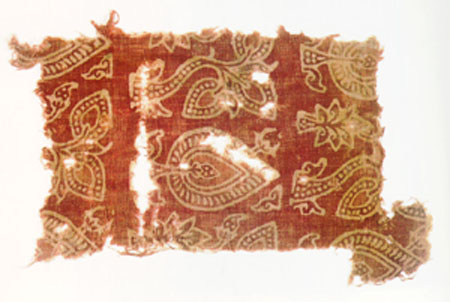
(above) A material fragement from Kelsey Museum of Archaeology. From: Indian Block-Printed Textiles Traded to Egypt 13th- to 17th-century Indian cotton trade textiles found in Egyptian sites Exhibit. No date is stated. It seems the Kelsey Museum is rather poor at showing dates for online items.

I've patterened four different motifs from this fabric, three paisley type  items, which when viewed in context are more likely representing trees and plants, and a rondel sort of thing. Stay tuned for more randomly inspired paisley patterns!