Showing posts with label Review. Show all posts

Tuesday, 6 August 2013

Iznik Pottery and tiles - a review

Iznik pottery and tiles in the Calouste Gulbenkian Collection, ISBN: 9789728847583

This book includes a brief history of the Calouste Gulbenkian collection and discusses different types of decoration in chronological order. Mention is made of the extent of Chineese influence on the Iznik styles as well as the positive outcomes of increased local demand and export. The second half of this book is dedicated to tiles looking at large panels, freizes and border tiles. The book discusses stylistic evolution and follows the use of 'traditional' forms and the inclusion of new symbols. Also highlighted is the evolution of the color pallet for which Iznik tiles are prized. Some lovely examples of experimental forms are included in this book such as a lovely tankard featuring salmon pink flowers (below).
The images in this book are beatifully presented with a good range of extant pieces so the reader can follow the evolution of the style. Information is provided t a level a non-expert would be comfortable with but enough additional references are included so that this becomes a good reference book rather than a pretty coffee table book.
9.5/10

Tankard, Turkey ca 1550. Item 17 in Iznik Pottery and Tiles. Inv. no. 834 in the Gulbenkian Museum collection.


Additional personal notes:

1520 - Turquoise was introduced into the Iznik pallet in the second decade of the 16th century (page 33). Previously, blue and white dominated the colour scheme, a trend adpoted from China
1530-1540 - Sage green (the third stage of evolution) came in
1540 onward  - violet was introduced (page 35)
1550-1570 - 'experimental stage'  uses dark and pale blue, violet, aubergine, light grey and olive green as well as lavender blue.(page 44)

Wednesday, 12 December 2012

V&A's Indian Court Painting

 An Introduction to Indian Court Painting by Andrew Topsfield.
ISBN: 0112903835

This book provides a good introduction into Indian Court painting, mostly during the Mughul period. With 28 colour images, the book covers the evolution of iconogrphy and techniques. The author provides a good explanation of the social and cultural pressures resulting in the changes in the painters art form, such as the influence of various Muslim rulers and the introduction of Western styles. The images pictured in this book range from the 15th century to the 18th. Due to humidity and other destructive forces, very few painted works are available prior to the 17th century. The author does a good job at capturing the compelling nature of these miniatures. The book is divided into sections, the mughul school, painting in the Deccan and Rajput painting in Rajasthan to name a few. Each section contains some good background information on the region and major political influences on the art world. The author also provides a good list of further reading on this subject. All in all, a good starting point for someone viewing a Mughul painting exhibition or starting their research in this area.

From an SCA perspective, many of the images contained in this book are post 1660. The handful of images that are available are full of intricate detail. It is just unfortunately that this book is B4 size so many of the images are too small to see the full detail properly. Andrew has selected some wonderful representations from the V&A catelogue and displays his expertise with a well written background on the socio-political impacts on the art form. He provides a good basis for additional research and assists the reader by providing a solid "further reading" section.

3/5

My favorite image from this book. pg 10. The chaste monk avoids the lures of women. From the manuscript of the Uttaradhyayana Sutra, Cambay, Gujarat. c. 1450. I love the colour and detail of the womens outfits as well as the sense of movement and grace the artist has managed to give them.

Sunday, 9 December 2012

South Indian Paintings - a review

South Indian Paintings by C. Sivaramamurti. ISBN: 8123000529

South Indian Paintings is written by Calambur Sivaramamurti who has authored many books featuring artworks of the Indian subcontinent. This book, first printed in 1968, is an excellent product for its era. It contains many full colour images of a variety of paintings as well as black and white line drawings of the authors interpretation of damaged works. The authors starts with an In depth view of painting in India, the use of colour and the process of painting itself. He then presents the works of art, sorted by culture and time making direct comparisons of different locations where relevant. He starts with Vakataka (4th-6th century CE)  to the Mahratta (19th century). He wraps up with a list, and description, of the schools of Indian painting and their styles. As this book was printed in 1968, it lacks computer enhanced imagery however Sivaramamurti’s descriptions of the artworks and the themes within them make up for the lack of detail in earlier works. I only wish that books by Sivaramamurti were more easily available.

From an SCA perspective this book has some lovely reference images. The author provides a nice cultural background and explains the theme of each image presented which is highly useful. Though some of the images can be found on the internet they usually lack background information which Sivaramamurti provides in spades.

From a personal perspective, I was disheartened to find that there is only one image, 1/3rd of a page for Kakatiya (11th - 13th century), which is the area and time I'm currently interested in. The author does however mention the inaccessibility of the Tripueantakam temple, I'm hoping this has been rectified in the last 50 years since print.

4/5

The back cover of South Indian Paintings. A quick search turned up no reference to this image however the sari's worn by the women have a very pleasing selection of decorations, from geometrical to floral.

Sunday, 2 December 2012

Samplers from V&A - a review


Samplers from Victoria and Albert Museum
Clare Browne and Jennifer Wearden
ISBN 10: 1851772901

This is a beautifully presented book showcases embroidery samplers listed chronologically from the 14th century to the 19th century. It contains 112 coloured images of embroidery and lacework from a variety of cultures (from English to Moroccan). A number of inserts showing additional details are included. The predominant stitches in each piece is listed in the index as is the museum accession number so interested parties can check the V&A website for additional images. In many cases, the images in this book are clearer than those available on the website. The authors introduction includes a brief but concise history of sampler work, highlighting some of the more interesting pieces in this collection. The back of this book includes a stitches and techniques section which examines all of the different techniques utilised in the samplers. The glossery also has some great black and white images showing how each stitch can be achieved. This book is a great inspiration and anyone interested in creating their own decorative embroidery work should purchase it. Only 45% relevant as SCA documentation.

3/5


Plate 3:. Linen embroidered with silk (like most of the samplers in this book). English, 1598.

From the V&A website regarding this example (information not available in the book):

This is the earliest dated British sampler to have survived, and its inscription commemorates the birth of a child, Alice Lee, two years earlier. Its maker, Jane Bostocke, who is known to have been a cousin of Alice's and was buried in the village where she lived, may have lived in the Lee family household. The motifs at the top of the sampler relate to their family crests. The sampler is from a period of transition in the practical use of such items - between the 16th century and earlier, when they served as a reference piece for a more or less experienced embroiderer, and what gradually became their nature in the 17th century: a method of measuring and recording the maker's skill.

The embroidery is worked in cross stitch and back stitch but there are examples of work in more complicated stitches showing that the back stitch was intended to be a grounding for further elaboration. Other stitches include satin, chain, ladder, buttonhole and detached buttonhole filling, couching in patterns, coral, speckling, two-side Italian cross, bullion and French knots and beadwork.

Tuesday, 27 November 2012

van Eyck by Till-Holger Borchert - A Review

van Eyck
Till-Holger Borcher
ISBN 10: 3822856878


Van Eyck is the painter behind the Arnolfini Portrait (1434) which depicts the wedding of a young couple in exquisite detail. His work features many portraits (my main reason for purchasing this book) and a number of religious pieces.  Though only 25 paintings can be attributed to van Eyck, this book details a chronological summary of the artists life and work. The author has also included a number of works that are termed ‘Eyckan’ which could be attributed to van Eyck. The author discusses the history of van Eyck’s style, his use of colour and light as well as his symbolism. Though my interest in this book is primarily in the pictures, the reasonably dense text provides some wonderfully supportive information. With 96 pages containing approximately 100 colour illustrations, I would heartily recommend this book to anyone interested in van Eyck’s work or history. For SCA types, the detail that van Eyck was able to paint is exquisite, the paintings make great references for jewellery and dress accessories.

4/5

Thursday, 6 September 2012

The Viking World - Review


 (above) A swedish pendant featuring a viking woman wearing a trailing dress and shawl. Beads hang from what is probably a brooch on each shoulder. Her hair is knotted behind her head. (page 114)


The Viking World by James Graham-Campbell, the 1980 version.

This book contains alot of good reference images, both photographs of artifacts and line drawings of the same. There are some schematic drawings of villages and women at work at bring all the information together in one image. A variety of topics are covered, from boat building to hoards and jewellery making. A large variety of primary sources are presented in this book. Well worth the read even if some of the conclusions are no longer up to date.

(above) Impressed gold foil from Norway of a couple embracing. The female on the right wears a long cloak. The males cloak appears to be held in a brooch over his right shoulder leaving his sword arm free. Page 114.  (below) 10th Century equal armed brooch from Birka. Page 116.


Strings of beads from Birka. page 118  Inner string of beads are made of imported crystal and carnelian.

4.5/5

Wednesday, 5 September 2012

The Macclesfield Alphabet Book - Review

 The Macclesfield Alphabet Book with introductions by Christopher de Hammel and Patricia Lovett
 ISBN-10: 0712358048

The Macclesfield Alphabet Book is a beautiful 15th century English manuscript which appears to be serve the purpose of a pattern book. It contains a range of alphabets including decorative initials with faces; foliate alphabets; a zoomorphic alphabet of initials, and alphabets in Gothic script. There are also large grotesque initials and a number of different types of borders (see below).

The manuscript was acquired by the British Library in 2009.

Grotesque on page 10


For those interested in reproducing medieval illumination this is an amazing reference. Images range from sketches, to outlines, to coloured peices and gold leafed sections. The range of alphabets has something to suite any work of art. The introduction discusses the Macclesfield Alphabet Book in terms of contemporary scribal work as well as other pattern books. The practitioners introduction has a wonderful discussion of the scribe and his tools. I was quite taken with the step by step process of creating a finished piece.

5/5


Coloured borders on page 45.

Thursday, 23 August 2012

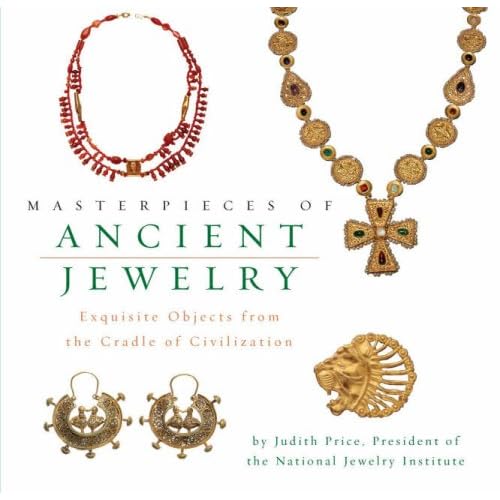
Masterpeices of Ancient Jewellery - Review


Masterpieces contains some lovely images of ancient jewellery. Some pieces are drawn from private collections so aren't usually available for study. The photographs in are detailed and highlight the glorious items featured in this book, from statues and stands, to earrings and pins.

The book is divided into sections concerning Mesopotamia, The Levant, Persia, Byzantium and Islam. Each section is prefaced with an interview of a leading archeologist in this specialty. The questions asked of the archeologists are very general such as "Tell us about the gods, the priests and the temples". I feel there isn't enough specific information provided in the text for this book to be labeled as a reference book. The text is formatted with x3 spacing, making it difficult to read and there is, at maximum, three objects per page and a lot of white space. For a book of 144 pages it contains surprisingly little information.

I consider Masterpieces more of a coffee table book than a resource.

3/5
 

Monday, 20 August 2012

Viking Designs - review

 
ISBN 13: 9780486404691 ISBN 10: 0486404692

Like most design books published by Dover, Viking Designs by A.G. Smith contains pages upon pages of black and white viking clip art. The publisher has also included an additional note which gives a enough of a background so as to furnish the lay reader with appropriate terminology to research later. "Borre-style pieces often show creatures with bulging eyes, triangular forward facing heads and large ears whereas Jellinge-style pieces the heads are slender, shown in profile and nearly always sport pigtails."
The book has 44 pages of images which range from interpretations of carved stone and wooden implements such as bedposts to tapestry and sword hilts. The clipart is clear and well drawn but due to their nature they cannot communicate placement and use of stones or enamel. Captions are frustratingly brief. Some objects are titled such as the Sutton Hoo items, however there is no list of extant sources. I would LOVE to see this book reprinted with the interpretation side by side with the original artificat. The scientist in me also wants these diagrams to come with a scale.
A good book for those wanting inspiration for Viking themed craft-work or someone just starting to research the Viking period. A mediocre book for someone wanting a good reference book for historical research.

3/5

Thursday, 9 August 2012

Traditional Jewellery of India - Review

ISBN 13: 9780500287491 ISBN 10: 050028749X

This is a very well researched and interesting book, as you would expect from Oppi Untracht. The main focus is on tribal jewellery, with specific notes on the construction, meaning and evolution. There are many pictures throughout, both black/white and colour as well as schematic drawings. Perhaps could have dated some of the images better as it isn't clear if the 'traditional' items shown are just from the last two centuries or are older.

For anyone with an interest in tribal jewellery this book is a must. If you are interested in medieval jewellery from the Indian sub-continent this book provides great information on construction and tradition but has comparatively few images prior to 1600 CE.
4/5