Showing posts with label Spanish. Show all posts

Wednesday, 21 May 2014

Ceramic 27 - Janets Plate

  
Lady Elizabet Hunters device as interpreted by Countess Constanzia.

I've been thinking about this one for a long time. Janet (Elizabet) has been kind enough to make me some lovely silk banners with my device and the college device. Then, for November Crown, she made me a rather smashing pennant with the Kingdom populace device, the College of St Monicas Device, the household badger and my device. So I'm been keeping her in the back of my mind when I research designs trying to come up with something appropriate so I can thank her in kind. It's been a challenge because her device is argent, a domestic cat passant to sinister sable and a base gules. There aren't many 'good' cats on extant ceramics that I've found so far. I quite like this one, very catty, or leopardy I guess, but it doesn't fit her persona.
Bowl, Selijuk, Persian. Early 13th C. Black pigment under translucent alkaline glaze. Accession number: 65.231. Museum of Fine Arts, Boston.


I finally settled on the one below. I've had it in mind for a while. Lady Alliette originally linked it to facebook while I was researching Spanish plates. As you can see the background decoration is very similar to Mirriams serving platter which is convenient given they're in the same household. I was initially reluctant to paint this design because the cat itself is too pointy for my taste. Then I realised, that the aim of this plate was not to reproduce an extant sample, but to make something in a medieval style for a modern day use. So I adapted it a little.

Dish featuring a Cat. 1400-1450, Spanish, Manises. Tin Glazed Earthernware. 34.6x5.5cm.  Accession number 56.171.115, Metropolitian Museum of Art.

Adaptions: In keeping with Elizabets device, I have flipped the cat to sinister and painted the bottom third of the plate in red. I have retained the decorative elements (originally in lustre on the extant piece) and used them to tie the whole plate together. I have also adapted the cat from the pointy, toothy one above to something closer to the interpretation of her device that she likes best. I've retained the long legs but made the cat appear more fluffed up and protective which I think fits Elizabet better. Hopefully she'll use this one for many years before accidentally breaking it at a feast one night.
The finished plate.

Friday, 21 February 2014

Ceramic 12 - Mirriams serving plate


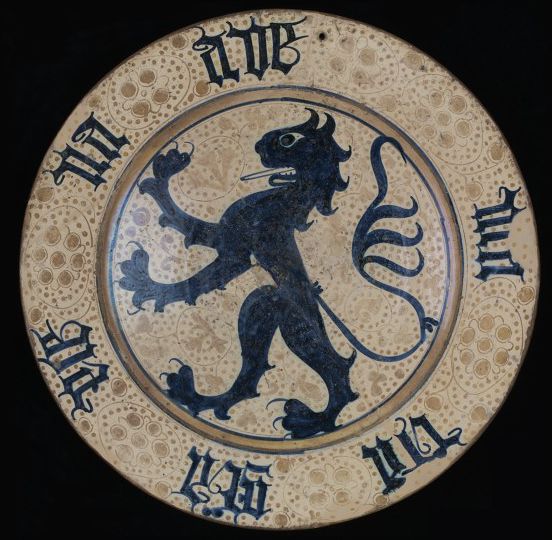
Dish - Manises, Spane. 1400-1450. Tin-glazed earthenware with lustre decoration, Item number: 1460-1870. V&A Museum.


I made Mirriams plate mid-last year. It was created as a prize for the table competition at one of the Winterfeasts I ran. I picked it up just before and event and delivered it that day. As a result I didn't get a picture, I haven't even seen the finished product!
It took me over a year to complete it because it was a large plate than I was accustom to (serving plate) and I had to make sure the design and colours suited her requirements (green). The design she chose was simple enough, a rampant lion but she also wanted a personalised motto - Agite primo recte. I will happily admit I have no idea what is written on the extant plate (hints anyone?).
So for this plate, I broke each word into two sections - Ag ite pri mo rec te. I then spent hours researching medieval hands (specific scripts and ways of writing) from both the time period and place. I couldn't for the life of me find something that looked like the very decorative script on the original. Then after a conversation with Waldo regarding woodgrain and the obvious impact on viking text I realised my mistake. The scripts I was researching were created with a quill. The shape of the quill, the viscosity of the ink and the absorbancy of the parchment would directly impact on the style of the script. The ceramic artist who painted the plate was using a brush with glaze, an entirely different medium. So, I stopped looking for scripts and tried to imitate the decorative nature of the text on the plate itself. I made up the script for the letters that I didn't have on the original and I joined a number of letters together to make sure they looked right. I then decorated the background in light green as I still haven't a working kiln for lustre experiments. I think it turned out quite well considering I didn't chose the subject matter. Mirriam seems happy with it so it's a successful project!
Also, I remember how much I dislike commissions, I hate feeling like I have to produce for a timetable.

Mirriam's finished plate - I think it's turned out quite well and is nicely balanced. The text isn't as florid as the original but that's important so the joined letters can be read.