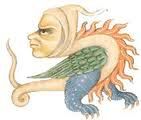
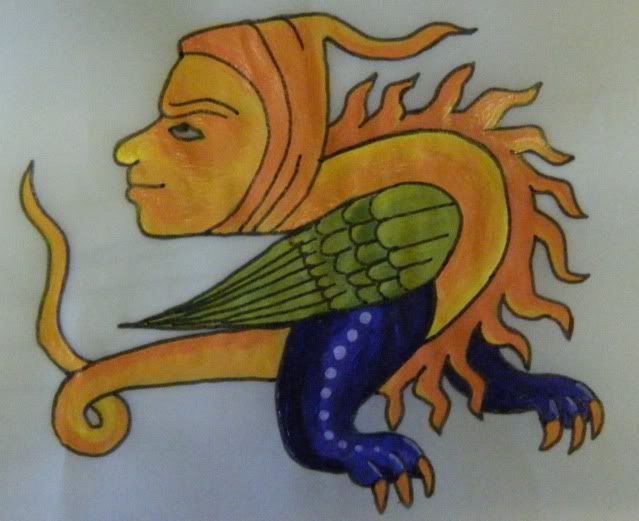
Plate 7 is another experiment in shading using a drollery image. This one is from Les Heures de Croy (the Croy Hours) currently in the collection of the Österreichische Nationalbibliothek in Vienna. I found a wonderful art blog which had posted a number of drollery images from the Croy hours (http://www.spamula.net/blog/2004/08/drolleries.html). The blog author had scanned the drollery’s from a book, Codices Illustres. As I have been having trouble to properly trace the previous drollery back to its manuscript I thought I’d try one of these instead (Figure 2). I picked this one for two simple reasons: I wanted to use blue (needing to take home the glaze for a different project) and I wanted to use some of the remaining yellow/brown from the previous drollery. This little guy seemed perfect.
 |
Figure 1: The vines used as inspiration. (San Marino, Huntington Library, HM 1100, f. 13, John on Patmos)
|
As the intent of this piece is to practice shading in different colours with the glazes I coloured in the back of the image with a 6B greylead and then traced the image onto the plate. Happily, the greylead burns off in the kiln. This meant I could maintain the proportions of the original image rather than having to freehand it like the last drollery. Having completed the drollery I decided the plate needed spiffing up a little. Though I sort of consider plate 6 and 7 to be a set, I didn’t want to do the same vines as I’d get board very quickly. So I cruised some images of illumination and found the perfect thing (Figure 1) and freehanded in onto the plate. In the before firing shot you can see the mess of greylead I left behind trying to get it right. At a loss for how to complete it, I took an idea from one of the Deruta plates and repeated the face of the drollery at the top of the page.
 |  |
Figure 2: The Croy drollery
|
Figure 3: My attempt
|
 |  |
Figure 4: The plate – pre firing. The greylead is visible
|
Figure 5: After firing. The colours become stronger and shading more evident.
|