Showing posts with label Pennsic. Show all posts

Sunday, 1 September 2019

Pennsic pottery achievements

I attend Pennsic again this year. I spent a lot of time hanging out at the Tudor House in the market place with Master Simon and all the amazing pottery people. I didn't help make the kiln this year as I was sleeping off a watch shift, but I was there for both firings. The first one didn't hit temperature. Master Simons thinks it might be because the woodbox tunnel roof sort of collapsed so it wasn't drawing properly. The collapsed part was dug out and the second firing went much better. The kiln was very crowded but everything seemed to come out generally fine.

I tried a new experiment this year. I was trying to make a quatrefoil cup because they have a very graceful form. I don't think I got the shape quite right though. It should cinch in under the foils slightly more. Then, not bad for my third ever item!

I did also try something a bit different with the glaze. I asked the blacksmith to crush up some malachite (copper carbonate ore) and some chrysocolla (copper oxide ore). I then mixed this with a clear glaze and applied it to the sides of my cup.


I now have a non-slip cup. It seems the chrysocolla had more gangue material (silica?) so left lumps on the side of the cup. The malachite, being a larger chunk of purer ore, turned into a finer powder so provided colour without texture. Very little copper is needed to achieve a good glaze.

I'm very happy with the outcome of this Pennsic and I'm looking forward to next time!
Left - malachite glaze; right - chrysocolla glaze.

Monday, 28 August 2017

Pennsic block printing haul - follow up

Remember my block printing haul from Joann's? I've started experimenting with them. The blocks are carved wood with the print surface sealed in a white (oil?) based paint. I had assumed this was the make the carving on the block easier to see for potential buyers but now I've experimented, I can see this has an interesting application. The white paints stops the wood from absorbing any of the paint so it doesn't dry out too quickly. Only a certain amount of paint will adhere to the shiny block reducing buildup concerns. Additionally, with my paintbrush-paint application method, paint collects around the edges of the block resulting in a darker outline for the shape. It could be quite effective if utilised properly.

Experimenting with design layout.

Thursday, 10 August 2017

Pennsic block printing haul

As you can tell from the recent flurry of posts, I attended Pennsic again this year. I also took the opportunity to goto Joann's. For those, like me, who reside in Australia, think of it as a cross between Spotlight and Bunnings for crafty things. Unlike Spotlight, Joann's store space is mostly taken up by craft supplies rather than home decorating items. I couldn't resist acquiring some cheap supplies for my block printing quest even though I was nearly at my baggage limit.


The haul includes 7 blocks - the three loose ones I got from a stall in Pennsic proper. I'm a little dubious about the pinkish rubber stamp as it's designed for ink/cards. I worry it won't be able to carry enough paint to be able to depict the fine details. If I thin the paint, it's likely to run into the fabric so it'll take some careful experimentation.

I also bought a rainbow of fabric paint colours. These were especially awesome, as I'm finding it hard to source a range of fabric paint colours in Australia. I decided to go with small bottles as the bigger bottles put my weight limit at risk.

Stay tuned for experimental updates!

Tuesday, 20 August 2013

Pennsic treasurers pt 2

Cream cotton sari drying on the line (strange concept for the Americans, older rentals don't come with white goods here, and we've got plenty of solar energy, in summer at least). From Garvi Gurjari, cost $12 USD.

I've just finished washing some new sarees in cold salty water as I didn't know if the dye would run. One of the hardest parts of coming home after Pennsic is dealing with the mound of wash. As Slippery Rock is so humid, even your clean clothes come home smelling musty after being trapped in a suitcase for 24-30 hours. Thus everything has to be washed, which is perfectly fine for the mundane items as they can be tossed in the dryer. The handmade garb needs to be washed carefully and line dried, a difficult prospect when you're returning to Melbourne winters which involve significant lengths of overcast cold weather and drizzle, and a sun that seems to rise and set while you're at work. Add to that the complication of washing and drying 10 lengths of 6-9 foot fabric with limited line space. The result: still finishing off the wash two weeks after returning from the event.

Brown, dark brown / black and green cotton block printed sari. The green lines appear to have been block printed on separate from the dark brown/black motifs. From Garvi Gurjari, cost $12 USD.

~


I'm not sure if Garvi Gurjari is a shop name or the name of the weavers/dyers of this sari. Google isn't helping much either. I'm going to assume the trader or maker takes their name from Gujarat. This is a north western state in India (above) and was a well known center for fabric crafts and trade in the middle ages. Many of the scraps of imported fabric found in Egypt are attributed to Gujarat. Below is an example of cotton block printed fabric that shows incredible intricacy and precision. I'll post at another time about the process of block printing, I may even try it myself.
While washing these two sarees, I half convinced myself they'd make beautiful Persian garb. Given I now have a plethora of sarees, I'm contemplating turning one of these two into a nice light under-dress/tunic. The block printing is lovely and perfect for the application. I'm also unlikely to wear a brown saree as I haven't an appropriate choli at this point. The only thing holding me back at this point is I've never sewn Persian garb before, and I'm really hesitant to cut up such nice fabric (I suspect this hesitation is also the secondary cause of my fabric stash).


Saturday, 17 August 2013

On Ikat

This year at Pennsic I was super lucky and managed to acquire some sarees from Flori of Northshield. She and her partner are moving back to the US from India and she offered to buy sarees for anyone interested on the SCA_India site. Given that I love the look of sarees, and I couldn't remember how many I had stored with Ronin I asked for 5, greedy yes I know. Flori was amazing , not only did she bring alot of sarees back to the US for us, she also labeled them with their source. She brought be 5 beautiful and varied new sarees one of which is an ikat saree in green and maroon.


I had never encountered ikat before but I loved the look so much, I bought some 'Persian' garb made out of ikat too. So, for those, like me, who have never encountered ikat before I present my notes made after returning home.


Ikat is the process of making cloth from pre-dyed thread. The thread is dyed in such a way that when woven it creates designs in the cloth. The process is very labour intensive as the threads need to be hand dyed in specific patterns before weaving. The Persian garb I bought was made out of double ikat were both the warp (up/down threads the weft thread is woven around) and the weft (left/right threads woven over and under the warp) are dyed and woven together to make a pattern. In the case of my Persian garb, there is no specific pattern rather a more modern take which features the colours and the weaving style. For more intricate patterns, the warp and weft are tied separately with cotton thread before being dyed, this is called double ikat. The thread is then removed and the warp/weft are retied and dyed again to create another layer of colour. Finally  after all the dye is applied, the weft is carefully strung and the warp carefully lined up and woven. Double ikat silk available in India and Indonesia is called patola (or single, patolu). Given I have trouble remembering if I'm on the third or forth coat of glaze half the time, I'd have a nightmare keeping track of which threads go where.

Arm of the persian top showing the texture of a random double ikat.

My new sari could be called double ikat as it has patterns dyed into both the warp and weft however these sections don't overlap and each creates an individual motif, either horizontal or vertical. Indian Ikat Textiles by Rosemary Crill (1998) includes some beautiful examples where double ikat has been used to feature designs such as elephants. In images of the more complicated and time consuming weaving, it's difficult to tell if the image is ikat or dyed on later. It's only when you look closely you can see the fuzziness that occurs when the dyed sections don't quite line up perfectly that you can tell. In the best examples, you can't tell without physically examining the fabric yourself.


Ikat is a old tradition that can be dated back to the Ajanta Caves in India. In the listening to the sage scene below, featured in Cave 1 of Ajanta, you can see various figures wearing striped cloth. The prince (?) wearing a garment made out of slightly fizzy arrow heads. Given the level of detail on other individuals, the fuzziness is assumed to be intentional and representative of the fuzzy outlines seen in ikat fabric. According to Crill (1998), Chandra (1960) was the first to highlight this, however that specific reference is rather hard to find. Crill (1998) suggests that arrows, broken and solid stripes and check patterns can all be found in the caves.

In summary:
1. Ikat is period for an Indian persona
2. Double ikat may also be period, more examination of images is required. Chandra 1960 suggests that 12th century Deccani sources reference double ikat.
3. The more precise and complex the dying, the more time consuming and expensive. This may have been a status symbol as well.
4. I'm glad I now have an ikat sari, thanks Flori!
5. Now you know why my last post was looking at sources of dye in India.


Resources and References:

Books:

Crill, Rosemary. 1998. Indian IKAT textiles. V&A Publications. 176. ISBN: 1851772421
Chandra, Moti. 1960. Indian costumes and textiles from the eighth to the twelfth century. Journal of Indian Textile History Vol 5.
Chandra, Moti. 1961. Costumes and Textiles in the Sultanate Period. Journal of Indian Textile History. Vol 6.
http://www.abebooks.com/book-search/title/journal-indian-textile-history/page-1/

(if you have a digital copy of either of the Chandra papers, I'd love a copy)


AMAZING resource for the Ajanta Cave 1, I'm still trying to navigate the rest of the website and find more (and see if I can access them without a student number). I'm also going to pin as many of these images as possible just in case they decide to block them.


Three useful websites which cover the basic concepts (not really good references though):


Friday, 9 August 2013

Pennsic teasurers pt 1 - Byzantine stuff

I just got back from my Pennsic pilgrimage and I managed to collect all sorts of treasures this year (yes, I went a little over budget). I got some delightful sari's from pennsic from Flori of Northshield. Some nice, possibly not very period, Persian garb and some random trinkets. The sari's have inspired me to find out more and attempt to document my newest acquisitions.

 First up: a birthday necklace that Dash bought for me (not pennsic treasure, but very close). It's been many years since I've received jewellery for my birthday. Dash commissioned the necklace from an Etsy seller as a replica of one in the Walters Museum. It's been created from recovered pieces from other necklaces. She's done a pretty good job and it's even in my heraldic colours!

 My new necklace: pearls, blue cats eye beads, red glass beads and silver doohickies.


The original Byzantine necklace from the Walters Art Museum. gold, malachite, sapphire and semiprecious stone. Item number: 57.54. From Egypt. 


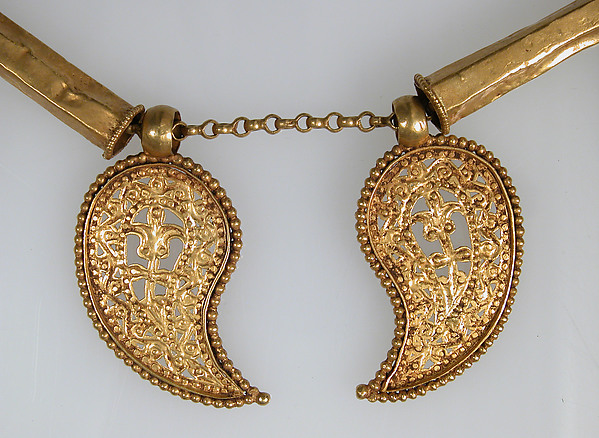
On the long trip home, I happened to traispe past the Met Museum of Art retail shop and I couldn't help being drawn in. It was hard not to buy most of the store. I ended up going home with some Byzantine paisley pendant earrings. They are lovely!