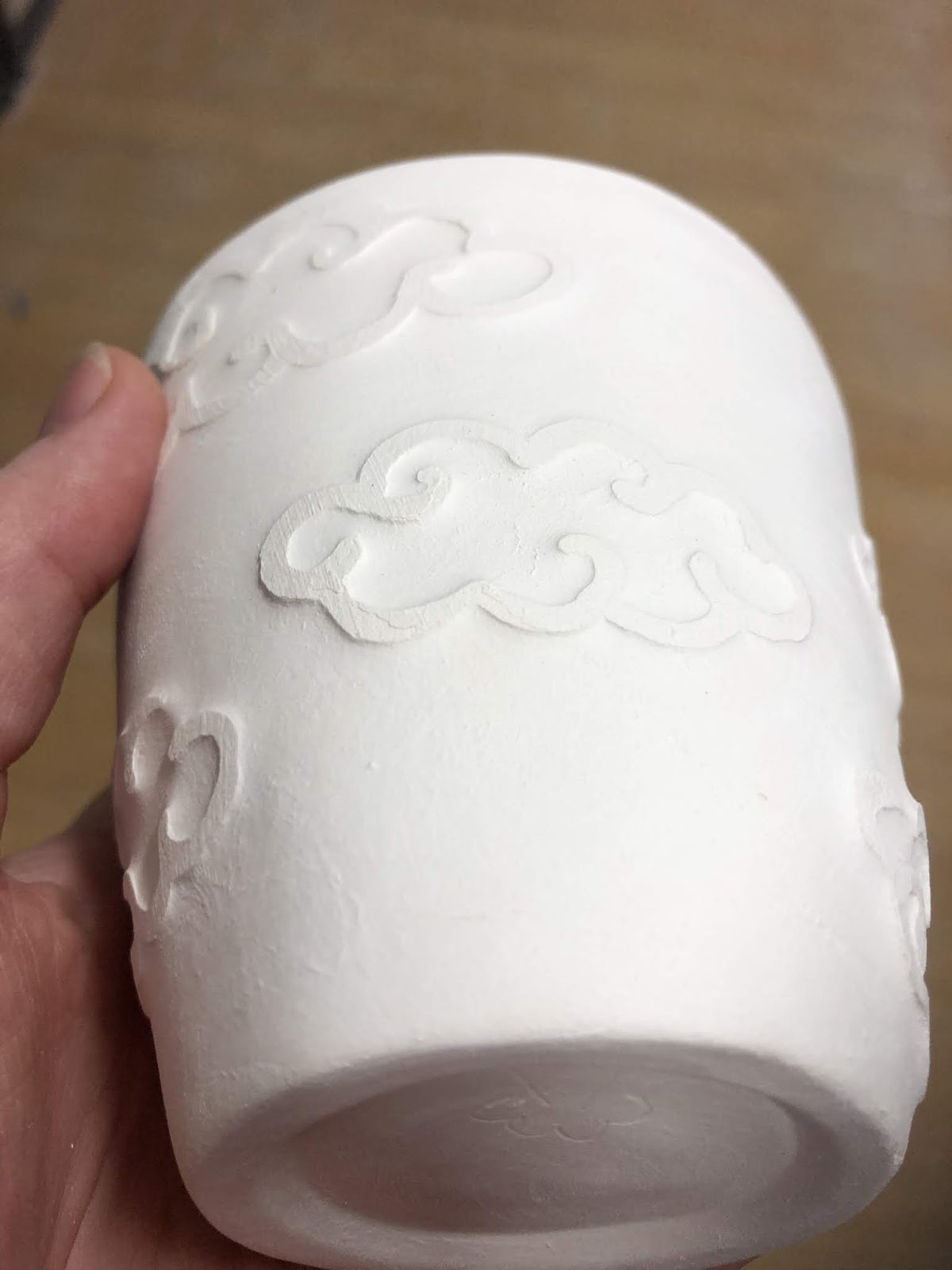
Recently I encountered a fellow potter at Claymake. She had the most lovely relief patterns on a cup. When I inquired how she'd achieved such fine lines she told me she was experimenting with shellac resist then removing the clay body with water. She couldn't tell me much more about the process so I decided to google it. I couldn't find any videos on Youtube but there are a number of ceramic boards which make some interesting reading. One board suggested using shellac as a resist as it's a naturally derived product that will burn off in the bisque firing. The following is my initial experiment and thoughts.
The only brand and smallest bottle of shellac available in the store. It would have been cheaper to purchase shellac flakes and make my own but there were no solvents available so I couldn't.
A slightly skewed cup. I picked it up when it was too damp and it tilted. Still usable and if not for this experiment it wouldn't have been fired.
Step 1:
Use a paintbrush to apply shellac to dry greenware. The greenware will adsorb all of the alcohol and the shellac will dry really fast. If you want finer lines, leave a small amount of shellac out in the sun to thicken for half an hour or so.
Thoughts - the shellac applies well but when it is the thickness of water you either need to only have a small amount on your brush and keep dipping and wiping or use a thicker consistency. If you don't, drips of shellac will spread making thicker lines and blotches. I like the golden shine and can see why this is used on furniture.
It occurs to me that stencils could be used with technique if the shellac were slightly thicker.
Step 2:
Use a wet sponge to wipe away clay from around your design. This is called hydro-abrasion even though typically that term is applied when using pressurized water. Circular motion of the sponge seems to prevent one side of the line from getting too much lower than the other. When the clay turns to a slurry, use the other, sopping, side of your sponge to wipe the clay away. Work on one area then move to another.
I used a brand new dish sponge. Under the sponge is a bit I've already done, the other three clouds still need attention. It's reasonably easy but I did get clay water everywhere.
Thoughts - This may work better as a staged step. I found that the water had undermined the strength of the cup. As I posed and held the cup my thumb has created a small divot in one side while between my fingers a small crack has formed. I think I managed to fix both but I believe that I need to reduce the amount of free water and probably do one side, wait for it to dry then do the other side. In the image above you can see a small area on the bottom cloud where I've accidentally wiped away the shellac. I believe this was because it was rather thin in that area. The thicker shellac, the more golden areas, seems to have held up fine.
Step 3:
Thoughts - It came out well. I'm really happy with how the relief works. I think it'll show off a glaze nicely. I also think this could be a substitute to create once off tiles patterned off molded items.
Step 4:
Glaze & stoneware fire it. I chose midnight blue glaze with a clear overcoat.
Thoughts - Love this look. Next time I'll use a thicker cup and try a two layer design. I think this may work really well for some heraldic displays similar to those carved in marble. I may also try a colour resist. After the first wash, I'll place some englobe or underglaze on the cup and then apply a second coat of Shellac.
#not-so-pro tip: hydro-abrasion works best if the sponge is run parallel to design. Right angles creates more of a sloped edge and it is harder to achieve a clear difference in clay body level.