Showing posts with label Aari. Show all posts

Monday, 10 December 2012

First Wife of Malkos Raga 1575 - 1600

First Wife of Malkos Raga, Folio from a Ragamala 1575 - 1600. Maharashtra Ahmadnagar Gauri Ragini, I found a nice high definition version of this on the LACMA collections website. 

The central figure (wife?) wears a golden / orange sari with zari hash embroidery and a maroon choli. Her pallu (decorated end of the sari) is decorated in gold and blue stripes and waves. The sari itself appears to be transluscent. Her golden skirt is decorated with red stripes, checks and swirl patterns.

The attendant to the left wears a golden sari with yellow and maroon stripes and bright dots (sequins or pearls maybe?) and a bright blue choli with gold crosses. Her pallu is decorated in bands of orange and blue with gold and silver stripes or hashmarks. A band of white is also visible with a red flower pattern embroidered upon it.. Her skirt matches the colour bands of the pallu but has simpler decoration, mainly stripes and checks.

Sunday, 16 September 2012

Paisley Roundup II

I'm still collecting ideas for my aari work. Paisley type motifs seem to be very popular even though I haven't found all that many dependable documented items. These three are a little dodgy on the dates but are still quite nice.


An old Ajrakh block-printed piece from Sindh, Pakistan in the V&A collection. I haven't been able to find it myself. I'm not sure how 'old' is old. I like the circular motif even though it's not a paisley.


(Original) From Riches to Rags: Indian Block-Printed Textiles Traded to Egypt 13th- to 17th-century Indian cotton trade textiles found in Egyptian sites. I've replicated the 'tree motif' which is quite a nice paisley too.


 (Original) From Riches to Rags: Indian Block-Printed Textiles Traded to Egypt 13th- to 17th-century Indian cotton trade textiles found in Egyptian sites. A simple teardrop paisley.

Wednesday, 12 September 2012

Paisley roundup I

I've started researching designs for aari work. There are many ideas out there but not so many medieval examples that I've found. For my first few samplers I'm going to think small so I've setteled on paisley / mango patterns which seemed popular in medieval India.


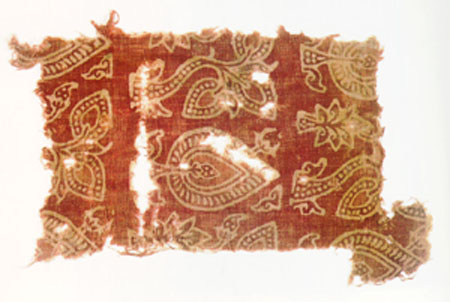
(above) A material fragement from Kelsey Museum of Archaeology. From: Indian Block-Printed Textiles Traded to Egypt 13th- to 17th-century Indian cotton trade textiles found in Egyptian sites Exhibit. No date is stated. It seems the Kelsey Museum is rather poor at showing dates for online items.

I've patterened four different motifs from this fabric, three paisley type  items, which when viewed in context are more likely representing trees and plants, and a rondel sort of thing. Stay tuned for more randomly inspired paisley patterns!


Monday, 10 September 2012

Aari embroidery patterns

I've been researching aari embroidery patterns. I've found a whole bunch of modern designs and designs created by various bloggers but not much in the way of medieval designs.

An Indian Heritage site has a number of simple motifs, however I'm not sure how old 'heritage' is.


I quite like these three designs. I think they'd make nice simple cuffs or trim on something.

To fix the apparent drought of medieval designs, I've started downloading documented images of cave paintings and such and copying out the designs. More on that to come.