If you do not know about this you should!
Are you trying to find miniatures?
Are you getting frustrated by the need to troll though an entire manuscript just in case there's an image you can use?
I found the Islamic Printed Page. http://www.islamicpaintedpage.com/
Its a meta-reference which will tell you where in each illuminated folio the images you are and what they are of. It really speeds up the search times and makes visual research so much easier!
Showing posts with label India. Show all posts
Showing posts with label India. Show all posts
Sunday, 8 March 2020

Sunday, 16 February 2020
Chola garb

A copper alloy figure of Parvati, Tamil Nadu, Chola Period, 12th century. Bonhams Auctions, Indian, Himilean and Southeast Asian art sale, item 3074

Tamil Nadu is located in the southern tip of India. The capital is currently Chennai (previously called Madras). The map above displays the general extent of the Chola Dynasty however it's influence extended far beyond this to Java and beyond. The Chola Dynasty left it's mark in history in many ways, but this posts focus is their acclaimed copper alloy statues of the 12-13th century. One statue in particular for auction at Bonhams is a beautiful example and has some very high resolution images, perfect for the armchair reenactor. All images below will be of this statue unless stated otherwise.

This is what caught my eye first. Are they amazing floral droopy earrings or braids decorated with flowers? The necklaces appear to be multiple individual necklaces stacked upon themselves with a single clasp seen from the back that peeks out from under her curls.


Drape: Parvati wears an assymetric (veshti / vaetti - tamil, or dhoti - sanskrit) drape with one leg wrapped to a few centimeters above the ankle and the other resting gently on the knee.


Depending on your interpretation, you could construct bands of floral patterns with leaves, or alternatively, geometric designs or potentially human torsos. I do like the floral patterns best but interestingly, there are whole flowers in places and halves in others. Th designs don't seem to cross the horizontal stripes. Are these supposed to represent block printing, woven patterns or thin bands of fabric joined together?


The girdle (red) appears to be a wide band slung low over the hips. Three loops on each side progress from just outside the buttcheek (so you dont sit on them) around and connect to the front. The top and the bottom of the girdle are stiff yet flexible. I suspect they are fabric. There is a possibility this is the top edge of the dhoti garment folded over but I doubt it. The girdle seems to be wrapped around the waist, possibly tied, and then secured with a beaded belt.

The beaded belt appears to be a double set of plaques or beads. At the centre front, and centre back, two larger plaque sections provide and avenue for tightening. The pink loops can be pulled to tighten the cord that runs through the beads. At the front the spare piece of cord or sash is tighten through the top most plaques and the falls to one side (pink). This would suggest that the end plaques on the back have two holes through which the cord / sash is run to prevent the fabric from slipping. The top front fastening could be achieved by running three pieces of fabric through one hole but a double hole would make removing the belt less likely to create a situation in which it'd need to be restrung. I am really going to have to play around with this design to see if my ideas would work!
Tuesday, 5 November 2019
Mughal flat hat
The Mughal flat hat!
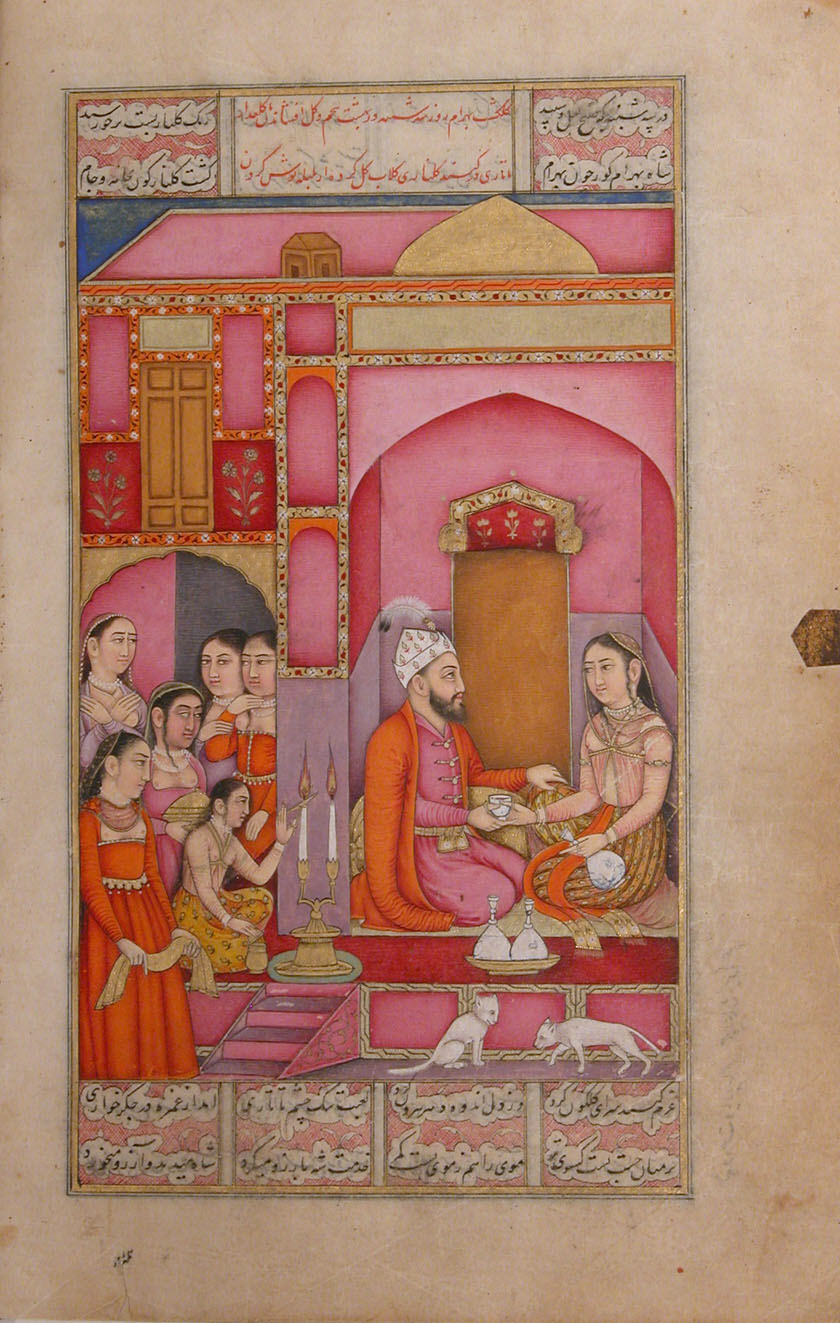
 Late 15th Century. Shapur with the daughter of Mihrak, by Qāsim. British Library MS 5600 - f.399v: Look at the detail on her hat! I love the beaded (pearl?) trim on the edge and the suggestion of gems all over.

Sunday, 17 June 2018
Ajanta caves
In December last year I attended a friends wedding in Delhi. I had only 8 days for this trip as I was taking it between FIFO swings. After the wedding, my traveling companions and I headed south to see the Ajanta Caves. Previous blog posts (here had outlined some of my arm chair research about the cave paintings so it was especially great to go see them in person. I cannot rave enough about this trip or about this UNESCO wonder. I am so in love with this wealth of history and the epic nature of these paintings.
If you want to know about the geology of Ajanta, some tid-bits can be found here. The posts following in the sequence will feature of some of the better photos I took plus a little background on the caves they're found in. I can't say this has been ticked off my 'places to see' list, but I've now seen enough to make the most of my next visit!

Me, thrilled to be seeing all the things!
Saturday, 30 April 2016
Pelican Outfil #4 - Cloud collar design research
As mentioned in a previous post Miriam of the Alawim of Stormhold has given me a number of PDF's of Persian Cloud Collar images. I believe she collected the images for a Laurel Prize Tourney entry. This week I've been analyzing the images in my typical science before art process. (This is going to be an image heavy post). My conclusions are as follows:
The first set of images Miriam sent me come from one manuscript. Firdawsī, Shāhnāmah, Book of Kings. which is Turkman/Timurid style. Dated 23 Jumadi II 891 (26 June 1486). This manuscript features to main styles of cloud collar, a floral style, and what I've been privately referring to as the geese style. Cloud collars of either design don't seem to be restricted to a certain class or sex and can be seen on a variety of coat styles. I've drawn up the designs from a couple of the images in black and white to make it easier to see the particular elements.
 |
 |
 |
 |
In both of the images above, the same goose like shape can be seen as a major symbol surrounded by blobs and tick marks. The goose is always pointing towards the left and is rarely inverted to balance out the pattern on the opposite shoulder. Given the frequent occurrence of this decorative element I began to wonder what it symbolised so I spent some time squinting at the screen and trying to determine what it actually was. One figure has a single goose on the upper thighs so I worked out the shape as best I could.
 |
 |
After looking at many examples of the goose, I've some to the conclusion that it's possibly a word or phrase written in islamic calligraphy. Islamic calligraphy is a beautiful art form but difficult to read for a Persian newbie. I've waxed lyrical about my reluctance to copy something I don't understand so that leaves the floral designs. Two of these come from military figures which wear a chain mail or scale coifs. Given the regular pattern and symbols, and the fact the pattern isn't adjusted to the lobes of the collar just the center neck, I'd suggest this fabric would have been a brocade rather than embroidered. Brocades are harder wearing and can be cut from second hand garments. The threads of the embroidery are more likely to be caught and damaged by the rings used in construction of either coif. The third floral design appears to be a leaf pattern and I copied it because it seems to blend seamlessly with the coat along the arm. Perhaps this one is embroidered directly onto the coat rather than onto a separate piece of applique attached to the shoulders?
 |
 |
 |
 |
 |
 |
Second manuscript set of images Miriam sent me were from The Khamsah' of Niẓāmī which dates from 1539-1543. This manuscript features cloud collars which were counter-coloured against the coat. The designs are stylistic and floral reminiscent of the Iznik tiles produced in the area. There's one I particularly like which has a tiny bee or month amongst the flowers. Once again, all sorts of figures wear these sorts of collars. The manuscript also has a number of indivisuals with the gold on base style collars seen in the previous manuscript. I've drawn up two of these designs.
 |
 |
 |
 |
The first is a seated man with a repetitive design on his collar. This may be done in multiple colours of silk. I've drawn the central medallion with a Star Wars twist as it's hard to tell what it is given the size of the image. The other collar is gold and features floral designs which are repeated in each lobe. This figure also has a slightly different floral design around the sleeve cuffs. I like both of these designs as repetition creates balance but I'm also away it may not be possible with my pattern given the different shapes and sizes of the lobes. This is something I'm going to have to research further and maybe draw up a bunch of mini images to see what I like the most.
One question you might be asking, if you've been following these posts, why am I researching Timurid / Turkish cloud collars when I've already stated I wanted to make an Indo-Mughal outfit?
The reason being is the image I'm most drawn to is Babar seeks his Grandmothers advice. It's a Mughal manuscript which depicts the Turkish born (1483) Babar who established the Mughal empire. At first I thought this image, painted around 1590, was a 16th century impression of garb worn by Persians in the 15th century. I then did some more research and found that cloud collars were a thing well past the 16th century so it was possible this scene was depicted with the figures wearing 'modern' clothing to assist the audience in relating to the tale. The Mughals did wear cloud collars and Persian inspired outfits. I've found a few other images that document this and will continue looking for more.

Detail - Court of Ravana, folio from a Ramayana. India, 1605. Met Museum, Accession no. 2002.505
Tuesday, 26 April 2016
Pelican outfit #3 - Cloud collar patterning
I've started work on the cloud collar. First step was getting the dress (mostly) right so I knew the collar opening and shoulder dimensions. To work out the neck line I simply sewed the dress front and back together then lay the resulting collar shape over some scrap paper to sketch out the neckline.
This next step involved sketching various designs from period references before drafting the cloud collar pattern onto paper. While I am referring to my two primary images from the previous post, I'm also using some of Miriam's research. She kindly sent me PDF's of her complied images which have been extracted from a variety of manuscripts. Her focus is on the Persian examples of cloud collars while I'm trying to look at the Timurid / Persian / Chinese influence on the garb of the Indians of the Mughal. You can see from my previous posts regarding the range of garb the Indians wore (including venetian dresses) that the fashion forward ladies of the Mughal Empire were likely to adopt a variety of designs.
The shape of the collars in the Indian reference is very similar to the Persian examples so given the huge collection of Persian images I find myself in possession of, I've based the shape on them.
To get the shape I took my neckline sketch, I folded it, refolded it and folded it some more until I could get each of the lobes symmetrical. They also had to fit the scrap of silk I'll be using for my test outfit #3.

Evolution of the back shape. When I decided I had cut away too much paper, I sticky taped another section on and extended out that part as you can see is occurring on the left from the middle down.

Once I had my shapes, I cut out a whole collar to see what it'd look like around my neck. Being paper it didn't drape well and I couldn't tell if it was right so I cut it out of yellow fabric and pinned it to the toile I discussed in the previous post. I knew I was on the right track because it looked like some of the out of period collars I'd managed to google.


I took the plunge and appliqued this one once I assured myself the neckline matched up and the lobes on the shoulders worked. I need to practice applique with the machine or do it by hand for the final one because even though I covered the thing in pins, I still managed to buckle some of it. I think more, smaller pins and a sharper, thinner sewing machine needle might be the first step. I could also leave some lines of embroidery with which to sew the applique down onto the dress with to help avoid buckling. Maybe a line around the outside? Hand sewing is never as tight as machine sewing and I'm quite worried about messing up with my embroidered collar. I'm going to have to practice a lot!
I'm not sure I like the wider front and narrower back, I'll have to decide if having the shoulders off set from the seam is such a bad thing, or maybe I can just alter the lobe without changing the front. The shoulder lobes wouldn't be symmetrical then but it'd allow the front to become narrow. I may line the toile just to see how much of the front I'll lose to the seam and see if that fixes the problem.
Either way - pattern 95% done!
Monday, 25 April 2016
Pelican outfit #2 - Patterning the coat
Now I've determined I'm going to make a fitted coat in the Indian style, the trick is to pattern it. Given that patterning typically takes more than one person, and I am reasonably deficient in the sewing skills department I decided to hunt through the commercial patterns to see if there was anything I could adapt to suit my needs.
I came across two potentially viable options. The first seemed perfect for a Persian coat given that it was loosly fitted, with long sleeves and designed to clasp under the breast. Closer examination of the pattern though shows very little shaping in the design and the toile would be difficult to adjust to follow my curves. There isn't a bust line seam so any shaping would have to come from the side seams, which would just end up pulling on the clasp making the coat look ill fitting and me look too busty. I get that enough as it is.


I came across two potentially viable options. The first seemed perfect for a Persian coat given that it was loosly fitted, with long sleeves and designed to clasp under the breast. Closer examination of the pattern though shows very little shaping in the design and the toile would be difficult to adjust to follow my curves. There isn't a bust line seam so any shaping would have to come from the side seams, which would just end up pulling on the clasp making the coat look ill fitting and me look too busty. I get that enough as it is.

Pattern number two is probably the jackpot. It has centre bust seams which I can use to fit the dress. It has an optional upright collar which can be seen in some of the Persian dress examples. The downside to this pattern is I'm going to have to design my own sleeve template because I do not want puffy shoulders. This is a major downside because sleeves have been my biggest fail in the past. The other adjustment I'll need to make to this pattern is flair it more over my hips and lengthen the design.

This pattern luckily comes with a "lengthen or shorten here" line along the waist so I have a good idea of where to start my flair from. For my first toile I used 90cm wide black, mid-weight cotton I had lying around. I don't tend to keep calico in my stash and I find black shows up chalk marks much better than most colours. The downside to black is the photos don't turn out all that well. I laid out the pattern pieces and continued the line of the final 25 cm of pattern down to the full length of the fabric. I then sewed the pieces together (minus the arms) with the widest stitch possible making sure I remembered not to double back on my stitches at the start and end.
To fit the pattern I pinned the front closed and pinched each seam around my waist and under my breasts and stuck a pin in. I used white chalk to mark the peak of my breasts, hips, bottom and my nautral waist. I then unpinned the front and chalked a line to connect the pins smoothly to the sewn seams retaining the points of flair around the hips and bust and smoothly curving into the waist. The waist came in about 6cm all up and the under-bust came in 3cm on each side. I also made sure to smoothly curve the side back seams up to my shoulder blades as I've been ruined outfits in the past by neglecting to fit the back right. The most important part of the fitting was getting the shoulders to sit right. Until I made a dress for Tamar's wedding I never realised that this was a thing. I guess I hadn't given much thought to the different shapes of shoulders given I'm usually wrestling with a non-standard bust to ribcage ratio.
Once I had the fitting lines, I sewed them up with a tighter stitch and trimmed away the excess fabric. Once I was sure I had the fit right, I unpicked the side seams so I could lay the dress flat and trace the neckline for the cloud collar.
During my first trial I decided that the coat was a little too tight around the upper thighs and if I make it any longer I may have trouble walking. The images of both the Indian and Persian coats show plenty of fabric in the skirt so I decided to make another toile with greater flair from the hips. This one I've made out of a dark blue brocade. It's not really a toile, more of an experimental garment. I'll trial a non-embroidered silk cloud collar on it and attempt to line it as well.
In the mean time, here's my first toile with my first attempt at a cloud collar pinned to it. The hem is a little jagged due to my ad-hoc lengthening method but I'm reasonably happy with the waist and chest fit. I'm pretty sure it won't pull on the buttons or clasps in a terrible way.

The collar didn't work as well as I planned so I decided to tackle the sleeves next. I ran out of scraps of black of an appropriate size so I used some maroon cotton I had left over from an experiment with Roman garb I did about 5 years ago. I used the maroon as sleeves and may use it to line the brocade test garment. Anyhoo, I'm not so good with sleeves as mentioned but I think I've worked out some of the secretes and I present my sleeve pattern. Please note this is a half sleeve pattern as the left side is designed to be placed along a fabric fold.

A is the crest of the shoulder. It is possible to the top line A-B more of a sinusoid (as shown in red). The greater the depth of the sinusoid, the greater the angle of the arm. If you do not have a sinusoid or a curve, the arm will sit square like the classic T-tunic shape. Most female garments have some sinusoid to the arm in modern clothing. Having the arm inset at an angle cuts down in excess fabric in the arm pit however it does mean if you need to lift your arms above that angle you'll be lifting the whole outfit. I especially hate this feature of womens reflective work shirts so I've decided to keep the curve to a minimum.
B is the armpit. You could use a rectangle and have a gore but since I have fabric to burn, little desire to sew more seams than necessary AND I know the Indian tailors of old were experts at seams and fitting, I've decided to go with a tapered shape.
The line A-B is the measured distance along the inside of the dress sleeve. I'll increase this distance slightly by adding the curve but that's negligible and will sort itself out during sewing.
A-C is the length of the sleeve. In this case the sleeve reaches to my inner elbow. This length seems to be a common feature in Indian art but was truthfully dictated by the size of the fabric scrap I used to trial the arms.
I couldn't complete the arms until the final cloud collar design had been appliqued on but here's how they turned out.

You can see the final shoulder seam is sitting too far below the point of my shoulder and there's excess fabric in my armpit. I should be able to resolve both of these problems by bringing the seam back to the point of the shoulder. I will experiment with this further on the blue brocade test dress.
In the mean time, now it's appliqued, I can probably do some cheater mc-fee modern finishing touches, like a sewn rolled hem on the sleeves, over locking on all the seams, a placket down the front and a commercial frog or three and turn this into a plain but nice modern summer coat.
Saturday, 9 April 2016
More cloud collars

The Sultan awakens the drunken judge at dawn by Mahmud Muzahhib, Burkara. 1560-61. Christies, Sale 1180, lot 26.
 |
 |
| The Sultan's collar comes to mid upper arm and seems to extend in a straight line to his belt. | The drunkard's coat is slipping off and shows embroidery to the navel, as well as above and below where the belt would go, at the end of long sleeves and along the base. |
 |
 |
| Smug guard guy gets a pointier collar that appears to have at least three lobes (one in the back too?_ and matching embroidery on his sleeves | Right hand man gets an honourable mention due to his fancy collar. Either the lining of his outfit is brocade or embroidered or his collar is embroidered. I wonder what it says. |
Friday, 15 January 2016
Venitian dresses in India?

Anne de Wilde's elevation dress.
A friend of mine has been making an elevation dress for Canterbury Faire this year and has been sharing the construction on facebook. It is a lovely Venitian dress inspired by this image, a lady from the 1600's. When she posted the finished dress I was interested by the fact the main body of the dress ends below the breasts which are covered by a plain or decorated partlet. There is a whole section of images of these dresses here. Apart from being a beautiful dress which has taken her hours to construct, it also reminded me of an interesting image I'd found when browsing the collection in the Met Museum. The image below featured in one of my classes on indian choli tops. I was fascinated by the contrast in garb between the central figure and the ladies on the left looking on. I was quite taken with the European garb combined with the indian veils etc. I had thought the European garb was Elizabethian garb depicted in such a way that still displayed the ladies breasts for some sort of symbolic reason. Now I'm not so sure.

The ladies could quite well be wearing complete Venetian dresses. Even better, if you examine the center lady in pink, there appears to be some pinkish gathers coming from her neck and the lady in purple on the far left also seems to be sporting a neckline of some sort. Is it possible that this manuscript also shows light weight, solid colour fabrics as transparent? This would fit with other images I've seen of more traditionally dressed indian ladies wearing light fabrics depicted as a wash over the womens body or a halo behind it so the breasts and upper body can still be seen.
17th century manuscript depicting Amir Khusrau Dihlavi (1253–1325).
Given my other research interests at the moment my next step will be to examine the bottle in the central figures hand as well as any other time frame indicators in this and associate images and see if I can nail down the reason for the dresses. Are they contempory to the time of painting (was there a Ventian influence?) or are they from a period before the manuscript was painted?
Saturday, 28 November 2015
Indian armour for SCA persona

The defeat of Hemu by Kankar. From an Akbar-nama manuscript 1590's. National gallery of Victoria As24-1876
At the moment when heavy and light (archery) fighting in the SCA I wear a mishmash of Viking (helm and bazubands), crusades (tabard) and15th century (shield sometimes) and everything else is covered with cloth so is unremarkable. I've been meaning to create a cohesive set of armour for a number of years now but I've never had the funds or the skillset to do this. I think I've finally found the look I'm going to try and go with. I know I posted something similar back in Janurary but the female archers lack of body armour made it impossible to copy well. The image above depicts a battle between warriors wielding spears, maces, bows, swords and machete type swords. There is also a guy in there with a billhook looking thing. They typically have round conicle highly decorated shields as well. There are also a couple of flag bearers and some of the guys have tiny flags out the top of their helmets. The ones I spotted were yellow or red and may have been a signal of allegiance?

Maceman detail from image above.
The important details for my future armour are:
knee high leather boots (sensible when riding)
pointed helm
chainmail aventail (or just back drape)
bazubands or forearm guards
decorateive knee cops with upper leg protection
articulated upper arm protection (could be quilted fabric instead)
decorative chest protection
pretty tunic over the top
 |
 |

Subscribe to:
Posts (Atom)