Showing posts with label Sari. Show all posts

Saturday, 17 January 2015

Sari collection


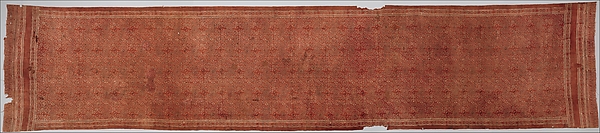
Extant sari (?)  length with hamsa geese print, cotton, Gujarat for the Indonesian Market - 481.3cm long, Met Museum. Accession Number: 2012.445

I wonder about the two spots of damage, is that due to folding and subsequent damage while being stored or displayed? Perhaps those are the sections that were preferentially knotted?

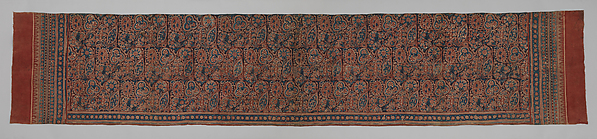
Textile with forested landscape, Gujarat for Indonesian market, 494.5m long, Met Museum, Accession number 2005.407


The saree's that I own:
Cotton brown with black blockprint and dark turquoise detail - 5.20m (5.7 yards)
Cotton red with gold triangle trim - 5.20m
Cotton maroon with straight gold trim and border protection -  5.20m
Cotton cream with brown block print - 6.20m
Cotton/silk blend white with gold spots - 5.20m
Cotton white with gold trim -
Cotton light brown with apricot gold trim -
Cotton purple with orange gold trim -
Cotton maroon with black and gold trim -
Faux silk art silk block print -
?? orange brocade -
Silk wine striped silk -
Cotton ? stiff orange with purple and applique - 

I find the softer and lighter the fabric the better it drapes. As a result, I prefer to wear the cream with brown block print (even though it's really long), the brocade or the wine silk. The art silk I keep around as a demonstration tool and because I love the block print design. It is too slippery to drape well without lots of safety pins but it does fall nicely as it's a light weight fabric.

Monday, 22 December 2014


I found a set of wonderful sari/saree wrapping videos on youtube.
https://www.youtube.com/playlist?list=PL0B1F2FE35193AC5C

This one, showing a Kerala sari, and this one showing how to drape a sari in under two minutes are pretty much the basic drape I've taught in all of my classes. It's still my favourite drape and I find it works best with softer fabrics or a heavy brocade. The image above is me attempting this drape with a light cotton, my orange blockprint. As you can see it's not really falling right and I look a little frumpy. Still, one of the easiest drapes to look graceful in I feel.

Thursday, 20 November 2014

Some sari/saree terminology

I recently was blipping around Pinterest searching for "Ancient Indian Sari" which as you can expect, doesn't produce anything older than the 18th century. I did see some modern designs as inspiration for my sari project and followed one link to Strands of Silk website. Not only did they have some lovely modern sari's but they also had sections of traditional styles of sari decoration. The following are small segments of their website with links to each piece, each page has a good intruduction then sections on the history, the motifs & colours, production techniques and producer communities. The sort of information that'll be invaluable starting point should I wish to visit these regions myself. I've picked a few forms of decoration, their full list is as follows:
  • Ajark printing
  • Applique
  • Banarasi brocade
  • Batik
  • Block Printing
  • Ikat
  • Kota Doria
  • Mirror Work
  • Patan Patola
  • Pipli Applique
  • Tie and Dye
  • Zardosi Embroidery

The term ‘ajrak’ derived from the Arabic word ‘azrak’ which can mean ‘indigo’ or ‘blue’. This reflects Sindh’s historic reputation as a dominant producer of indigo dye and illustrates the extensive use of the indigo shade of blue in traditional ajrak print, which is still common to this day. Traditionally, ajrak prints were donned by both men and women. To this day men continue to use ajrak printed turbans and cummerbunds, as well as draping the fabric over their shoulders. Just as before, women continue to wear ajrak printed dupattas, chadors and shawls that exquisitely complement other garments such as sarees. The Khatri community, who continue to be dominant ajrak printers in the Kutch district, have recognised contemporary markets, producing traditional ajrak prints on modern pieces such as yardages and home furnishings.
Historically - The art of block printing as a whole flourished in India in the 12th century, and motifs were heavily influenced, in the 17th century, by the reign of Mughal emperors. Ajrak printing, however, historically evolved in parallel as an intricate genre of block printing. Though ajrak printing is synonymous with the Sindh culture of Pakistan, its roots stretch to the Indian states of Gujarat and Rajasthan due to the inhabitants of the ancient Indus Valley Civilisation who, from 3300 BCE, settled along the basins of the Indus River.

Banarasi brocades are one of the finest fabrics that India has to offer. It is a specialty of Varanasi, formerly known as Banaras, from which the fabric derives its name. Throughout history, brocade was a fabric of luxury worn by nobility in various cultures, from India to Korea. Brocade is a heavy fabric similar to jacquard with a raised pattern or floral design. Traditionally the pattern was produced with gold or silver thread said to be of such superb quality that they could be woven into fabric of pure gold and silver. There is evidence of different textured brocades since the Rig Vedic period c. 1750-500 BCE, including fabric of gold known as Hiranya Vastra. Silkora, a mixture of silk and cotton, is a modern textile innovation of Banarasi brocade.
Historically - The textile industry fits into this milieu and brocade weaving with gold and silver thread, zari, has been a Banarasi specialty since the Rig Vedic period between c. 1750-500 BCE. It was during this time that the oldest scriptures of Hinduism, the Vedas, were composed. Banarasi brocades, or kimkhabs, woven with gold and silver thread gained widespread renown during the Mughal period of the 14th century, and with the arrival of Europeans.

The word ‘batik’ is derived from the Indonesian word ambatik, which can be translated to ‘wax writing’. Batik is a 2000 year old art form predominantly practised in Indonesia, Malaysia, Japan and India. Batik is an ancient form of handloom and fabric painting in which the fabric is printed with wax resist before being dyed. Batik was once considered a sign of sophistication and cultivation, owing to its striking yet delicate motifs that include flowers and birds. Batik print encompasses a three dimensional feature with depth and texture.
Historically - Early evidence of batik dating back more than 2000 years has been found across Africa, Central Asia, the Middle East, South East Asia, and the Far East. The theory that the art form of batik evolved independently in each of these regions is plausible. However, historians believe it is also likely that batik spread through caravan trade routes. By the 17th century there were established trade routes between China, the Indonesian islands Java and Sumatra, Persia, which is present-day Iran, and Hindustan, which includes the North Indian Gangetic Plain and the Indus River basin in Pakistan. Batik even travelled as far as the Netherlands, Germany and Switzerland in the 19th century during the Dutch East Indies colonisation. Many historians dispute the true origins of batik. Some attribute it to Egypt, while others believe it originated from India.


THIS heavily embroidered lehenga is my favourite of their outfits I think.


Front, back and the skirt

Thursday, 30 October 2014

Pattern research for silk painted sari

Not amazing resolution, But I Love what the edge of the sari, it looks like dagging, or bling or maybe weights?  Standing Pavati, India, Tamil Nadu, Chola period, 11th century, copper alloy. Accession/museum number 1979.021, Asia Society


Standing Shiva and Parvati, India, Chola period, 13th century. Copper alloy, accession Number 2000.284.5, Met Museum of Art.

 Close-up of Pavati's garment with circular pattern. Centre of one looks like a 5 petal flower while a lower one looks like a swirl.


Not Indian but Indonesian (java). A posthumous portrait of a Queen as Parvati (detail). Eastern Javaneese, 14th century, Andesite, Accession number 2001.407. Met Museum. Her lower garment seems to be 100% decorated in interlocking geometric shapes/overlapping circles. This is possible blockprinted fabric such as that I've posted previously.

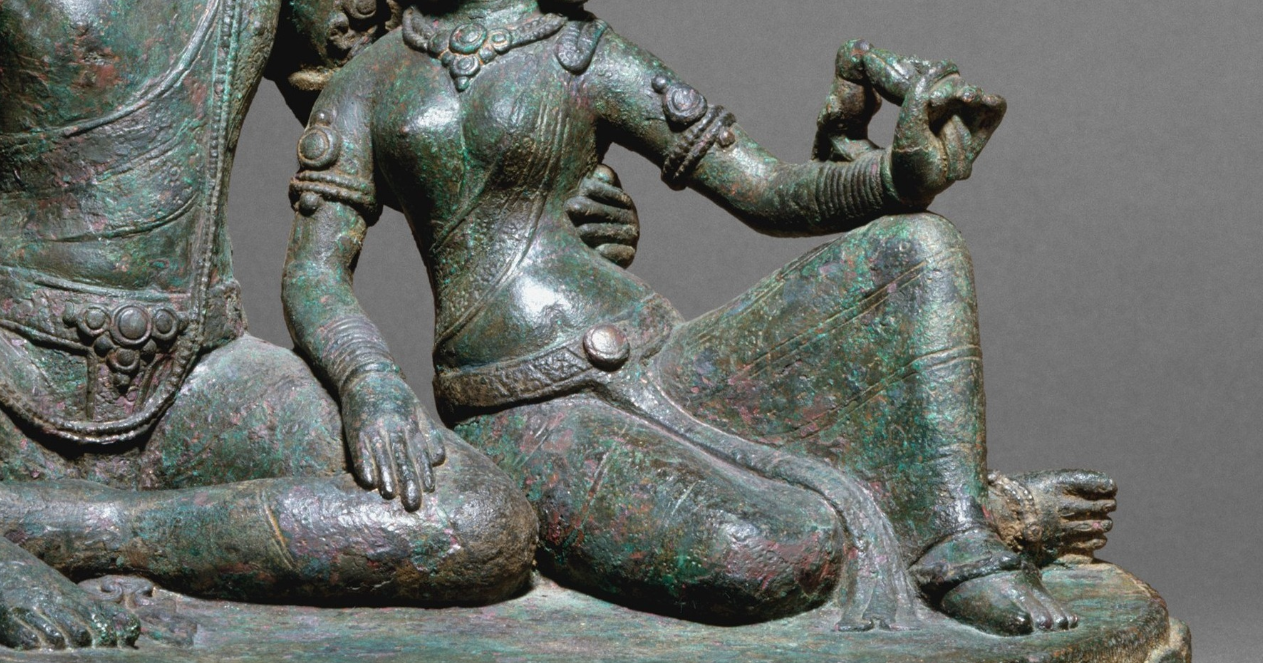
Detail of Shiva Seated with Parvati. Nepal (Kathmandu Valley), 10th centiry. Accession number 1983.563. Met Museum. Parvati's lower garment features horizontal stripes with pattern infill very similar to that of the cushion on which they recline (leaves? and flowers?)


Detail of Pavarti. 16th century, Tamil Nadu, India, Bronze. Accession Number 33.65.8. Met Museum. Lower garment is deocrated in a repeating pattern of concentric circles // flowers?


Detail of Shiva, Uma and their son Skanda (Somaskandamurti). Tamil Nadu, early 11th century, copper alloy. Accession number 1982.220.10 Met Museum. Uma's lower garment is decorated in a range of (non-repeating patterns) that feature circles.

Detail of Yashoda with the Infant Krishna. India, Tamil Nadu. early 12th century. Accession number 1982.220.8, Met Museum. Simple by comparison to previous images, this garment features a repeating pattern of dots forming a diamond and a circle linked with a chain of dots - lovely!

Detail of Shiva seated with Uma (Umamaheshvara), Thakuri dynasty, 11th century, Nepal, Copper Alloy. Accession number 1987.218.1. Met Museum. The garment here is badly corroded so I cannot make out much detail from the picture. Her drape appears to go over her shoulder and the lower garment seems to be decorated with small circles ringed by dots.


That's it for now because it's late and I have to work tomorrow.

Wednesday, 30 April 2014

Ideas from Textiles and dress of Gujarat pertaining to the silk sari project

Some quotes from 'Textiles and Dress of Gujarat (ISBN: 9781935677123)" and the ideas they've given me.


pg 64  - "For Hindus, silk is the purest of fibres and is worn by Brahmins and officiating prists and is extensively used for saris. It is, however, proscribed for Muslim men in the Quran... some circumvented the proscription via the development of mashru satin which has a silk warp and cotton weft... Sufis, the influential mystics of Islam, much venerated in Gujarat, were identified by their use of wool; their name derives from suf, the Arabic for wool."

I think I'll use silk for this project as I have the wonderful Elizabet Hunter living close by who can advise me on the techniques and use of silk paints.

pg 77 - "Although veilcoths appear to be in the category of unstitched clothing, many in common use are actually stitched. The looms on which handwoven veilcoths are made do not produce a stable fabric if the eft is wider than about eighteen inches. In order to produce a garment that gives sufficient cover in terms of utility and modesty, two matching lengths are woven and then stitched together. Since these joins and seams are perceived as vulnerable to pollution, many groups reinforce them with embroidery featuring auspicious motifs and colours in order to deflect malign influences."

Sari project thoughts - multiple things have delayed my sari project. One has been selection of appropriate design elements. The other is the use and justification of silk paints. I could make the silk painting a lot easier if I could subdivide the length of silk as I wouldn't need a 5m long frame to ensure the dye doesn't dry prematurely. If I use clear gutta to sub divide, then embroider over the top I can include the decorative elements and disguise my not-so-period methodology. I may start with an embroidered veil piece first. Something smaller to practice on.

pg 79 - Figure 2.60. Woven in two pieces, Rabari women embroider the centre seam and end borders with auspicious motifs which they believe deflect malign influences. Protection is amplified by the use of fragrant spices packing into embroidered discs (tigudi) at intervals along the seam.

pg 157 - "Greek ambassador to the Mauryan court in the late fourth century, reported the Indian love of finery, describing court dress as 'worked in gold and ornamented with precious stones'.

Perhaps I can use gold thread and make some little pockets in the embroidery for packets of scent on the veil.

Tuesday, 20 August 2013

Mint cushion

Last night I completed another cushion for my collection. I'm aiming to make a pile for in front of the heater for winter napping and book reading. The idea for the cushion originated from my lovely bottle green georgette saree. The fabric wasn't period but I loved it because it draped so nicely. This year at Pennsic, when I tried it on, I noticed a couple of stains on the pallu. To make matters worse, I sampled the dimsims from the Australian Grill place and dripped soy sauce all over it. Three washings later, I've had no luck getting the stains out and since they're in a rather obvious place when I use my standard drape I can't really keep using this sari.


One of the reasons I liked this sari so much is the embroidery. It's done in simple colours and while it has some sequins, it's comparatively understated. I always thought it was machine embroidered, but now I've had a really close look, I can see it's aari work and hand stitched. I couldn't throw away the embroidery, so I backed it with a light green and added it to my trim stash. The main embroidery on the pallu has a beautiful plant motif, with sequins. There's not really enough to do anything medieval with but I really liked it. So I made a cushion out of it.


How to cushion it up:
Step 1: Purchase a cushion insert and a zip from your local craft store. I had a 61 cm square cushion insert left over from my embroidered cushion UFO.
Step 2: Cut one 63cm square (if you are overlocking the edges, use 65cm instead), This is the back of your cushion.
Step 3: Cut one 65x63cm rectangle. This is the front of your cushion.
Step 4: Pin and sew one side of your trim to the front of your cushion, right side to wrong side.
Step 5: Use the extra 2 cm to make a 1cm fold at the base of your trim. Machine sew one side and handstitch the other down, securing the edge of the trim with the fold..
Step 6: Place front and back right sides together, sew the zip side with widely spaced stitches. Open and press.
Step 7: Pin the zip to the back of the new seam and sew.
Step 8: Unpick the seam over zip.
Step 9: Pin front and back right sides together and sew. Open and press.
Step 10: Trim corners for neatness, stuff in cushion insert, zip closed, plump and enjoy.


Things I learned: When sewing a 61cm cushion, use a 59 cm zip. If you use a 61cm zip you end up with really messy corners. Also, gourgette is hard to sew neatly as it's more slippery than the poly cotton (ex-sheet) I used for the main body of the cushion and tends to bunch.


Pennsic treasurers pt 2

Cream cotton sari drying on the line (strange concept for the Americans, older rentals don't come with white goods here, and we've got plenty of solar energy, in summer at least). From Garvi Gurjari, cost $12 USD.

I've just finished washing some new sarees in cold salty water as I didn't know if the dye would run. One of the hardest parts of coming home after Pennsic is dealing with the mound of wash. As Slippery Rock is so humid, even your clean clothes come home smelling musty after being trapped in a suitcase for 24-30 hours. Thus everything has to be washed, which is perfectly fine for the mundane items as they can be tossed in the dryer. The handmade garb needs to be washed carefully and line dried, a difficult prospect when you're returning to Melbourne winters which involve significant lengths of overcast cold weather and drizzle, and a sun that seems to rise and set while you're at work. Add to that the complication of washing and drying 10 lengths of 6-9 foot fabric with limited line space. The result: still finishing off the wash two weeks after returning from the event.

Brown, dark brown / black and green cotton block printed sari. The green lines appear to have been block printed on separate from the dark brown/black motifs. From Garvi Gurjari, cost $12 USD.

~


I'm not sure if Garvi Gurjari is a shop name or the name of the weavers/dyers of this sari. Google isn't helping much either. I'm going to assume the trader or maker takes their name from Gujarat. This is a north western state in India (above) and was a well known center for fabric crafts and trade in the middle ages. Many of the scraps of imported fabric found in Egypt are attributed to Gujarat. Below is an example of cotton block printed fabric that shows incredible intricacy and precision. I'll post at another time about the process of block printing, I may even try it myself.
While washing these two sarees, I half convinced myself they'd make beautiful Persian garb. Given I now have a plethora of sarees, I'm contemplating turning one of these two into a nice light under-dress/tunic. The block printing is lovely and perfect for the application. I'm also unlikely to wear a brown saree as I haven't an appropriate choli at this point. The only thing holding me back at this point is I've never sewn Persian garb before, and I'm really hesitant to cut up such nice fabric (I suspect this hesitation is also the secondary cause of my fabric stash).


Saturday, 17 August 2013

On Ikat

This year at Pennsic I was super lucky and managed to acquire some sarees from Flori of Northshield. She and her partner are moving back to the US from India and she offered to buy sarees for anyone interested on the SCA_India site. Given that I love the look of sarees, and I couldn't remember how many I had stored with Ronin I asked for 5, greedy yes I know. Flori was amazing , not only did she bring alot of sarees back to the US for us, she also labeled them with their source. She brought be 5 beautiful and varied new sarees one of which is an ikat saree in green and maroon.


I had never encountered ikat before but I loved the look so much, I bought some 'Persian' garb made out of ikat too. So, for those, like me, who have never encountered ikat before I present my notes made after returning home.


Ikat is the process of making cloth from pre-dyed thread. The thread is dyed in such a way that when woven it creates designs in the cloth. The process is very labour intensive as the threads need to be hand dyed in specific patterns before weaving. The Persian garb I bought was made out of double ikat were both the warp (up/down threads the weft thread is woven around) and the weft (left/right threads woven over and under the warp) are dyed and woven together to make a pattern. In the case of my Persian garb, there is no specific pattern rather a more modern take which features the colours and the weaving style. For more intricate patterns, the warp and weft are tied separately with cotton thread before being dyed, this is called double ikat. The thread is then removed and the warp/weft are retied and dyed again to create another layer of colour. Finally  after all the dye is applied, the weft is carefully strung and the warp carefully lined up and woven. Double ikat silk available in India and Indonesia is called patola (or single, patolu). Given I have trouble remembering if I'm on the third or forth coat of glaze half the time, I'd have a nightmare keeping track of which threads go where.

Arm of the persian top showing the texture of a random double ikat.

My new sari could be called double ikat as it has patterns dyed into both the warp and weft however these sections don't overlap and each creates an individual motif, either horizontal or vertical. Indian Ikat Textiles by Rosemary Crill (1998) includes some beautiful examples where double ikat has been used to feature designs such as elephants. In images of the more complicated and time consuming weaving, it's difficult to tell if the image is ikat or dyed on later. It's only when you look closely you can see the fuzziness that occurs when the dyed sections don't quite line up perfectly that you can tell. In the best examples, you can't tell without physically examining the fabric yourself.


Ikat is a old tradition that can be dated back to the Ajanta Caves in India. In the listening to the sage scene below, featured in Cave 1 of Ajanta, you can see various figures wearing striped cloth. The prince (?) wearing a garment made out of slightly fizzy arrow heads. Given the level of detail on other individuals, the fuzziness is assumed to be intentional and representative of the fuzzy outlines seen in ikat fabric. According to Crill (1998), Chandra (1960) was the first to highlight this, however that specific reference is rather hard to find. Crill (1998) suggests that arrows, broken and solid stripes and check patterns can all be found in the caves.

In summary:
1. Ikat is period for an Indian persona
2. Double ikat may also be period, more examination of images is required. Chandra 1960 suggests that 12th century Deccani sources reference double ikat.
3. The more precise and complex the dying, the more time consuming and expensive. This may have been a status symbol as well.
4. I'm glad I now have an ikat sari, thanks Flori!
5. Now you know why my last post was looking at sources of dye in India.


Resources and References:

Books:

Crill, Rosemary. 1998. Indian IKAT textiles. V&A Publications. 176. ISBN: 1851772421
Chandra, Moti. 1960. Indian costumes and textiles from the eighth to the twelfth century. Journal of Indian Textile History Vol 5.
Chandra, Moti. 1961. Costumes and Textiles in the Sultanate Period. Journal of Indian Textile History. Vol 6.
http://www.abebooks.com/book-search/title/journal-indian-textile-history/page-1/

(if you have a digital copy of either of the Chandra papers, I'd love a copy)


AMAZING resource for the Ajanta Cave 1, I'm still trying to navigate the rest of the website and find more (and see if I can access them without a student number). I'm also going to pin as many of these images as possible just in case they decide to block them.


Three useful websites which cover the basic concepts (not really good references though):


Monday, 7 January 2013

Christmas happenings

I took a week and a bit off over Christmas which was rather nice. We didn't go anywhere or do anything which was even better. I got a good amount of time to spend on my unfinished projects and start a few more. Some things I did:

Gutta practice on blue silk scrap.

I tensioned a scrap of blue silk on a small embroidery frame and decided to practice my gutta work. I attempted some paisley designs which look okay when photographed but I think the gutta is just too thick for designs this small (about 5cm long). I wanted to try bleaching the colour out of the silk to see if I could paint the inside of the paisleys red or something. I had read online somewhere not to use chlorine bleach as it destroys cellulose (silk) so I tried painting on 6% peroxide bleach. I left it to dry (about 5 minutes) and then rinsed it off.... no effect. The only thing that happened is the gutta softened and some of the thicker areas peeled off. I shall have to do some more bleaching experiments. Perhaps I could use the paste they use on hair so it doesn't dry so quickly.

Wooden chair slats after sanding and oiling with Walnut oil.

This is a project I've been 'working' on for years. It's moved house with me twice now and I believe I've lost a piece in the last move. No matter, it was a simple dowel rod that I can replace at need. This is a rocking chair I got at the Dandenong junk auction for $10?. It had a stamp on the bottom, imported by Euro Furniture in Scoresby, Made in Solvenia.

The chair was covered in crumbling varnish and had extensive sun damage. The main seat was also cracked and came apart into three pieces once I took the slats off. Not knowing anything about woodwork, I started by sanding the back slats you can see in the picture with 40 grit sandpaper. It took the varnish off nicely. Unfortunately, when I tried this with the turned pieces, I ended up leaving deep gouges in the wood. I spent every day over Christmas through to new year hand sanding this thing and I've brought the slats, the back, the arms and the upper turned bits down to 320 grit and then oiled them with Walnut oil. You can see the slat on the right hasn't been oiled yet and is a nice pale creamy colour. The seat and legs are harder as they're more sun damaged and I had to glue the seat back together. I decided not to sand the legs back to fresh wood as I'd have to cut too deep and had no way of sanding in the turned dinty bits. Instead I've brought it to 150 grit and oiled them. They look a little darker brown than the slats.

I'm currently at the reconstruction stage which is awkward as the legs don't want to fit back in the holes they came from.
I'm rather happy this UFO is getting done and will be very happy with the final result... once I get there.

Tuesday, 11 December 2012

A variety of fabrics from South Indian Paintings.

A small sample of the fabrics shown in South Indian Paintings by C Sivaramamurti.

7thc devi, The Pallava Kingdom (7th-9th c),  Panamalai. South Indian Paintings pg 48. The goddess Parvati watching the dance of her lord.I love the beautifully decorated umbrella depicted here. Even though much of the painting has gone, the detail of the fabric on her bent left leg shows a block print or embroidery of flowers.

Painted on palm leaf manuscripts, these images are paintings of the Hoysala (rulers, group period?). 12th century CE. The top leaf clearly shows to attendants wearing choli tops and different coloured lower garments (skirts / sari?). The bottom leaf shows the attendants dancing with the scarves or such from their belts. They both have a circular golden crown? at the back of the head and appear to be carrying flails/fans?

Another manuscript painting of the Hoysala, 12th Century. The top leaf shows two attendants draped in striped fabric saris while the bottom leaf shows imagry VERY similar to the previous image.

 Arjuna's archery contest. A Hoysala (12th Century) sculpture from Belur. The contestant wears a decorative belt with fabric elements very similar to the previous image.

Page 81, Figure 55. Vidyaranya's procession. From the Vijayanagara (14th - 17th century), a dominant power in the south. Painting is from the 15th century. Men appear to be wearing light coloured, mid calf trousers and feature decorative fabrics with stripes, and diamond patterns. Insufficient detail is available on the female in the pannier though I rather like the tassels and construction of her conveyance.

Page 82, Same mural as the above image painted on teh ceiling of Cirupaksha Temple, Vijayanagara, 15th C in Hampi. This is another image of Arjuna's archery contest. The image of interest is the woman on the right who appears to have a very detailed trim on her sari which is also flopped over a belt around her miiddle. It may cross her chest under her many gold necklace, it is hard to tell. The pallu also has intricate golden embroidery.

Monday, 10 December 2012

First Wife of Malkos Raga 1575 - 1600

First Wife of Malkos Raga, Folio from a Ragamala 1575 - 1600. Maharashtra Ahmadnagar Gauri Ragini, I found a nice high definition version of this on the LACMA collections website. 

The central figure (wife?) wears a golden / orange sari with zari hash embroidery and a maroon choli. Her pallu (decorated end of the sari) is decorated in gold and blue stripes and waves. The sari itself appears to be transluscent. Her golden skirt is decorated with red stripes, checks and swirl patterns.

The attendant to the left wears a golden sari with yellow and maroon stripes and bright dots (sequins or pearls maybe?) and a bright blue choli with gold crosses. Her pallu is decorated in bands of orange and blue with gold and silver stripes or hashmarks. A band of white is also visible with a red flower pattern embroidered upon it.. Her skirt matches the colour bands of the pallu but has simpler decoration, mainly stripes and checks.

Sunday, 9 December 2012

South Indian Paintings - a review

South Indian Paintings by C. Sivaramamurti. ISBN: 8123000529

South Indian Paintings is written by Calambur Sivaramamurti who has authored many books featuring artworks of the Indian subcontinent. This book, first printed in 1968, is an excellent product for its era. It contains many full colour images of a variety of paintings as well as black and white line drawings of the authors interpretation of damaged works. The authors starts with an In depth view of painting in India, the use of colour and the process of painting itself. He then presents the works of art, sorted by culture and time making direct comparisons of different locations where relevant. He starts with Vakataka (4th-6th century CE)  to the Mahratta (19th century). He wraps up with a list, and description, of the schools of Indian painting and their styles. As this book was printed in 1968, it lacks computer enhanced imagery however Sivaramamurti’s descriptions of the artworks and the themes within them make up for the lack of detail in earlier works. I only wish that books by Sivaramamurti were more easily available.

From an SCA perspective this book has some lovely reference images. The author provides a nice cultural background and explains the theme of each image presented which is highly useful. Though some of the images can be found on the internet they usually lack background information which Sivaramamurti provides in spades.

From a personal perspective, I was disheartened to find that there is only one image, 1/3rd of a page for Kakatiya (11th - 13th century), which is the area and time I'm currently interested in. The author does however mention the inaccessibility of the Tripueantakam temple, I'm hoping this has been rectified in the last 50 years since print.

4/5

The back cover of South Indian Paintings. A quick search turned up no reference to this image however the sari's worn by the women have a very pleasing selection of decorations, from geometrical to floral.

Sunday, 2 December 2012

Sari I - complete


The weather was beautiful this weekend so I finally got a chance to wear my completed red stripe silk sari set to Stormhold's Monthly Bash. The sari fabric is 100% silk I bought from Spotlight for $10 (yay!) a number of years ago. It doesn't drape as nicely as I'd like but it's wonderfully light and simple.
It took me a while to get around to finishing of the edges of the sari and making a choli top to go with it. I completed the top last year... unfortunately, I've put on weight so I couldn't wear it this weekend. (I'm also not very good at shaped, supportive garmets yet) Instead, I whipped out one of my backup tops, a not-quite medieval, not-quite velvet (stretch) number in turquoise.
Accessories (very important): 20 gold plated bangles (from Dandenong), be-gemmed (imitation) necklace, earring and mangtikka set (from Footscray), and carnation headband. I unfortunately broke one of the earrings while taking it off, on the upside, I now have extra dangles to make more tikka's from.


I'm really happy with how the headband turned out. When I wear a plait, I frequently re-do it two or three times a day as I hate the whispy bits that eventually work their way free. After my flowered headband post I started working on a set of artificial flowers for my hair. This one was made from fake carnations (with the green sepal removed). I wrapped the headband in a cream ribbon and then hotglued the carnations on. I left lengths of ribbon dangling from the ends of the headband and tied additional carnations onto that. The idea was to braid the ribbon into my plait creating the 'covered in flowers' look and allowing me to avoid modern hair ties. Unfortunately it was too bulky for me wave in myself, and one of the flowers came off in the process. The headband keeps all the stray whispy bits from my face!
I might cut the ribbon off the headband and make the plait decorations an entirely separate piece. I still haven't gotten around to making a jasmine hair accessory, it's on the list though!

Things learnt: The green sepal is essential to keeping the carnation petals together. Hot glue can be used in it's place if you don't mind getting a few burns to your fingers when shaping the petals. Hot glue doesn't work for the braid bits though.

Note: Did you know there's an SCA India email list? I only found out this weekend! Excited!