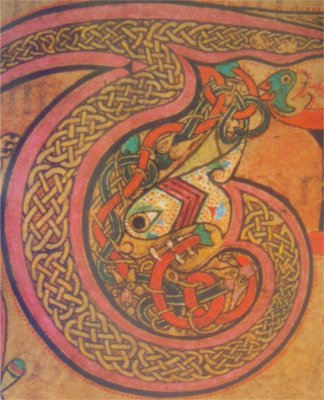
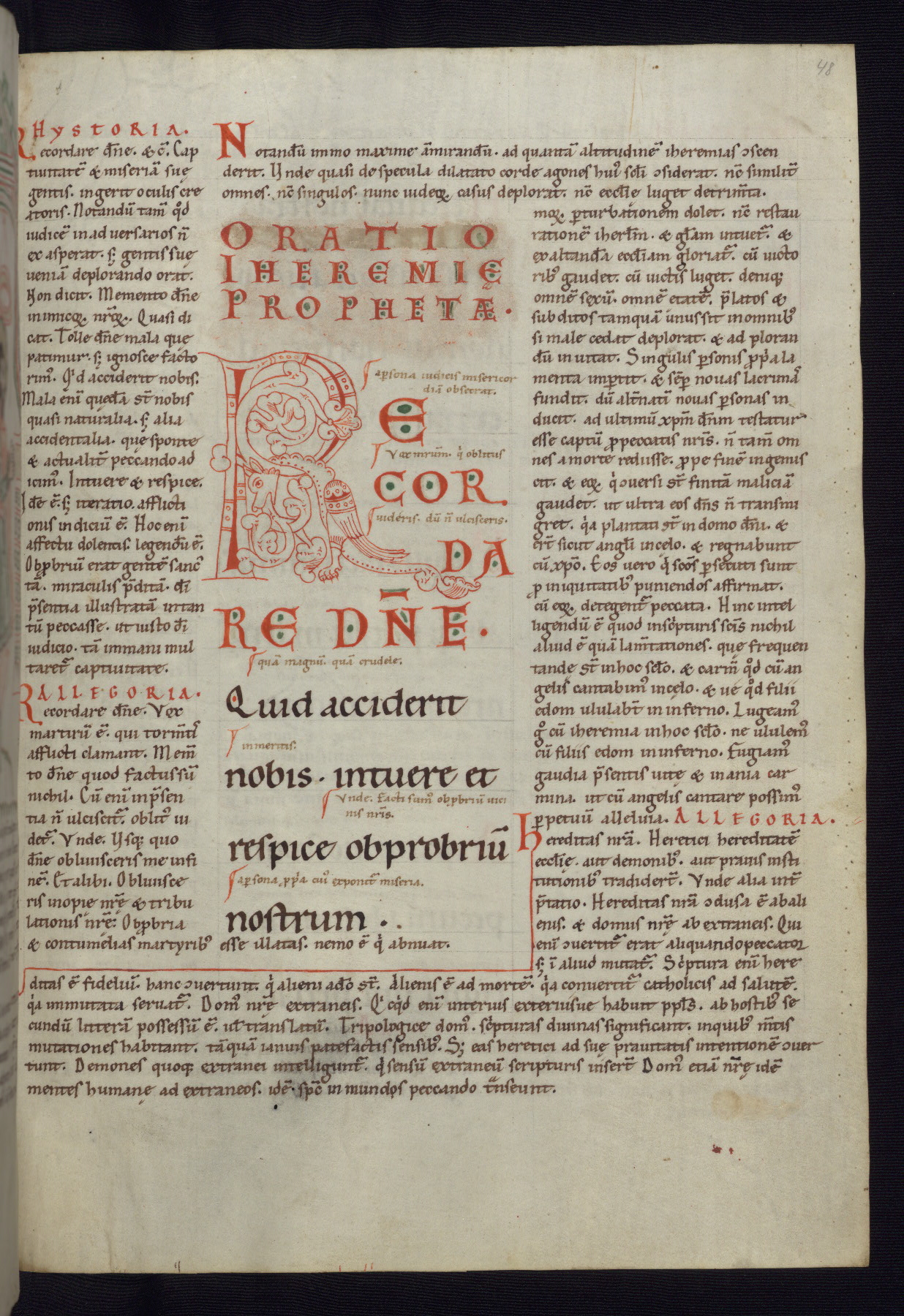
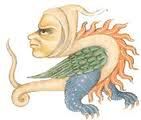
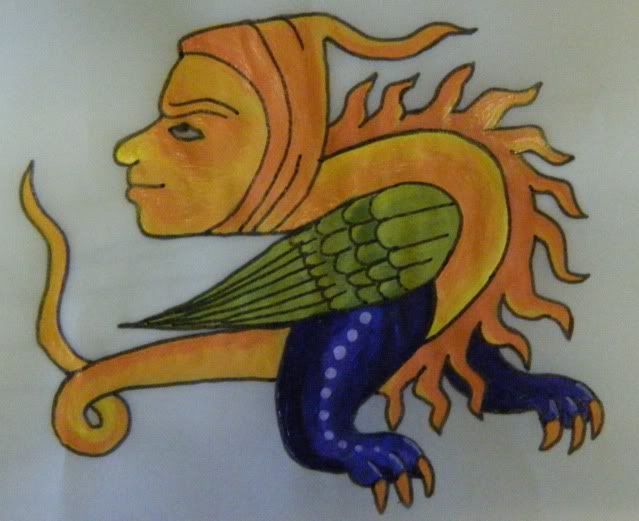
I hit a minor wall with my celtic scroll the other day. I decided to start with the device and then work out the colour distribution from there. I started by doing a test run of all the colours I currently have so I start with a good idea of what tones match the colours of the original Book of Kells. Then I hit a snag - green. The two greens I had were a light green and a dark green. I needed a brighter mid-green colour. and I don't want to mix my own, because I know inevitably I'll run out right before finishing and won't be able to match the colour. I've talked to a number of other illuminators and most of them remarked on the problems of getting a good green (mostly because they seem to need two coats).
In my travels back and forth this week I decided to acquire myself a range of greens rather than mixing them myself. If I find one I'm happy with this has the benefit of being consistent and I won't run the risk of running out of pigment as I work on this scroll.
These are all of the colours so far (dried) with their brands and colour name written next to them. I was hoping reno art - pale green would work well but like Reeves crimson it's sort of shiny so not suitable for my needs.
Showing posts with label Illumination. Show all posts
Tuesday, 28 October 2014
Scribal things #2 - Going green
Thursday, 23 October 2014
Scribal things #1 - Book of Kells AoA scroll
I'm now a member of the College of Scribes and I have been assigned an AoA to do. This AoA is for a lass who I'm not familiar with. Apparently she likes celtic things so I'm completing one of the Book of Kells blanks for her. The benefit of this is it's all block colours, so reasonably straight forward once I decide on a colour theme.
To start with I've researched the scroll - here's an example of a completed version on the Lochac scribes database. I've googled up all sorts of Book of Kells images (I've misplaced my Book of Kells book in the move) and have found some of the original reference material.
Folio 124r - lion on wikimedia.
and a close up:
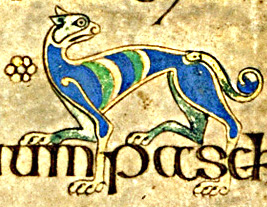
And the dog from folio 111(r?)
So the question is: retain the colours of the originals and be all over the shop, or bend to more modern ideals and sort of colour co-ordinate with the device (green and white)?
To start with I've researched the scroll - here's an example of a completed version on the Lochac scribes database. I've googled up all sorts of Book of Kells images (I've misplaced my Book of Kells book in the move) and have found some of the original reference material.
Folio 124r - lion on wikimedia.
and a close up:
And the dog from folio 111(r?)
So the question is: retain the colours of the originals and be all over the shop, or bend to more modern ideals and sort of colour co-ordinate with the device (green and white)?
Sunday, 18 May 2014
Scribes guild application - exemplar
Anyway, I present my exemplar. It's been styled
after the Macclesfield
Alphabet Book. It is similar to my previous
attempt which was done with acrylics. I have added some things and remove
the berries and tried to stay true to the colour scheme. I have sort of failed
in one way because the original colour scheme has two red pallets, one fading
to an orange and one fading to a pink. Ah well, I still think it is vastly
superior to any of the attempts I have made with acrylic thus far. I'd hope someone would be happy to have something like this on their wall as their AoA.
Friday, 1 November 2013
Preliminary documentation for potential November Crown A&S entry. Pt 1
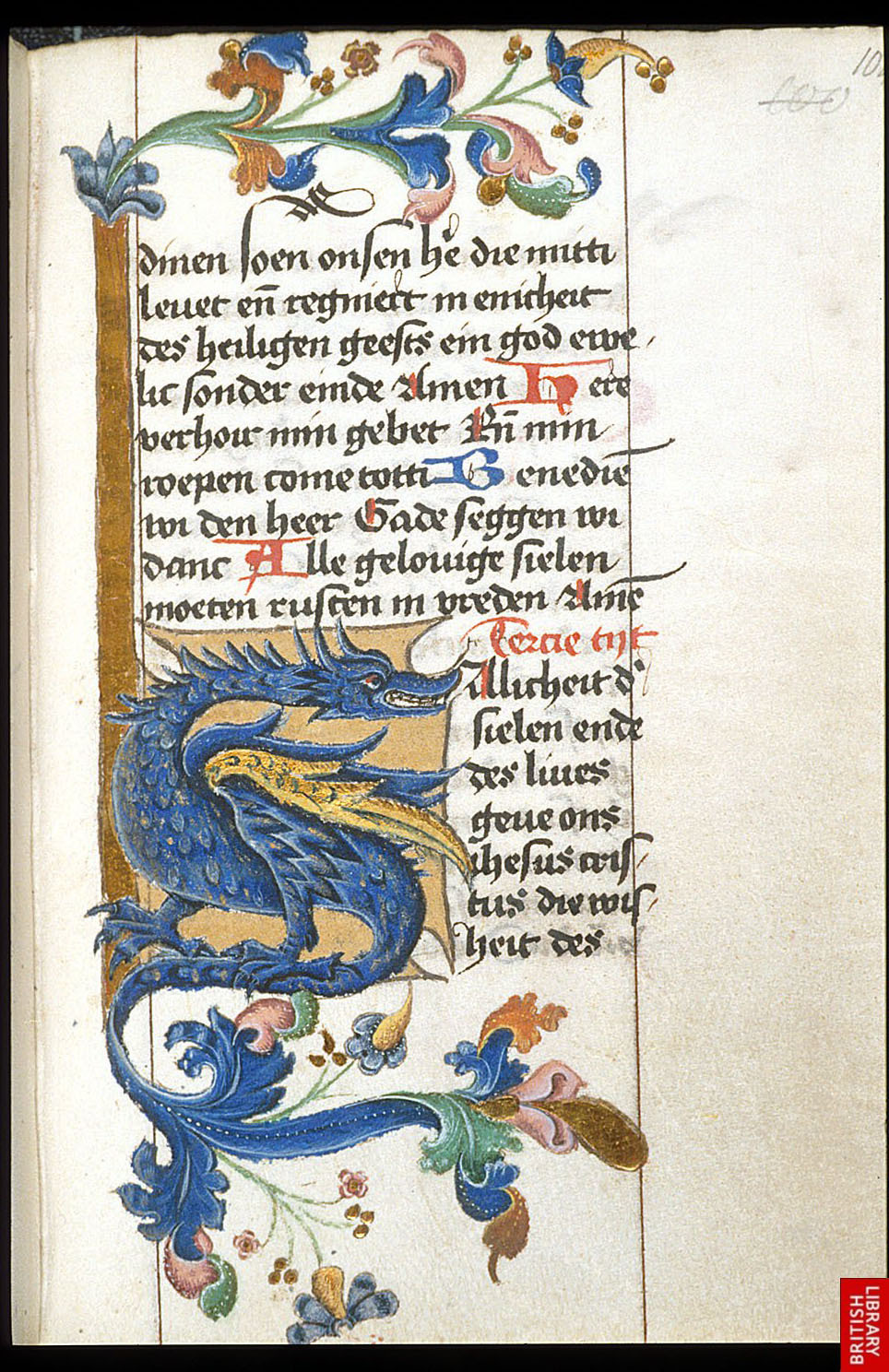
Preliminary documentation for potential November Crown A&S entry - an Illuminated letter
H (12)
| Title | Codex Vindobonensis Palatinus 1173 |
| Description | Zoomorphic initial H. Dragon.<br>Bible. Old Testament: Job, Tobias, Judith, Esther, Machabaeorum II, Isaias, Jeremias, Baruch et Ezechial |
| Date | 15th century |
| Source | 17560 |
| Language | Latin |
| Folio | 199 f. |
| Further Information | For further information, visit http://www.hmml.org |
| City | Wien |
| Library | Österreichische Nationalbibliothek |
| Country | Austria |
| Shelfmark | Codex Vindobonensis Palatinus 1173 |
| Folio Number | f.123v |
| ImgBC | IM00025587 |
T, R, C, S, Y, M (13)
Secondary source, The art of illuminating as practised in Europe from the earliest times. Illustrated by borders, initila letters and alphabets, selected and chromolithographed by W.R Tymms. With an essay and instructions by MD. Wyatt, archt. Published 1866 by Day in London
Plate detail: 12th Century. Mr Henry Shaw, in his beautiful work on illuminated manuscripts has devoted no less than eight plates, giving an entire alphabet of initial letters, to the illustration of the remarkable MS, which is well known as the Harleian No. 2800 and which has furnished the material for the Plate under notice, as well as for our pl. 28 of the same century. Sir Frederic Madden considers the MS. to be "written in the class of character which came into use at the close of the 12th century, and which formed the link between the round open letter of the preceding century and a half and the square or Gothic letter of later period.
(caption for plate 28 reads: the alphabets have been selected form the Harleian MSS No 2,800 which contains in three large folio volumes a series of lives of Saints for the whole year. The voluyme formerly belonged to the Monastery of St Mary and St Nicholas at Arnstein in the diocese of Treves. The initial letters throughout are for the most part executed in red, with the grounds of the scroll-work, of which they are composted, filled in with light blue and green, after the usual German manner of the 12th century. The drawing of the altogether conventional foliage is good throughout the whole work, which is ascribed by Sir Frederic Madden to "about the year 1190".
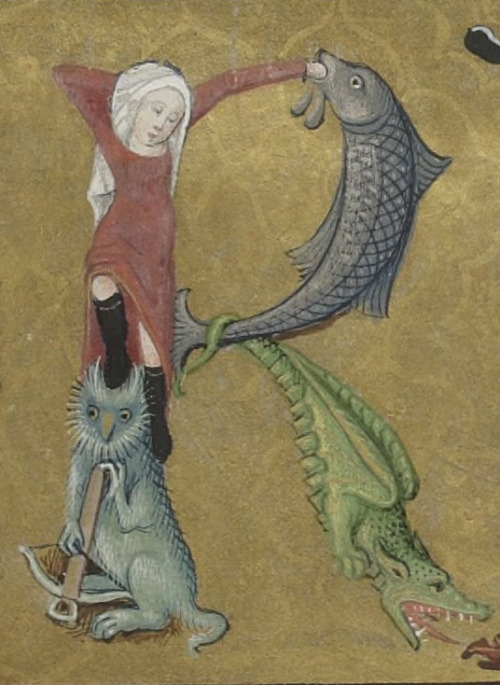
R (14)
Bibliothèque nationale de France, Latin 1173, two initials from f. 52r. Horae ad usum Parisiensem. France, 1475-1500.
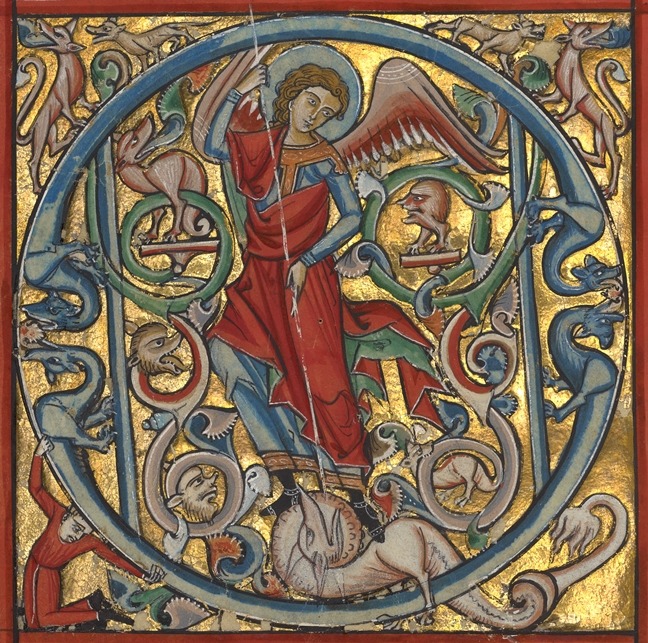
O or Q (15)
Saint Michael and the Dragon in an initial Q by an Unknown master German, Würzburg, about 1240 - 50 Getty Museum
This illustrated copy of The lamentations of Jeremiah with the gloss
(or interpretation) of Gilbert of Auxerre was written in Austria in
the second half of the twelfth century and comes from the monastery of
Seitenstetten. Gilbert died in 1134, and the manuscript is an early
and important witness to his text. The gloss is written in a small
script and is both interlinear and marginal. This layout is typical of
glossed books of the Bible from the twelfth century. The illustrations
of the sack of Jerusalem and the return to Babylon give valuable
information on twelfth-century armor. The manuscript is in its
original binding.
For a page-turning view of this manuscript, visit art.thewalters.org/detail/19816/gloss-on-the-lamentations...
For high-resolution images and full cataloging information, visit www.thedigitalwalters.org/Data/WaltersManuscripts/html/W30/
F(16)
Dragon with its tail tied in a knot. The initial "F" from a 12th-century
manuscript at Stift Zwettl, Austria, Codex Zwettlensis 208 : HMML Color
Microfilms
B(17)
A dragon forms part of the initial "B" in a manuscript from Stift
Klosterneuburg, Austria, Codex Claustroneoburgensis 710 : HMML Color
Microfilms
S(18)
19
Detail of a miniature of the dragon constellation ('Draco'), in tables
from Ptolemy's Almagest. Arundel 66 John Killingworth, Ptolemy, Guido
Bonatti, Plato of Tivoli Almagest (extract), Liber Astronomiae, Liber
Arenalis, astronomical and geomantic tables, political prophecies
England, S. E. (London) 1490 Latin and French Gothic cursive
U(20)
- Historiated initial 'U' depicting an interlacing pattern and fantastical animals, from the Bible of Saint-Andre aux-Bois (vellum) creator French School, (12th century)
- French
- lettre ornee d'entrelaces et d'animaux fantastiques;
- Bibliotheque de l'Ecole des Beaux-Arts, Paris, France
- vellum 12th (C12th)
- S(21)
Second page with decorated initial S.
Minute for Le Miroir de la Salvation humaine .
Bibliothèque Royale, Brussels, Ms. 9249–50, fol. 1 verso.
Minute for Le Miroir de la Salvation humaine .
Bibliothèque Royale, Brussels, Ms. 9249–50, fol. 1 verso.
Thursday, 11 October 2012
Illumination - November intent to contest I
An attempt at illuminating our intent to enter November Crown letter. The fine black ink lines aren't strait enough and I've screwed up the shading on some of the blue items so I'm not entirely happy with it. I'll be re-doing it with a light green as well as it looks to dark, and the green doesn't match the original close enough. Apart from that, this was an enjoyable learning project for shading. I might apply some of these techniques on my next plate project. Though here the base colour is dark, and when dry, shaded with two lighter colours which won't work with glaze pigments.
Wednesday, 5 September 2012
The Macclesfield Alphabet Book - Review
The Macclesfield Alphabet Book with introductions by Christopher de Hammel and Patricia Lovett
ISBN-10: 0712358048
The Macclesfield Alphabet Book is a beautiful 15th century English manuscript which appears to be serve the purpose of a pattern book. It contains a range of alphabets including decorative initials with faces; foliate alphabets; a zoomorphic alphabet
of initials, and alphabets in Gothic script. There are also large grotesque initials and a number of different types of borders (see below).
The
manuscript was acquired by the British Library in 2009.
Grotesque on page 10
For those interested in reproducing medieval illumination this is an amazing reference. Images range from sketches, to outlines, to coloured peices and gold leafed sections. The range of alphabets has something to suite any work of art. The introduction discusses the Macclesfield Alphabet Book in terms of contemporary scribal work as well as other pattern books. The practitioners introduction has a wonderful discussion of the scribe and his tools. I was quite taken with the step by step process of creating a finished piece.
5/5
Coloured borders on page 45.
Sunday, 22 January 2012
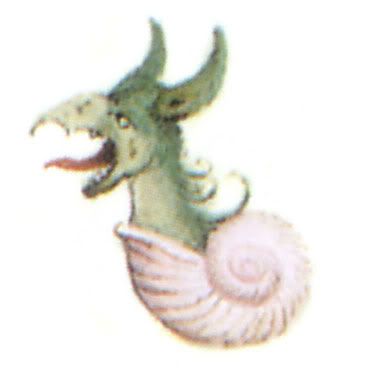
Drollery
Original drollery image (Google
|
I think it turned out reasonably well. The eye isn't as nice as I wanted but the colours on the legs and feet I'm happy with.
|
Saturday, 21 January 2012
Thursday, 19 January 2012
Illumination experiments continued
Continuing the theme of my last post I have increased my attempts at learning medieval style shading and illumination.
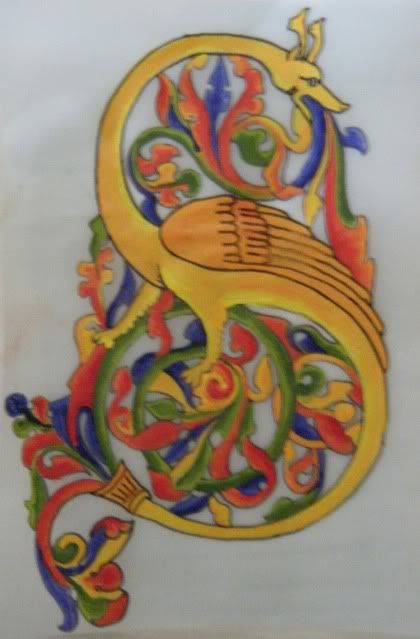
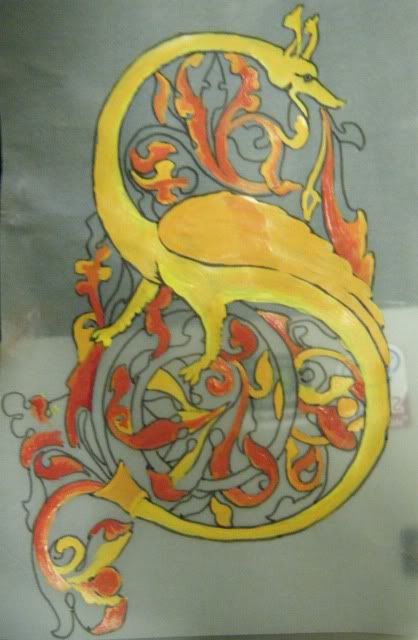
Below is an as-yet unfinished attempted at an illuminated S. I have completed all of the reds and much of the yellows and just need to finish up the greens and blues. I rather like how this one is looking (apart from the smudge fingerprint on the left). Maybe I should find someone willing to do all the calligraphy so I can make an attempt at a scroll. Maybe I should have a chat to Stanzi or Katherine Alicia of Sarum as I've seen them produce some lovely work.
Monday, 16 January 2012
Illumination experiments
I have been pondering my next plate (after the two household ones currently in the works). There's alot of very nice 15thc plates from Deruta however many of them require shading rather than solid lines and textures. I'm not confident enough in my abilities yet to commit to a large plate so I've been trying to find ideas in which I can practice on before doing a full plate.
One idea is practicing with some drolleries on smaller plates. Something like the one above which came from the Croy Hours (date unknown because I google image searched rather than re-searched).
During my wanderings around Spotlight a couple of months ago I found some sheets of vellum which are about A6 in size. So I've tried my hand at illumination as a shading experiment. Once I'm happy with an illumination project I'll go back to the plates and the added complication of blending (or not) glazes.
Experiments so far:
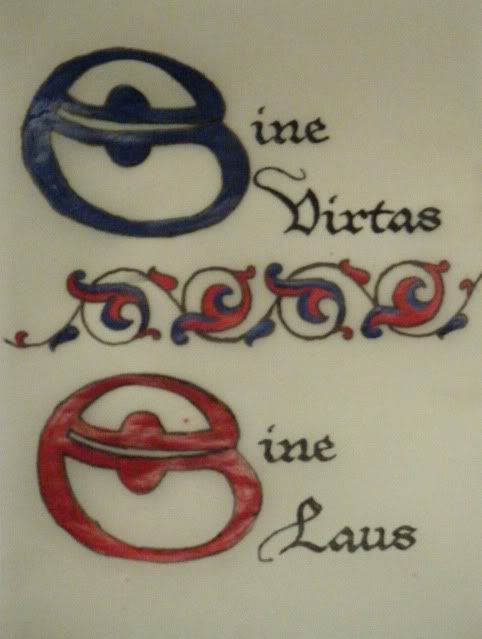
Attempt 1: No guts, no glory. I was thinking of my man when chosing this motto. I'll admit the calligraphy isn't mine (as this is a skill I've attempted in the past and don't have enough time/interest in perfecting). I actually found a collection of medieval fonts on line developed from period resources by Pia Frauss (http://www.pia-frauss.de) and I fell in lust with some of them. This one, EtBoemieRex is based on a charter issued in 1359 by the German/Roman emperor Charles IV, granting a market privilege to the city of Hambourg. I printed then traced the words I wanted as the calligraphy is just bulk for the illumination to surround. | Attempt 2: Knowledge is power. Same deal with the font here as in attempt 1 however where I traced the font with a ink pen for attempt 1, here i traced it with paint, it's thicker and uglier I think. I created the little Dolphin scrollie things inspired by a 'medieval designs' book I own and the fact that Krae Glas' animal seems to be a dolphin, The white work within the S was done using a whiteout pen as I thought that using a brush would be too difficult as I'd have to go over it multiple times. Since taking this image I have painted over the white and redone it much finer and neater with white paint and a paintbrush. Sometimes short cuts aren't short cuts at all. I really like how the fish things turned out. |
Subscribe to:
Posts (Atom)