
Showing posts with label Mughal. Show all posts
Showing posts with label Mughal. Show all posts
Tuesday, 5 November 2019
Mughal flat hat
The Mughal flat hat!
 Late 15th Century. Shapur with the daughter of Mihrak, by Qāsim. British Library MS 5600 - f.399v: Look at the detail on her hat! I love the beaded (pearl?) trim on the edge and the suggestion of gems all over.

Tuesday, 29 October 2019
Lets talk about pants
So, in my usual method of garb creation, I've started with a half remembered reference and jumped into my project. I've begun practicing block printing on bigger items and thought I should start with a ~2m bit of fabric because then I could make it into pants. Because, you know, you can never have enough pants.

Cue many many hours of trolling through manuscripts trying to find diagonal prints!
Here are some findings and comments thus far:
Some Safavid pants to start...




Anyway, I've now block-printed half the fabric and I couldn't remember if the original reference looked like the diagonal strips both trended the same way or opposite ways. i.e. do I need to change orientation half way through the print to make a V shape or can I get away with //// all over?
Cue many many hours of trolling through manuscripts trying to find diagonal prints!
Here are some findings and comments thus far:
Some Safavid pants to start...

Folio 155r, British Library. MS 6613. Pants appear to have a dark stripe over blue, red and black diamond pattern. The diamond pattern is offset in the right leg which suggests an alternate construction method where the pale fabric is sewn together out of isosceles triangles, allowing the pants to gently increase in size with every rotation. Given I'm not very good at sewing, I think this would only happen if you were short on fabric, otherwise just gather / pattern to taper to the ankles.

Folio 184v, British Library. MS 6613. Pants worn by the Greek Princess. Same manuscript so artistic style is unlikely to change however these appear to have aligned triangles and alternating gold and grey bands. I wondering if the white dots are dyed, pearls, embroidery or spangles?

Woman holding a daisy. Herat (Afghanistan) Safavid. 1570-1578m. The Met Museum, 55.121.42. Diagonals again but such detail on the closeup! The fabric is fantastic and does suggest the entire piece is either diagonal stripes or vertical and the pants are cut on the bias. Cutting them on the bias would provide some stretch.

Christian Maiden dies. 1600 Iran. The Met Museum. Folio 22v. Accession no. 63.210.22. Look at that splendid acanthus print!

Woman nursing a child. Bibliotheque Nationale Paris. folio 23r. Arabe 5847. Glorious colour combination and multiple foliages. It looks like these would fall into horizontal strips should she stand up.
Skipping to the Mughul culture now because when it comes to pants, I'm not picky.

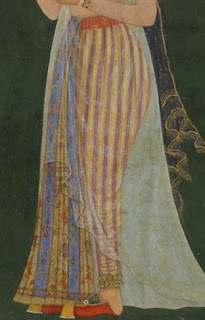
These are the pants of Princess Jahanara, painted in 1632. British Library, Add Or 3129. Folio 13v. I am really taken with these pants, the strips are fantastic! Unfortunately, the geometry doesn't work well. We see three red stripes at the ankle, which becomes 6-8 at the waist. We see no narrowing of stripes up the leg suggesting all stripes must either be cut off or gather/taper. To achieve this look, the fabric must be cut to ensure excess stripes on the front and back are cut to terminate on the inner thigh. Even then, superior tailoring is required to taper the cut from the hips up to the waist.

Lady with a narcissus. 1631-1633. British Library, Add Or 3129 folio 34r. Take a moment and admire this spectacular pair of pants. Yellow with blue mangos? outlined in red, with a blue framing pattern. Splendid!
I'll leave this collection there as there are many many pants down this particular rabbit hole. For now, I believe i have sufficient justification for horizontal, vertical and diagonal stripes. There is no supporting evidence, yet, of stripes that originate on the inside ankle with one leg clockwise and the other counter-clockwise so for now, I shall make the stripes all go one direction.
Saturday, 30 April 2016
Pelican Outfil #4 - Cloud collar design research
As mentioned in a previous post Miriam of the Alawim of Stormhold has given me a number of PDF's of Persian Cloud Collar images. I believe she collected the images for a Laurel Prize Tourney entry. This week I've been analyzing the images in my typical science before art process. (This is going to be an image heavy post). My conclusions are as follows:
The first set of images Miriam sent me come from one manuscript. Firdawsī, Shāhnāmah, Book of Kings. which is Turkman/Timurid style. Dated 23 Jumadi II 891 (26 June 1486). This manuscript features to main styles of cloud collar, a floral style, and what I've been privately referring to as the geese style. Cloud collars of either design don't seem to be restricted to a certain class or sex and can be seen on a variety of coat styles. I've drawn up the designs from a couple of the images in black and white to make it easier to see the particular elements.
 |
 |
 |
 |
In both of the images above, the same goose like shape can be seen as a major symbol surrounded by blobs and tick marks. The goose is always pointing towards the left and is rarely inverted to balance out the pattern on the opposite shoulder. Given the frequent occurrence of this decorative element I began to wonder what it symbolised so I spent some time squinting at the screen and trying to determine what it actually was. One figure has a single goose on the upper thighs so I worked out the shape as best I could.
 |
 |
After looking at many examples of the goose, I've some to the conclusion that it's possibly a word or phrase written in islamic calligraphy. Islamic calligraphy is a beautiful art form but difficult to read for a Persian newbie. I've waxed lyrical about my reluctance to copy something I don't understand so that leaves the floral designs. Two of these come from military figures which wear a chain mail or scale coifs. Given the regular pattern and symbols, and the fact the pattern isn't adjusted to the lobes of the collar just the center neck, I'd suggest this fabric would have been a brocade rather than embroidered. Brocades are harder wearing and can be cut from second hand garments. The threads of the embroidery are more likely to be caught and damaged by the rings used in construction of either coif. The third floral design appears to be a leaf pattern and I copied it because it seems to blend seamlessly with the coat along the arm. Perhaps this one is embroidered directly onto the coat rather than onto a separate piece of applique attached to the shoulders?
 |
 |
 |
 |
 |
 |
Second manuscript set of images Miriam sent me were from The Khamsah' of Niẓāmī which dates from 1539-1543. This manuscript features cloud collars which were counter-coloured against the coat. The designs are stylistic and floral reminiscent of the Iznik tiles produced in the area. There's one I particularly like which has a tiny bee or month amongst the flowers. Once again, all sorts of figures wear these sorts of collars. The manuscript also has a number of indivisuals with the gold on base style collars seen in the previous manuscript. I've drawn up two of these designs.
 |
 |
 |
 |
The first is a seated man with a repetitive design on his collar. This may be done in multiple colours of silk. I've drawn the central medallion with a Star Wars twist as it's hard to tell what it is given the size of the image. The other collar is gold and features floral designs which are repeated in each lobe. This figure also has a slightly different floral design around the sleeve cuffs. I like both of these designs as repetition creates balance but I'm also away it may not be possible with my pattern given the different shapes and sizes of the lobes. This is something I'm going to have to research further and maybe draw up a bunch of mini images to see what I like the most.
One question you might be asking, if you've been following these posts, why am I researching Timurid / Turkish cloud collars when I've already stated I wanted to make an Indo-Mughal outfit?
The reason being is the image I'm most drawn to is Babar seeks his Grandmothers advice. It's a Mughal manuscript which depicts the Turkish born (1483) Babar who established the Mughal empire. At first I thought this image, painted around 1590, was a 16th century impression of garb worn by Persians in the 15th century. I then did some more research and found that cloud collars were a thing well past the 16th century so it was possible this scene was depicted with the figures wearing 'modern' clothing to assist the audience in relating to the tale. The Mughals did wear cloud collars and Persian inspired outfits. I've found a few other images that document this and will continue looking for more.

Detail - Court of Ravana, folio from a Ramayana. India, 1605. Met Museum, Accession no. 2002.505
Monday, 25 April 2016
Pelican outfit #2 - Patterning the coat
Now I've determined I'm going to make a fitted coat in the Indian style, the trick is to pattern it. Given that patterning typically takes more than one person, and I am reasonably deficient in the sewing skills department I decided to hunt through the commercial patterns to see if there was anything I could adapt to suit my needs.
I came across two potentially viable options. The first seemed perfect for a Persian coat given that it was loosly fitted, with long sleeves and designed to clasp under the breast. Closer examination of the pattern though shows very little shaping in the design and the toile would be difficult to adjust to follow my curves. There isn't a bust line seam so any shaping would have to come from the side seams, which would just end up pulling on the clasp making the coat look ill fitting and me look too busty. I get that enough as it is.


I came across two potentially viable options. The first seemed perfect for a Persian coat given that it was loosly fitted, with long sleeves and designed to clasp under the breast. Closer examination of the pattern though shows very little shaping in the design and the toile would be difficult to adjust to follow my curves. There isn't a bust line seam so any shaping would have to come from the side seams, which would just end up pulling on the clasp making the coat look ill fitting and me look too busty. I get that enough as it is.

Pattern number two is probably the jackpot. It has centre bust seams which I can use to fit the dress. It has an optional upright collar which can be seen in some of the Persian dress examples. The downside to this pattern is I'm going to have to design my own sleeve template because I do not want puffy shoulders. This is a major downside because sleeves have been my biggest fail in the past. The other adjustment I'll need to make to this pattern is flair it more over my hips and lengthen the design.

This pattern luckily comes with a "lengthen or shorten here" line along the waist so I have a good idea of where to start my flair from. For my first toile I used 90cm wide black, mid-weight cotton I had lying around. I don't tend to keep calico in my stash and I find black shows up chalk marks much better than most colours. The downside to black is the photos don't turn out all that well. I laid out the pattern pieces and continued the line of the final 25 cm of pattern down to the full length of the fabric. I then sewed the pieces together (minus the arms) with the widest stitch possible making sure I remembered not to double back on my stitches at the start and end.
To fit the pattern I pinned the front closed and pinched each seam around my waist and under my breasts and stuck a pin in. I used white chalk to mark the peak of my breasts, hips, bottom and my nautral waist. I then unpinned the front and chalked a line to connect the pins smoothly to the sewn seams retaining the points of flair around the hips and bust and smoothly curving into the waist. The waist came in about 6cm all up and the under-bust came in 3cm on each side. I also made sure to smoothly curve the side back seams up to my shoulder blades as I've been ruined outfits in the past by neglecting to fit the back right. The most important part of the fitting was getting the shoulders to sit right. Until I made a dress for Tamar's wedding I never realised that this was a thing. I guess I hadn't given much thought to the different shapes of shoulders given I'm usually wrestling with a non-standard bust to ribcage ratio.
Once I had the fitting lines, I sewed them up with a tighter stitch and trimmed away the excess fabric. Once I was sure I had the fit right, I unpicked the side seams so I could lay the dress flat and trace the neckline for the cloud collar.
During my first trial I decided that the coat was a little too tight around the upper thighs and if I make it any longer I may have trouble walking. The images of both the Indian and Persian coats show plenty of fabric in the skirt so I decided to make another toile with greater flair from the hips. This one I've made out of a dark blue brocade. It's not really a toile, more of an experimental garment. I'll trial a non-embroidered silk cloud collar on it and attempt to line it as well.
In the mean time, here's my first toile with my first attempt at a cloud collar pinned to it. The hem is a little jagged due to my ad-hoc lengthening method but I'm reasonably happy with the waist and chest fit. I'm pretty sure it won't pull on the buttons or clasps in a terrible way.

The collar didn't work as well as I planned so I decided to tackle the sleeves next. I ran out of scraps of black of an appropriate size so I used some maroon cotton I had left over from an experiment with Roman garb I did about 5 years ago. I used the maroon as sleeves and may use it to line the brocade test garment. Anyhoo, I'm not so good with sleeves as mentioned but I think I've worked out some of the secretes and I present my sleeve pattern. Please note this is a half sleeve pattern as the left side is designed to be placed along a fabric fold.

A is the crest of the shoulder. It is possible to the top line A-B more of a sinusoid (as shown in red). The greater the depth of the sinusoid, the greater the angle of the arm. If you do not have a sinusoid or a curve, the arm will sit square like the classic T-tunic shape. Most female garments have some sinusoid to the arm in modern clothing. Having the arm inset at an angle cuts down in excess fabric in the arm pit however it does mean if you need to lift your arms above that angle you'll be lifting the whole outfit. I especially hate this feature of womens reflective work shirts so I've decided to keep the curve to a minimum.
B is the armpit. You could use a rectangle and have a gore but since I have fabric to burn, little desire to sew more seams than necessary AND I know the Indian tailors of old were experts at seams and fitting, I've decided to go with a tapered shape.
The line A-B is the measured distance along the inside of the dress sleeve. I'll increase this distance slightly by adding the curve but that's negligible and will sort itself out during sewing.
A-C is the length of the sleeve. In this case the sleeve reaches to my inner elbow. This length seems to be a common feature in Indian art but was truthfully dictated by the size of the fabric scrap I used to trial the arms.
I couldn't complete the arms until the final cloud collar design had been appliqued on but here's how they turned out.

You can see the final shoulder seam is sitting too far below the point of my shoulder and there's excess fabric in my armpit. I should be able to resolve both of these problems by bringing the seam back to the point of the shoulder. I will experiment with this further on the blue brocade test dress.
In the mean time, now it's appliqued, I can probably do some cheater mc-fee modern finishing touches, like a sewn rolled hem on the sleeves, over locking on all the seams, a placket down the front and a commercial frog or three and turn this into a plain but nice modern summer coat.
Subscribe to:
Posts (Atom)