Showing posts with label Kashan. Show all posts

Tuesday, 9 June 2020

The final globe

This is the final globe cup from my green series. I decided I needed to further expand my use of the medieval motifs and thought maybe for the final cup I'd step away from the green over black. Instead, I used the period motifs and modified to them to align with a more heraldic colour set.

After glazing in the rim decoration and the three cats in ebony, I decided I wanted to move as far from the green as possible. I thought this would be a really good project to trial my new Firetruck Red glaze performance. I retained the motifs of the extant cup with the striped half base and the vines but used olour to emphaise the design. The red glaze is a beautiful colour and I am really happy with how this design turned out.
The dimensions of the cup are more bulb shaped rather than the tapered look of the extant jug howver when handled, the elements tie nicely in together so I am satisfied with the look.

Jug with running animals. Kashan. 12-13th century. Cleveland Museum of Art. 1947.495

Saturday, 6 June 2020

Back to blue

I've spent a lot of time working with green overglaze these last few months. This was partly driven by the need to round out my skills with regards to my 12th night Arts and Sciences entry. While the green has been fun and I've enjoyed the new design elements, I must admit I find blue much more appealing. This piece was thrown during Covid19 lockdown times in my little basement workshop. I used PB103 white clay so I could avoid adding the complication of white underglaze. This piece has been fired to stoneware.


This piece was inspired by my previous arbarello collaboration piece. I rather liked the background fill and the use of white elements to balance the darker blue. I used 'Colbalt blue' underglaze for this one which is a much deeper, and delightfully dark blue. I do prefer the lighter Electric Blue I think but this is still pleasing.


Instead of copying a pattern direct, I thought I'd combine multiple design elements and continue my 'balance' project. I was largly inspired by the above asymmetric vine design. The image isn't amazing quality and remains quite fuzzy even when zoomed in which is unfortunate. I took inspiration from the vines as well as the white / black / blue balance. I've tried a number of versions of this which I'll post in future blog updates.


The design is symmetrical with a 1/2 division of the cup. after layering the underglaze, I dipped it in clear glaze. Once dry, I then carefully rubbed glaze with my finger tips to ensure no air bubbles had formed. This seems to have worked really well as this cup has excellent gloss coverage. I am really happy with how this cup turned out!


Thursday, 7 May 2020

Green globe attempt 5


This was my 5th attempt at a green globe cup. I think I have figured out the difference between batch 1 & batch 2. Batch 1 was glazed at peak summer just after 12th night. Batch 2, glazed about a month later during cooler weather. As a result, a lot of the water from the first mid-green glaze didn’t evaporate before I dipped the cups in the translucent green. This meant less translucent green so a lighter frothier pale green. This time the first coat was given more time to dry so more of the translucent green glaze stuck. It provided a better green colour however the translucent glaze has a fair amount of silica in it so too much will make the glaze run and smear the under glaze.

Kashan cup with stylised vegetal decoration and inscriptions under a transparent turquoise glaze, Persian, early 13th century. Sotheby’s. Arts of the Harvey B Plotnik collection, item 177. There is also a slightly fancier version with slightly different proportions in the Victorian and Albert museum here.


Pictured above is the extant ewer whose pattern I have utilised. Per standard, I haven’t even bothered replicating the text as I do not know what it says nor do I know what effect an imprecise replication could have. I just loved how well balanced this design was and wondered if I could manage something similar. The original is 12cm high while mine is only 8cm, two thirds of the height. Skipping the basal section seemed like the right approach to maintain the shapes and ratios. I think it has worked out quite well.

The design in black under glaze. This was quite fun to do as the pattern wraps around the bulb of the cup quite nicely.

Fired. A small amount of running has obscured parts of the design. An interesting lesson from this cup - do not underglaze the rim. On previously posted green glaze cups it is possible to see the rim of the cup has very thin glaze. This section is usually pulled out of the glaze dip last and while thin, has the most time to accumulate glaze. As it is at the top of the cup during firing, it also is the first to have the glaze run. The sort of metallic shades to the rim on this cup is due to the glaze running and collecting the black underglaze. This has given it an interesting sheen. Though this is an easy way of treating the rim and makes a good visual border, I won't be using thick bands of underglaze like this again.

Friday, 1 May 2020

Not-a-globe but still green

Finished - green glaze conical cup with black underglaze in the style of 12-13th century Iran.

I've been focusing on achieving balance in my underglaze pieces recently. It is an interesting challenge to even out the light and dark space as well as the thick and thin lines. I was intrigued by this extant cup (below) as it has so much black yet still achieves a balanced finished look. I wondered if I could replicate it and if the lighter green I've been using will still do it justice.


Left: black underglaze. Sketched in 8B pencil then hand painted. Right: Extant cup, 12-13th century, Iran. Harvard Art Museum. Item 1936.48.

Even though the green ran a little, I'm pretty happy with how close to the extant item the colour is. The cup probably needs to be a tighter cone shape with slightly thicker walls. This unfortunately deformed a little in the kiln losing it's pleasing circular shape. It's still viable just not as perfect. A solid 7/10 in my opinion.


Saturday, 4 April 2020

Kashan fish cup


I don’t really care how the overglaze on this one turns out. I’m already very happy with how this design has turned out.


I copied this design from the bowl above. I’ve found two images of it but other details are slim. It is captioned ‘ Bowl with fish (late 13th to mid-14th century), Iran, probably Kashan. Stonepaste; black decoration under transparent turquoise glaze. The Hossein Afshar Collection’. I’ve found a similar bowl at the Art Gallery of South Australia here but it doesn’t have quite the same fishy swirl.


This is going to look amazing once it is green!

Monday, 9 March 2020

Iranian globe cup decoration


Full discussion and analysis once they have been fired. For now, an under-glaze update. I’m in love with the fish and kelp? I thought I’d also create my own motif with the octopie for a proper nautical theme.

Saturday, 20 May 2017

Belated ceramic 48 & 49 - Tiles 12, 13, 14, 15 & 16

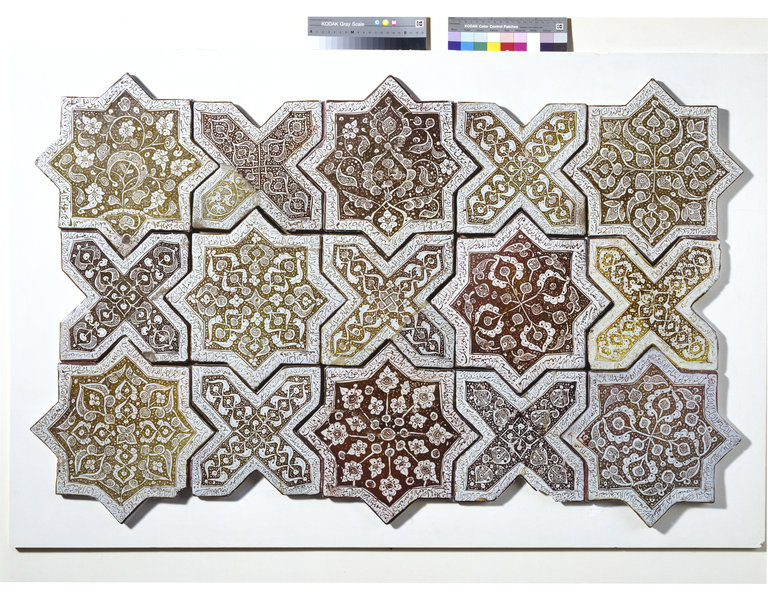
The tile project is ongoing! I collected four new tiles this April and I'm so happy with how the design is going. I'm going to start posting my reference chart as well as boast about my project. Forgive the not so amazing picture but it's the best I have.

One of the small 1/4 cross tiles isn't show here as it doesn't have it's matching stars yet. The key (belated) tiles are the three in the bottom left of the image.


Two of the tiles are from one reference panel, the third on the panel is already featured on the right of the middle row.

Lustre tiles. 14th Century. Kashan, Iran. The British Museum. 1888.0109.4

Sunday, 14 May 2017

Why Iran? Why Kashan?

So, I have resolved my first research question:

How did Blue and White ceramics transition from China to Europe?
Turns out they didn't. Blue and white ceramics originated in Iran and spread across the middle east and eventually made it to China. China developed a new style as they were able to fire their glazes at a higher temperature for porcelain. This changed the colour slightly as they were able to burn out arsenic and some of the manganese. China eventually discovered their own deposits of cobalt, but were dependent on imports from Iran for many years. The lighter, stronger porcelain transitioned out of China into Europe along the silk road. It resulted in the revival of Blue on White popularity and the many duplication of patterns onto heavier earthenware. This Asian-appropriation was adopted by the Dutch in their manufactories and given a more European theme (Delft) while the Italians went down the multi-colour path of majolica. Turkey meanwhile, developed their classic red, blue, turquoise of the Iznik style.

The next research question to be answered (it's a two parter):
Why Iran and Why Kashan?
What was it about Kashan that permitted the production of such a large number of tiles? Was it geology, geography or political?
Where did the cobalt actually originate from? There are a number of geological settings that could produce cobalt ores. How was it refined?


Wednesday, 5 October 2016

Ceramic 47 - Tile 11

This one collected dust for a while. That is to say, the plastic I wrapped it in after it was glazed and dry collected dust as I didn't have an opportunity to drop it off to get glazed for months. This is the start of the top corner. I'm not sure if I'm going to finish the entire square but I do hope to finish at least the top half.


Monday, 1 June 2015

Pot of the Week: Iranian ewer with braided inscriptions

I love the intricate detail on this item!
Ewer, lustre fritware. Kashan, Iran. 1270-1271 (CE), 669 (AH). British Museum. G.242

Saturday, 25 April 2015

Blue on White Ceramics, Iran pt 1- Extant objects 50-89

This is the post contains extant references 50 - 89 which I utilised in my blue-on-white ceramics in Iran pt 1 (the first 45 can be found here, and yes, I skipped numbers 46-49). I've downloaded each of the images and provide the reference details so those who don't want to have an explosion of tabs while reading my little essay can enjoy the making the visual comparison of all the items together. If you wish to see all the images I don't mention but helped me form my conclusions please visit my pinterest collection. 
If you know of an extant item that contradicts my research or that belongs in my pinterest collection, please throw a link in the comments below!

Thursday, 23 April 2015

Blue and White ceramics - Iran part 1

Blue on White ceramics: the reciprocal influence of Chinese porcelain on European and Middle Eastern ceramics - Iran - Part 1

Other essays on the history of BoW in IraqEgyptlate Iran, JapanChina, Turkey, Spain, The Netherlands, Italy and England.

Iran

Early carved/incised and molded items

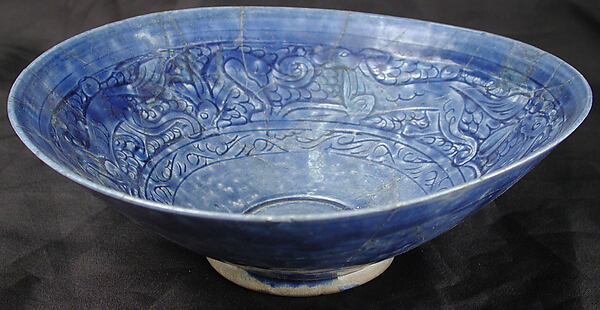
I have bundled carved/incised and molded items together because the application of the glaze (dipping) is similar. These are not strictly speaking BoW items, however the timing of pure cobalt glaze use is interesting. The earliest cobalt Iranian examples come from the 12-13th century (1, 2, 3, 4, 5, 6, 7, 8, 9) (I have also located one from Syria dated to the 11-12th century (10)). Decorative carving/incising predates this, however these items often weren't covered in coloured glaze. Instead, an earthenware item would be dipped in a white slip (clay) which would then be carved to reveal the red/black of the original item before a clear lead based glaze was applied over the top to seal the item (11).

12th century
In the 12th century, Iranian potters seem to have started dipping carved items in a thin layer of coloured glaze filling the deep cuts and outlining the design (1-9). The dipping process (as opposed to submerging or painting) is evident by the unglazed section of the foot, often featuring drips of coloured glaze (12). It is possible they adopted this method from Egyptian potters who were using opaque green and turquoise glazes in this manner since the Ancient Egyptian dynasties. Incised or moulded items were both produced in Fustat, Egypt (13) as discussed in my previous post on Egyptian BoW.

The Iranian potters also combined slip carving with coloured glazes. By applying a black or white slip and then carving down to the coloured body of the item, potters could then apply a single coloured glaze producing a dual-colour item with only one firing required (14). There seem to be many turquoise examples of incised items (15, 16, 17, 18, 19) but only a few cobalt. Perhaps this is because the cobalt is typically darker and doesn't contrast well with the darker clay body. Colours such as brown (20) and turquoise, seem to be utilised more frequently than cobalt for both molded (21, 22) and incised (23, 24, 25) items. Note the similar shape between the brown molded bottle (20), and a Kashan striped bottle (26).

In addition to the dual-chrome incised items, potters had developed a style involving painting multiple coloured glazes onto a carved item creating polychrome designs (27, 28, 29). I have yet to find an example of this in cobalt. I believe this is because cobalt works best on a white background, and the Iranian potters weren't using white opaque underglaze yet.


13th century
Later in the 13th century molded-ware seems to become the dominate form of dipped cobalt items possibly due to ease of mass production. Items are molded out of stonepaste or earthenware (30) before being glazed. This style seems to use a thicker application of glazes so the raised sections, which are thinner and therefore lighter, outlined the design (31, 32, 33, 34, 35, 36, 37, 38). At the same time, plain dipped cobalt ware was also being produced (39, 40, 41, 42) across Iran.

Molded items could also be overglazed with lustre (43) after the initial firing or have gold applied to the raised sections (44, 45). This is a relatively easy approach as the raised sections, especially on flat items like tiles, are easy to gently grind away providing a superior application surface for gilding. In addition, the sloped sides of the raised sections provided a graded effect in the glaze and essentially highlight the shape. Gilding is typically utilised for tiles as the gold is rubbed off with continued use so would not be appropriate for everyday vessels.

Interestingly, a majority of the Iranian monochrome carved and molded items I found were turquoise not cobalt blue. It could be argued that cobalt blue ceramics should occur frequently in Iran as the source of the pigment is proximal making the glaze comparatively cheap (or at least cheaper than their distant counterparts could source it). Though blue did feature often, it was one colour in the glazier's pallet and the predominance of turquoise suggests it was easier to mass produce or socially more desirable (perhaps the Egyptians love for turquoise plays a part here?).

Given this essay is focused on BoW ware, it behooves me to mention the BoW radial striped items originating from Kashan (the location of the cobalt resource).

Bowl
Item 12 - Bowl, Iran, 12th - 13th century. Metropolitian Museum of Art accession no 12.72.3

Kashan BoW Striped Items

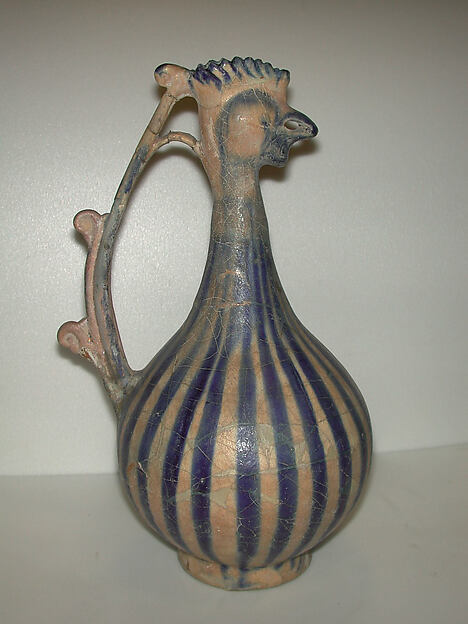
To date, I've collated a number of blue and white radial striped items specifically listed as originating from Kashan. Created in the 12th-13th century, this unique striped look was clearly massed produced and applied to multiple forms. Bowls (50, 51, 52, 53, 54), bottles/jugs (26, 55, 56, 57), vases (58, 59, 60), chicken headed ewers (61, 62) and cups (63, 64) are all represented. This style cannot be examined in isolation (as much as I like to make sweeping generalizations about BoW earthenware) as there are a number of transitional items that show the BoW radial stripes combined with other forms. For example, ewer 65 is molded, cast and pierced before being coated in tin-glaze and cobalt underglaze stripes (as is 66). In this case, the striped design element has been utilised on a molded piece rather than a built or thrown pots. This transitional piece bridges the gap between the production of the radial striped works and items such as this late 12th/early 13th century bowl (67) which has been completely covered in cobalt glaze. It suggests that either, stylistically, the style evolved quickly or the potters maintained several design 'lines'. Further evidence for this are two transitional bowls (68, 69) which are identified as 13th century. Both bowls feature a combination of the radial blue lines, with an inscribed black border and a central roundel with fish. A third bowl (70) with radial cobalt lines sports a central black geometric decoration. Produced alongside the radial BoW designs were blue and black floral designs such as these bowls (71, 72) and these cups (73, 74, 75). The cups feature a similar inscribed black band as the transitional bowls as well as the floral and geometric design elements this Persian style is known for. Additionally, the shape of both cups are extremely similar to the BoW cups (13 & 14), particularly the unique design of the handles.

Blue-black items dating from the 13th-16th centuries have been recovered from both Egypt (76) and Syria (77) suggesting this style was widespread. It's possible that this style was spread either by the movement of Iranian potters after the Mongolian conquests or later by the Mongols themselves throughout their empire.

Alongside the BoW ware and the Persian BBW items is a line of turquoise/black (78) and lustreware (79). This jug (80) is another bridging piece, with the turquoise/black glaze with radial stripes and a black band of inscription.

Rooster-headed Ewer 
Item 61 - Chicken headed ewer, Kashan, Iran. 13th century. The Metropolitian Museum of Art accession no 19.68.2

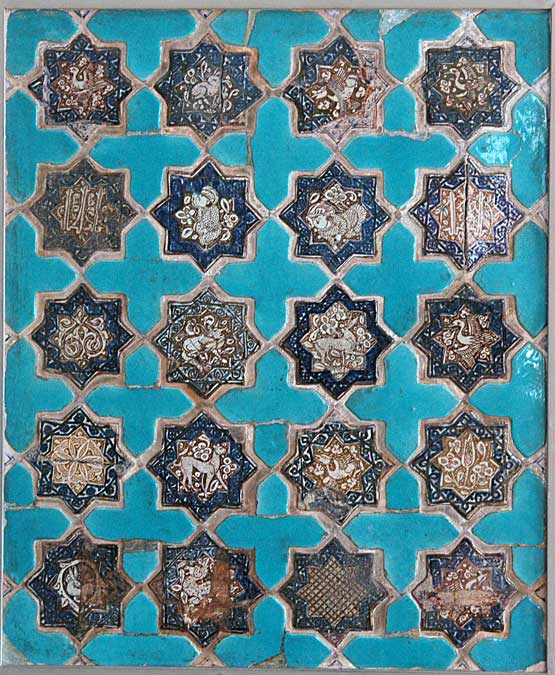
Kashan was also the production center for tiles (such as those utilised in my tile projects). Tiles produced in the 12th - early 13th century were typically lustreware (81) but later evolved to a lustreware/cobalt or turquoise combination (82) in the 13th century and later in the 14th century solid turquoise tiles (83) were featured. As cobalt and turquoise are both stable at high temperatures, items can be underglazed, fired, then have a lustre applied over the top (84, 85).

In the 14th century plate decorations evolved too, with lustreware being used in combination with blue and turquoise glazes (86), which in turn led to the evolution of Sultanabad-ware (87), more of which can been seen in my Sultanabad roundup or on my Saltanabad pinterest collection. There is some suggestion that the methods of lustreware was brought to Iran via the migration of potters from Egypt who originally gained the information from the potters of Basra, Iraq.

I have yet to find any BoW items labeled as being produced in Kashan after the 13th century. (There does seem to be a recent revival of the BoW striped pattern (88) which may be tapping into the antique market so care must be taken when identifying Kashan BoW striped ceramics.) The mid-end of the 13th century saw significant upheaval in Iran and Iraq due to the Mongolian conquest. Thousands of civilians were slaughtered or died of famine. This, undoubtedly, disrupted trade routes and severely affected the arts.

It's possible that the workshops producing the blue and white radial patterns were shut down at this time or supplies of cobalt were limited as the focus of the labour force would have turned to recovery and food production. It's also possible that the demand for finely painted polychrome or molded items led to the craftsmen turning away from the simpler radial designs and BoW items. During this time, the Il-khanid period, Kashan was producing lovely luster and cobalt/turquoise tiles well into the 14th century which were utilised on many public monuments (89).

Around the end of the 14th century a majority of the tile production in Kashan had wrapped up. This was due to the rise of the Timurid Dynasty which, at it's peak, controlled Iran, Afghanistan, much of Central Asia as well as parts of Pakistan, Syria and India. The capitol was based in Samarkland, Uzbekistan, resulting in a political and financial focus significantly further away from the Kashan potters. The Tamurid dynasty experienced a greater Asian influence than previously seen in Iran. This was in part due to the location of their capitol and partly due to greater trade along the silk road routes. This influence is reflected in the BoW items produced at the time.

Lustreware tiles from the 13th century. Tile Panel, Kashan, Iran. 1262. Victorian and Albert Museum, item numbers: 1837&A, C, E, F-1876, 1487-1876, 1489-1876, 1838&C, E-1876, 1077-1892, 1099&A-1892, 1100&A-1892