Showing posts with label Brustflect. Show all posts
Tuesday, 28 August 2012
Brustflect / Cranach Gown research cont.
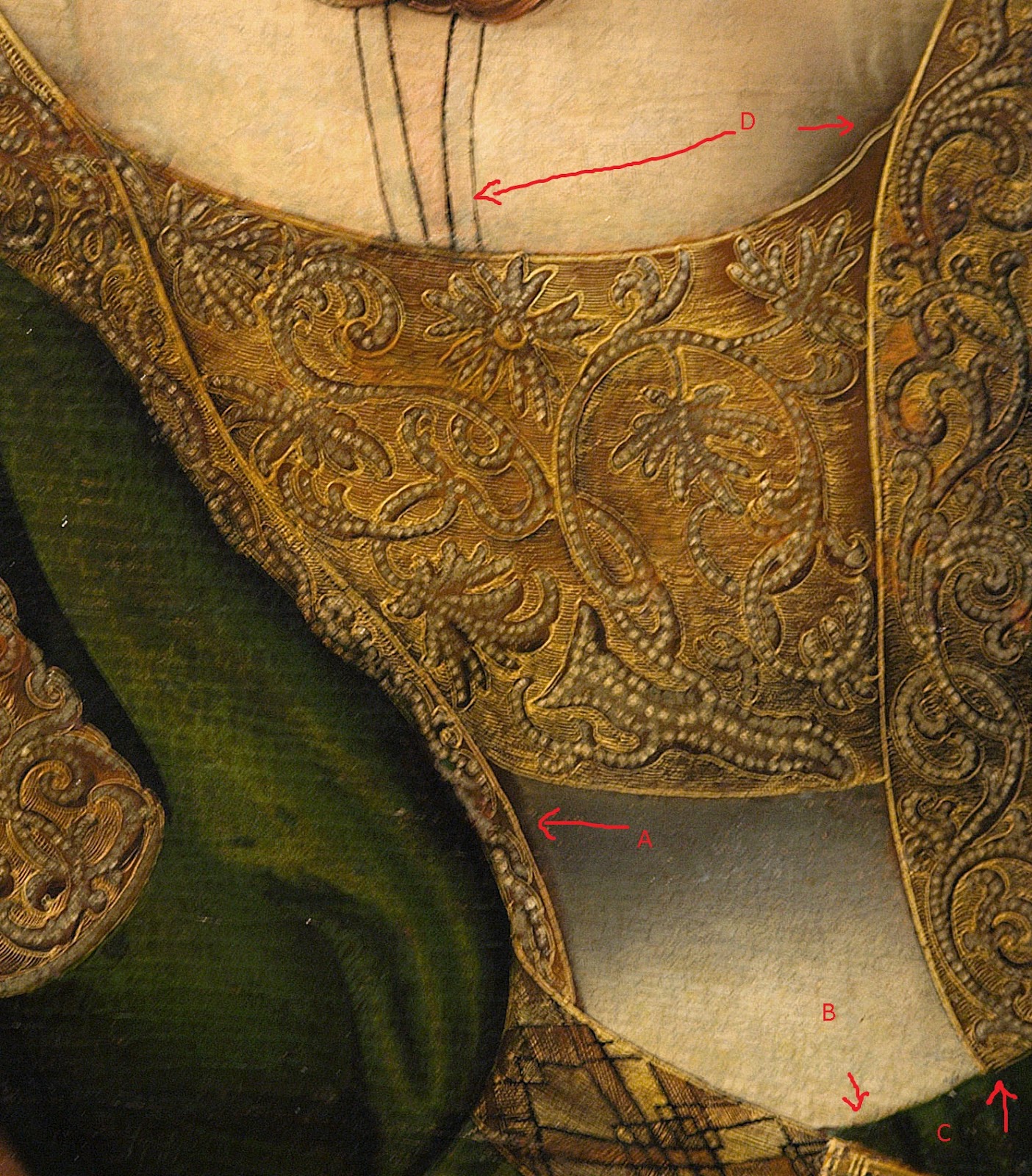
Portrait of a Woman - Detail about 1525, Lucas Cranach the Elder
This image clearly shows golden loops where the black lacing ties the bodice together. The lace seems to start on the right of the dress (left of the image) and laces back and forth until finally disappearing under the right side of the skirt.
Thursday, 16 February 2012
Cranach gown brustflect construction - an analysis
I'm still trying to work out how to construct a Cranach gown 'properly'. I've found some higher resolution images of some of the Cranach women which is helping in my task.
The Brustflect
1 - Jesus with Mary & saints Catherine & Barbara & 2 cherubs – Detail Highlighted here in green, the brustflect seems to join the right of the bodice snugly (A) while on the left the shading may suggest that the bodice overlaps the brustflect (B). The embroidery also seems to stop at the right but continue under the bodice at the left. At the bottom of the brustflect (C), shading indicates the guards on the dress overlie the opaque white fabric. | |
2 - The suicide of Lucretia. In this image the brustflect has been folded down however the folding at A suggests the opaque fabric continues around her body but it seems to run under the guard. At B we can see the decorative part of the brustflect is attached directly to the opaque white fabric and would continue down to meet the skirt (C). The Brustflect and opaque white marterial seem to be a single unit and run under the guards of the dress. | |
3 - Lucretia (1512). In this image we can see the Brustflect (A) has been folded down to bare her breasts. This brustflect is golden on the back rather than white (maybe because Cranach wanted to highlight then opened dress rather than have the panel blend into the excessive levels of white). There are strong black ties which would be the waist chinching ties seen on many Cranach gowns. I first thought these were tying the brustflect on and the pearled trim was the brustflects decorative trim. Closer examination shows the pearled trim is part of the dress guard as it runs straight from her shoulder. It is also possible to see lighter ties (C) that appear to come from the brustflect. These ties are too thick to be part of the fur and run against the grain in some locations. These images somewhat contradict each other, it may be that one side of the brustflect is pinned or sewn in place while the other is pinned or tied. |
Chemise / underdress
1- Jesus with Mary & saints Catherine & Barbara & 2 cherubs – Detail Here we clearly see two different fabrics, the translucent chemise (D) and the opaque white fabric below the brustflect. The skirt seems to join the bodice at C and shadows at A suggests the bodice overlies the opaque white (chemise?). It is not clear at B if the white is separate to the skirt, an underdress, or joined as a stomacher. | |
2- The suicide of Lucretia (1529). In this image the brustflect has been folded down however the folding at A suggests the opaque fabric continues around her body but it seems to run under the guard. At B we can see the decorative part of the brustflect is attached directly to the opaque white fabric and would continue down to meet the skirt (C). | |
3 - Judith with the Head of Holofernes (1537 – 1540) Here we see the white opaque material has been trimmed with tiny pearls and pleated in a ruffle on the top of the brustflect. On the basis of these images, I would propose the brustflect is most likely attached to the opaque fabric and the combination is used as a supporting garment under the main gown. I would suggest that it is attached on either side with pins much like the tudor gown outlined in Patterns of Fashion by Janet Arnold. |
Chemise Neckline?
1- Mary Magdalene, 1525. A number of the Cranach women have been painted with sloping black lines over their breast. It has been suggested that this is the neckline of a translucent chemise however in many of the images (like the one opposite) there is no discernable change in skin tone nor is the | |
2 - Jesus with Mary & saints Catherine & Barbara & 2 cherubs – Detail The Chamise: In this image two parallel lines curve over Catherine’s chest (A). Her skin tone between these lines (B) is pink suggesting this is the collar of a translucent chemise (there are also wrinkles near her armpits where it tucks into the brustflect). It’s unlikely that the fabric would change at the bust line from translucent to opaque as the translucent fabric doesn’t seem structural enough to support the opaque fabric. | |
3 - Saint Dorothea, 1530. Here Dorothea has a simple black ribbon looped around her neck. This is clearly not the edge of a chemise as it loops around itself multiple times. John Thrupp in “The Anglo-Saxon Home: A History of the Domestic Institutions and Customs of England” proposes that ribbons embroidered with prayers would be worn around the neck. While his book covers a period earlier than the Cranach dresses and of a different culture, it strikes me that a majority of the women wearing the ribbons wear simpler dresses. I’ve also noticed that when I wear a longer chain it does tend to get wedged in the top of my breasts and the chain forms an arc similar to that seen in the top image. Some of the Cranach women, i.e. Duchess Katharina von Mecklenburg are painted wearing a chain that drapes over their breasts a lot like the ribbon seen in 1. |
Thursday, 8 December 2011
Brustflect designs illuminated
| |
| An example of a gold brustflect with a blackwork floral design. The blackwork design is matched by the design on the guards of the dress except in the case of portraits of Katharina von Bora. (Mary Magdalene, Cranach the Elder, 1525) |
| |
| |
| An example of a gold on gold brustflect. These are typically made of a floral brocade. Some of the brustflects have a dark edging, some are adorned with pearls along the top edge. (Young man and old woman with girl, 1545-1550) |
| |
| |
| Pearl work on gold with a central motif and floral work / spirals. Motif is different than that depicted on dress guards. (Salome, Lucas Cranach the Elder, 1530). |
| |
| |
| An example of pearlwork on gold mounted on black. The pearls in these brustflects appear to have been mounted on black cord, or surrounded by blackwork. (Portrait of a Young Woman, Lucas Cranach the Elder, 1530) |
| |
| |
| An example of pearlwork on gold, diamond shapes without a central motif. These diamonds also have a sort of star or knot design at the junctions of the diamonds. Typically these brustflects are made of a different fabric than the guards. |
Tuesday, 29 November 2011
Brustflect popular designs
I'm having trouble not thinking about the Cranach gowns. I did a breastcover (actually brustflect aparently) analysis today. I examined 85 images showing a brustflect and compared the designs. I'll compile an example of the more popular ones next time I need a distraction from the PhD.
UPDATED: Now includes 91 brustflects, Gold on Gold (no pearl or blackwork) is the catchall category where images are of poor resolution and I am unable to place the design (i.e. smeary gold)
Of the 91 images examined, 20 of the ladies sported a V shaped chain which terminated just under the top of the brustflect (56 had no chain). 14 of the ladies had a black ribbon in the same position. This may be the edge of a chemise so further examination of high resolution images needs to occur.
UPDATED: Now includes 91 brustflects, Gold on Gold (no pearl or blackwork) is the catchall category where images are of poor resolution and I am unable to place the design (i.e. smeary gold)
Of the 91 images examined, 20 of the ladies sported a V shaped chain which terminated just under the top of the brustflect (56 had no chain). 14 of the ladies had a black ribbon in the same position. This may be the edge of a chemise so further examination of high resolution images needs to occur.
| Blackwork on gold, diamonds | 1 |
| Blackwork on gold, geometirc, no pearls | 1 |
| Blackwork on gold, vertical only | 1 |
| Blackwork on gold, writing | 1 |
| Broacade gold fabric with black outline | 23 |
| Diamond frabric with pearlwork with central motif and floral or spirals | 3 |
| Dimond fabric with blackwork motif | 1 |
| Gold on gold work (no black or pearls) | 10 |
| Other - showing lacing or attachment detail | 5 |
| Pearlwork on black | 1 |
| Pearlwork on gold with central motif and two spirals or floral designs | 6 |
| Pearlwork on gold, abstract, flowing design | 3 |
| Pearlwork on gold, diamonds with flower central motif | 3 |
| Pearlwork on gold, diamonds with m central motif | 1 |
| Pearlwork on gold, diamonds without central motifs | 5 |
| Pearlwork on gold, fan patterns | 1 |
| Pearlwork on gold, floral designs | 2 |
| Pearlwork on gold, floral mounted on black | 7 |
| Pearlwork on gold, geometirc braid / knot | 3 |
| Pearlwork on gold, interlocking rings | 2 |
| Pearlwork on gold, vertical only | 1 |
| Pearlwork on gold, writing | 1 |
| Pure black | 2 |
| Pure Gold | 2 |
| Pure Red | 1 |
| Square pattern fabric with lattice pearlwork borders | 1 |
| Two sets of gold flames on white | 1 |
| Vertically slashed | 2 |
Subscribe to:
Posts (Atom)