Showing posts with label Safavid. Show all posts

Tuesday, 31 March 2020

Blue hats of MS 6613

Hats of MS 6613 - a safavid manuscript with many lovely illuminated pages

These images were gleaned off multiple pages and there are a few similarities across the board:


  • Bright sky blue hats with white dots - These may or may not be spangles as they  occasionally appear to raise off the edge of the hat.
  • Black decoration around brim - this looks like lace or fur floof
  • Brim - the brim is at least half the hat tall
  • Point - the point is slightly rounded may be floppy given the multiple directions it moves.


Tuesday, 29 October 2019

Lets talk about pants

So, in my usual method of garb creation, I've started with a half remembered reference and jumped into my project. I've begun practicing block printing on bigger items and thought I should start with a ~2m bit of fabric because then I could make it into pants. Because, you know, you can never have enough pants.


Anyway, I've now block-printed half the fabric and I couldn't remember if the original reference looked like the diagonal strips both trended the same way or opposite ways. i.e. do I need to change orientation half way through the print to make a V shape or can I get away with //// all over?

Cue many many hours of trolling through manuscripts trying to find diagonal prints!

Here are some findings and comments thus far:

Some Safavid pants to start...
Folio 155r, British Library. MS 6613. Pants appear to have a dark stripe over blue, red and black diamond pattern. The diamond pattern is offset in the right leg which suggests an alternate construction method where the pale fabric is sewn together out of isosceles triangles, allowing the pants to gently increase in size with every rotation. Given I'm not very good at sewing, I think this would only happen if you were short on fabric, otherwise just gather / pattern to taper to the ankles.

Folio 184v, British Library. MS 6613. Pants worn by the Greek Princess. Same manuscript so artistic style is unlikely to change however these appear to have aligned triangles and alternating gold and grey bands. I wondering if the white dots are dyed, pearls, embroidery or spangles?

  
Woman holding a daisy. Herat (Afghanistan) Safavid. 1570-1578m. The Met Museum,   55.121.42. Diagonals again but such detail on the closeup! The fabric is fantastic and does suggest the entire piece is either diagonal stripes or vertical and the pants are cut on the bias. Cutting them on the bias would provide some stretch.

Christian Maiden dies. 1600 Iran. The Met Museum. Folio 22v. Accession no. 63.210.22. Look at that splendid acanthus print!

 Woman nursing a child. Bibliotheque Nationale Paris. folio 23r. Arabe 5847. Glorious colour combination and multiple foliages. It looks like these would fall into horizontal strips should she stand up.

Skipping to the Mughul culture now because when it comes to pants, I'm not picky.
 These are the pants of Princess Jahanara, painted in 1632. British Library, Add Or 3129. Folio 13v. I am really taken with these pants, the strips are fantastic! Unfortunately, the geometry doesn't work well. We see three red stripes at the ankle, which becomes 6-8 at the waist. We see no narrowing of stripes up the leg suggesting all stripes must either be cut off or gather/taper. To achieve this look, the fabric must be cut to ensure excess stripes on the front and back are cut to terminate on the inner thigh. Even then, superior tailoring is required to taper the cut from the hips up to the waist.


Lady with a narcissus. 1631-1633.  British Library, Add Or 3129 folio 34r. Take a moment and admire this spectacular pair of pants. Yellow with blue mangos? outlined in red, with a blue framing pattern. Splendid!


I'll leave this collection there as there are many many pants down this particular rabbit hole. For now, I believe i have sufficient justification for horizontal, vertical and diagonal stripes. There is no supporting evidence, yet, of stripes that originate on the inside ankle with one leg clockwise and the other counter-clockwise so for now, I shall make the stripes all go one direction.

Monday, 21 October 2019

Princesses MS6613


I had hoped the Princesses mentioned in this manuscript would all be wearing clothes reminiscent of their culture or at least Safavid interpretations of their garb. Unfortunately, a majority of them appear to be wearing the fashion of the times, that is, Safavid fashions.


The Moorish Princess, F165v The Tartar Princess, F168v
The Russian Princess, F171v The Khvarazm Princess, F178v
The Chineese Princess F180r The Greek Princess F184v

Happily, the Indian Princess and her attendants wear something slightly different.


The Indian Princess. F159v Indian Princess' attendant / dancer


Sunday, 13 October 2019

Safavid pants - MS6613


Detail: Folio 155r: Fitnah carrying the ox on her shoulders up steps to Bahrām Gūr. 
Khamsah by Niẓāmī Ganjavī (1665-7) which contains 41 minitures in the Safavid style. This manuscript was written for Tājā Mīrzā Abu al-Ḥasanā. Colophons dated Jumadi II 1075 to 5 Rabi‘ II 1076 (AD 1665). British Library. MS 6613


Pants appear to have a diagonal blue/grey pattern which overprints blue triangles / diamonds outlined in red and black.

Tuesday, 16 June 2015

Blue and White ceramics - Iran part 2

Blue on White ceramics: the reciprocal influence of Chinese porcelain on European and Middle Eastern ceramics - Iran - Part 2

Other essays on the history of BoW in IraqEgyptearly Iran, JapanChina, Turkey, Spain, The Netherlands, Italy and England.
 
I'm going to take this opportunity to note that most of my research has been done in the opposite direction of the standard approach. I have collected a large number of reference items, 627 to date. I've then sorted them spatially and made comments about the clusters, with a focus on the Chinese influence on the design elements. The main problem with this method is it utilises the dates and cultures ascribed to the items by museums and professional researchers. These dates are typically found through petrographical analysis (chemical analysis of the clay or glazes), recovery relationships, or through the designs and workshop marks on the items. Often the dates and locations ascribed to an item are quite broad and the method of arriving at these dates is rarely noted. As a result, this is a circular, self-referencing research project. If I wanted to do this scientifically, I could make my statements about the clusters and isolate the items that are anomalous. I could then read all the research papers regarding the regional pottery, geology and social impacts on the production. I could then determine if the anomalous items were appropriately assigned or should be assigned to a different culture/location/year. Unfortunately, I have neither the time, nor access to the appropriate resources. As this is arm-chair research, I'm going to have to be comfortable with circular referencing in the knowledge that some of my items have been incorrectly assigned. If I focus on the general trends rather than single items I should be pretty safe making sweeping generalizations as much as they irk me.

The extent of the Timurid Dynasty (1370-1506) courtesy of Wikimedia.

The Timurids & 14th/15th century Iranian ceramics

At the peak of it's power the Timurid Dynasty controlled Iran, Afghanistan, most of Central Asia as well as Pakistan, Syria and some of India. The capitol was based in Samarkland, Uzbekistan. In 1400, the Spanish ambassador, de Carvijo, noted that Tamur had forcibly relocated potters, weavers, armours, bow-makers and glass makers to the new capitol after the sacking of Demascus, Syria. The crafters were later released in 1411 by an edict from Ulugh Beg. This gathering of potters and their subsequent diaspora would have fostered the development of a more uniform style across the Timurid empire. The Tamurid dynasty also experienced a greater Asian influence than previously seen in Iran. This was in part due to the location of their capitol and partly due to greater trade along the silk road routes. Items collected from this period and not specifically labeled as being produced in Iran have been filed in the Pinterest collection under Uzbekistan.

Tiles

A majority of the identified pieces from this time are tiles. Tiles from local monuments can be dated with reasonable accuracy and in all likelihood, are produced in the local region. Plates on the other hand are harder to identify without workshop markings or extant examples in a clearly datable deposit.

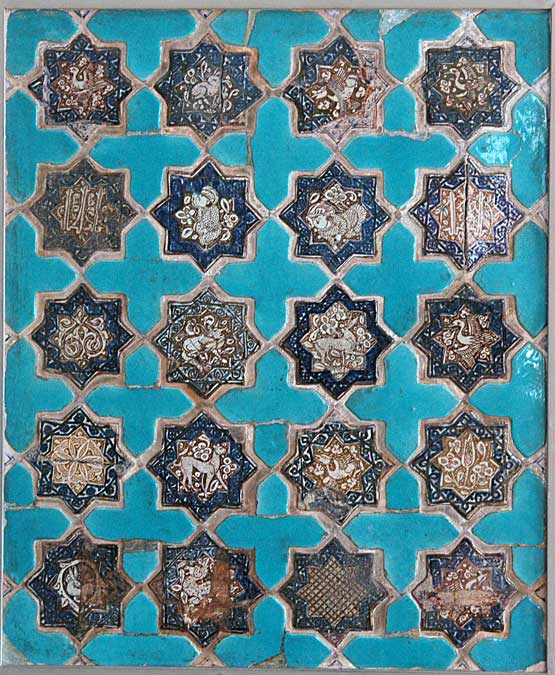
As discussed in an earlier essay, Kashan Iran was a major production hub of tiles in the 13th and 14th centuries. While a majority of these tiles were lustreware, some featured a blue border (1) and occasional blue highlights (2). Tiles produced in the 14th century started to sport a mix of turquoise and cobalt with white and red (3, 4, 5). The patterns on the polychrome tiles (6) closely resembles that lustreware tiles produced almost 100 years earlier (7). The colours are very reminiscent of Iznik (Turkish) items.

Item 4: Tile, Iran, 1420. British Museum item:1908,0804.5

Late Timurid items

Late Timurid BoW work displays a mish-mash of influences with Iranian/Iraqi inscriptions (8),  geometic Persian patterns (9, 10) and Chinese motifs (11). This indicates the ceramic production had settled down and was deriving it's influence from the east and the west. Dish 12 was created in 1475 and shows both double scroll and wave, and crest motifs popular in Yuan porcelain combined with fleshy peonies from the Ming dynasty. Plate 8 from a similar time frame (1450-1500) combines a central lotus flower with a distinctly middle eastern inscription. Other items display the classic Mingware cloud rim (13). Though there are few extant items specifically dated to the Timurid -> Safavid transition, it's clear the potters of Iran continued to copy antique patterns from Chinese items such as the decorative elements of dish 14.

Item 14: Dish, Iran, 1500-1550, Fritware decorated in underglaze cobalt. V&A item: 562-1905


Safavid Dynasty & 16th/17th century Iranian ceramics

The 16th century saw the rise of the Safavid dynasty which held much of Iran, Azerbaijan, Bahrain, Armania, Georgia, Iraq, Kuwait and Afghanistan as well as parts of Caucasus, Turkey, Syria, Pakistan, Turkmenistan and Uzbekistan. In the early 16th century, the capital was Tabriz, Iran, later moving to Qazvin, Iran for the late 16th century and then Isfahan, Iran for the 17th-18th centuries. As the capitol of the Safavid Dynsasty was based in Iran it strongly influenced the local cultural identity and provided secure trade routes and new technologies to the local industries. I will concentrate on the Iranian BoW traditions here and discuss other Safavid production hubs, namely Turkey, in a different post. Research note: Blue on White items from this time period are often called Kubachi after a town where many examples survived to the current day.

Tabriz

Though there is no documented evidence of ceramic production in Tabriz, some dishes (15) have shown a chemical similarity with tiles produced in Tabriz at the time. Interestingly, dish 15 sports a honeycomb design from late 15th century Mingware indicating the Tabriz artists were gathering their artistic influences from the East. Generally items produced in Iran during the Safavid Dynasty haven't been linked to a specific region or workshop. They do however display a distinct grouping of motifs. Though some scholars may disagree, I've gathered them into loose categories based on the majority of their design elements; Persian (16, 17), Iznik (18), Mid-Chinese (19, 20), Late Chinese (21, 22, 23) and Spanish (24). The range of Chinese motifs utilised is quite varied, and designs from the Yuan and Ming periods will often be displayed together. 


Item 18: Safavid dish, Iran, 17th century. Christies, Sale 8652, Lot 152

Stylistic reinterpretation

The influence of Chinese porcelain and the reciprocal influence of the middle eastern and European ceramics is the main focus of this group of essays. The high production levels of local potters in the 17th century and an opening in the market for BoW ceramics resulted in a plethora of extant items available for analysis. Many examples have already been presented of BoW ceramics featuring Chinese motifs such as lotus, dragons or even Buddhist symbols. The best examples of the copying of Chinese designs come from group of bowls and dishes created in China in 1600-1620 (25). The Chinese bowls feature Buddhist motifs and lotus flowers as well as the European touches. These items were produced specifically for the European market and featured Latin inscriptions such as SAPIENTI NIHIL NOVUM (to the wise man, nothing is new).  Bowl 26 is an Iranian replica, of the Chinese imitation of European styles. As such, the inscription is illegible. 27 is another example of pseudo-writing executed by Iranian potters when copying Chinese items.

Lustreware

During the 17th century, lustreware returns as a strong feature in the glaziers pallet. In addition to lustre over white slip (28), Iranian potters produced stoneware with white slip, cobalt underglaze and lustre  in a variety of forms, ewers (29, 30),  bottles (31), and flasks (32, 33). These items display uniquely Iranian motifs and though cobalt is utalised, doesn't feature any Chinese motifs. The return of the lustreware was perhaps sparked by a push for stronger cultural identity  to boost the empire in the waning years of the Safavid Dynasty. No central hub has been identified as the origin of the rebirth of lustreware however it seems to coincide with the establishment of the Iranian capitol at Isfashan in the mid-late 17th century.

Item 30: Stonepaste ewer, Iran, 1650-1750. British Museum, Item: 1913,1220.108


Kirman

An examination of work produced in the mid to late 17th century reveals a production center in Kirman producing lovely BoW items.  At this time access to Chinese porcelain was restricted due to turmoil in China. This increased the market available to the BoW earthenware trade, resulting in the mass export of items from Iran into Europe which is likely the reason for the success of the Kirman potters.

The Kirman potters utilised Chinese motifs (34) but created an Iranian twist by displaying them in an various middle eastern formats. Jar 35is a perfect example of this, where the Chinese lotus has been painted in a lattice arrangement. Few 'pure' BoW items are available as the Kirman potters included reds and other colours to highlight design elements (36). In item 37, the BoW component is distinctly asian with free flowing designs while the red section shows the more rigid patterns associated with the Persian tradition. Many items display the geometrical influence of the Persian tradition combined with the the softer flowing blue on white designs (38, 39, 40, 41, 42).

The Kerman potters produced items for a broad export marketing including items combining Chinese designs, caligraphy and buddist symbology (43, 44). An elephant shaped kendi (Chinese drinking vessel) indicates that they also produced crude copies of Chinese forms (45). The crudeness may be the result of the different strength of the mediums earthenware vs porcelain and the ease in which they can be molded.

Kirman potters were also experimenting with cobalt glazes and slip to create negative design features . The stonepaste item would be dipped in slip before being coated in a thick layer of cobalt glaze. The glaze would then be scratched away to reveal the slip underneath or slip would be added over the glaze to create raised white decorations. While I've discussed this technique before, typically the potters utalised the slip as the main colour by scratching it away to reveal the earthenware beneath then adding highlights with glaze. This revival and alteration of the old form indicates the Iranian potters have managed to develop cobalt glazing techniques that are unlikely to ruin the design by running/bleeding into the white slip. The items created featured both Chinese floral designs (46, 47) and the geometric influence of the Persian style (48).


Resources:
Golombek, L. Mason, R.B. Bailey, A. 1996 Tamerlane's tableware: A new approach to the chinoiserie ceramics of fifteenth-sixteenth century Iran. Mazda Publishers  ISBN 10: 1568590431

Golombek, L. Mason, R.B. Bailey, A. 2013 Persian pottery in the first global age: The sizteenth and Seventeenth Centuries. Brill. ISBN 10: 9004260927

Milwright, M. 1999. Pottery in the written sources of the Ayyubid-Mamluk period (c. 567-923 / 1171-1517). Bulletin of the School of Oriental and African Studies, University of London. Vol 62, No 3. pp 504-518.

Thursday, 23 April 2015

Blue and White ceramics - Iran part 1

Blue on White ceramics: the reciprocal influence of Chinese porcelain on European and Middle Eastern ceramics - Iran - Part 1

Other essays on the history of BoW in IraqEgyptlate Iran, JapanChina, Turkey, Spain, The Netherlands, Italy and England.

Iran

Early carved/incised and molded items

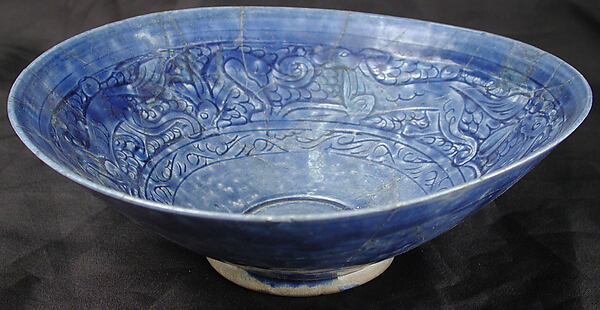
I have bundled carved/incised and molded items together because the application of the glaze (dipping) is similar. These are not strictly speaking BoW items, however the timing of pure cobalt glaze use is interesting. The earliest cobalt Iranian examples come from the 12-13th century (1, 2, 3, 4, 5, 6, 7, 8, 9) (I have also located one from Syria dated to the 11-12th century (10)). Decorative carving/incising predates this, however these items often weren't covered in coloured glaze. Instead, an earthenware item would be dipped in a white slip (clay) which would then be carved to reveal the red/black of the original item before a clear lead based glaze was applied over the top to seal the item (11).

12th century
In the 12th century, Iranian potters seem to have started dipping carved items in a thin layer of coloured glaze filling the deep cuts and outlining the design (1-9). The dipping process (as opposed to submerging or painting) is evident by the unglazed section of the foot, often featuring drips of coloured glaze (12). It is possible they adopted this method from Egyptian potters who were using opaque green and turquoise glazes in this manner since the Ancient Egyptian dynasties. Incised or moulded items were both produced in Fustat, Egypt (13) as discussed in my previous post on Egyptian BoW.

The Iranian potters also combined slip carving with coloured glazes. By applying a black or white slip and then carving down to the coloured body of the item, potters could then apply a single coloured glaze producing a dual-colour item with only one firing required (14). There seem to be many turquoise examples of incised items (15, 16, 17, 18, 19) but only a few cobalt. Perhaps this is because the cobalt is typically darker and doesn't contrast well with the darker clay body. Colours such as brown (20) and turquoise, seem to be utilised more frequently than cobalt for both molded (21, 22) and incised (23, 24, 25) items. Note the similar shape between the brown molded bottle (20), and a Kashan striped bottle (26).

In addition to the dual-chrome incised items, potters had developed a style involving painting multiple coloured glazes onto a carved item creating polychrome designs (27, 28, 29). I have yet to find an example of this in cobalt. I believe this is because cobalt works best on a white background, and the Iranian potters weren't using white opaque underglaze yet.


13th century
Later in the 13th century molded-ware seems to become the dominate form of dipped cobalt items possibly due to ease of mass production. Items are molded out of stonepaste or earthenware (30) before being glazed. This style seems to use a thicker application of glazes so the raised sections, which are thinner and therefore lighter, outlined the design (31, 32, 33, 34, 35, 36, 37, 38). At the same time, plain dipped cobalt ware was also being produced (39, 40, 41, 42) across Iran.

Molded items could also be overglazed with lustre (43) after the initial firing or have gold applied to the raised sections (44, 45). This is a relatively easy approach as the raised sections, especially on flat items like tiles, are easy to gently grind away providing a superior application surface for gilding. In addition, the sloped sides of the raised sections provided a graded effect in the glaze and essentially highlight the shape. Gilding is typically utilised for tiles as the gold is rubbed off with continued use so would not be appropriate for everyday vessels.

Interestingly, a majority of the Iranian monochrome carved and molded items I found were turquoise not cobalt blue. It could be argued that cobalt blue ceramics should occur frequently in Iran as the source of the pigment is proximal making the glaze comparatively cheap (or at least cheaper than their distant counterparts could source it). Though blue did feature often, it was one colour in the glazier's pallet and the predominance of turquoise suggests it was easier to mass produce or socially more desirable (perhaps the Egyptians love for turquoise plays a part here?).

Given this essay is focused on BoW ware, it behooves me to mention the BoW radial striped items originating from Kashan (the location of the cobalt resource).

Bowl
Item 12 - Bowl, Iran, 12th - 13th century. Metropolitian Museum of Art accession no 12.72.3

Kashan BoW Striped Items

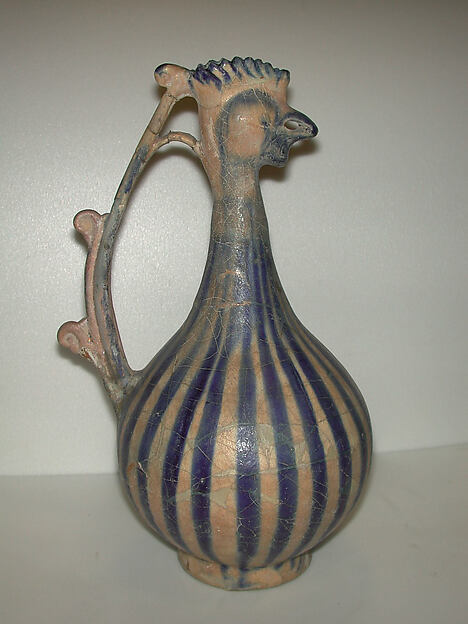
To date, I've collated a number of blue and white radial striped items specifically listed as originating from Kashan. Created in the 12th-13th century, this unique striped look was clearly massed produced and applied to multiple forms. Bowls (50, 51, 52, 53, 54), bottles/jugs (26, 55, 56, 57), vases (58, 59, 60), chicken headed ewers (61, 62) and cups (63, 64) are all represented. This style cannot be examined in isolation (as much as I like to make sweeping generalizations about BoW earthenware) as there are a number of transitional items that show the BoW radial stripes combined with other forms. For example, ewer 65 is molded, cast and pierced before being coated in tin-glaze and cobalt underglaze stripes (as is 66). In this case, the striped design element has been utilised on a molded piece rather than a built or thrown pots. This transitional piece bridges the gap between the production of the radial striped works and items such as this late 12th/early 13th century bowl (67) which has been completely covered in cobalt glaze. It suggests that either, stylistically, the style evolved quickly or the potters maintained several design 'lines'. Further evidence for this are two transitional bowls (68, 69) which are identified as 13th century. Both bowls feature a combination of the radial blue lines, with an inscribed black border and a central roundel with fish. A third bowl (70) with radial cobalt lines sports a central black geometric decoration. Produced alongside the radial BoW designs were blue and black floral designs such as these bowls (71, 72) and these cups (73, 74, 75). The cups feature a similar inscribed black band as the transitional bowls as well as the floral and geometric design elements this Persian style is known for. Additionally, the shape of both cups are extremely similar to the BoW cups (13 & 14), particularly the unique design of the handles.

Blue-black items dating from the 13th-16th centuries have been recovered from both Egypt (76) and Syria (77) suggesting this style was widespread. It's possible that this style was spread either by the movement of Iranian potters after the Mongolian conquests or later by the Mongols themselves throughout their empire.

Alongside the BoW ware and the Persian BBW items is a line of turquoise/black (78) and lustreware (79). This jug (80) is another bridging piece, with the turquoise/black glaze with radial stripes and a black band of inscription.

Rooster-headed Ewer 
Item 61 - Chicken headed ewer, Kashan, Iran. 13th century. The Metropolitian Museum of Art accession no 19.68.2

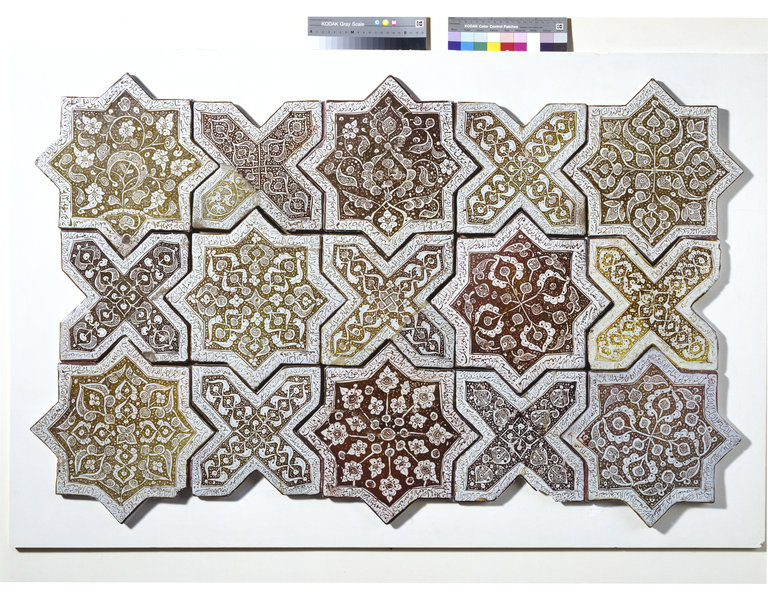
Kashan was also the production center for tiles (such as those utilised in my tile projects). Tiles produced in the 12th - early 13th century were typically lustreware (81) but later evolved to a lustreware/cobalt or turquoise combination (82) in the 13th century and later in the 14th century solid turquoise tiles (83) were featured. As cobalt and turquoise are both stable at high temperatures, items can be underglazed, fired, then have a lustre applied over the top (84, 85).

In the 14th century plate decorations evolved too, with lustreware being used in combination with blue and turquoise glazes (86), which in turn led to the evolution of Sultanabad-ware (87), more of which can been seen in my Sultanabad roundup or on my Saltanabad pinterest collection. There is some suggestion that the methods of lustreware was brought to Iran via the migration of potters from Egypt who originally gained the information from the potters of Basra, Iraq.

I have yet to find any BoW items labeled as being produced in Kashan after the 13th century. (There does seem to be a recent revival of the BoW striped pattern (88) which may be tapping into the antique market so care must be taken when identifying Kashan BoW striped ceramics.) The mid-end of the 13th century saw significant upheaval in Iran and Iraq due to the Mongolian conquest. Thousands of civilians were slaughtered or died of famine. This, undoubtedly, disrupted trade routes and severely affected the arts.

It's possible that the workshops producing the blue and white radial patterns were shut down at this time or supplies of cobalt were limited as the focus of the labour force would have turned to recovery and food production. It's also possible that the demand for finely painted polychrome or molded items led to the craftsmen turning away from the simpler radial designs and BoW items. During this time, the Il-khanid period, Kashan was producing lovely luster and cobalt/turquoise tiles well into the 14th century which were utilised on many public monuments (89).

Around the end of the 14th century a majority of the tile production in Kashan had wrapped up. This was due to the rise of the Timurid Dynasty which, at it's peak, controlled Iran, Afghanistan, much of Central Asia as well as parts of Pakistan, Syria and India. The capitol was based in Samarkland, Uzbekistan, resulting in a political and financial focus significantly further away from the Kashan potters. The Tamurid dynasty experienced a greater Asian influence than previously seen in Iran. This was in part due to the location of their capitol and partly due to greater trade along the silk road routes. This influence is reflected in the BoW items produced at the time.

Lustreware tiles from the 13th century. Tile Panel, Kashan, Iran. 1262. Victorian and Albert Museum, item numbers: 1837&A, C, E, F-1876, 1487-1876, 1489-1876, 1838&C, E-1876, 1077-1892, 1099&A-1892, 1100&A-1892