Showing posts with label Research. Show all posts

Monday, 23 March 2020

Bowl shapes black underglaze - Iran

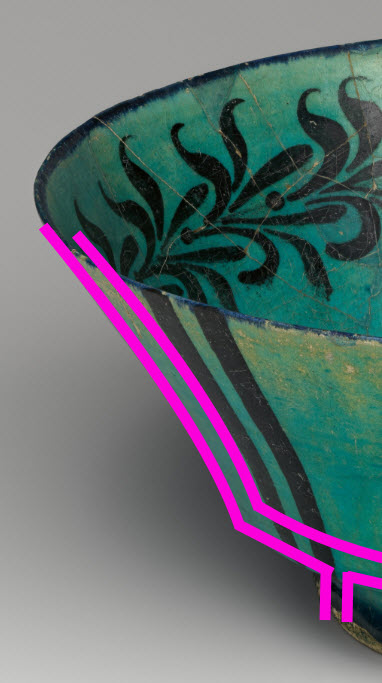
I've been working on cups for a couple of months now but many of my favourite references are bowls or dishes. Before trying to make some bisque to decorate I thought I should review some shapes before I get throwing. To narrow it down a little, I'll focus on Iranian objects preferentially black underglaze.
Bowl - 1180-1220 Kashan Iran. V&A, CIRC 53-1938
Small flare above foot then reasonably conicle. Likely incised foot / foot ring but no images of the base is available. Similar shape at The Met.

Bowl. 13th century. Kashan, Iran. The Met. Accession No. 20.120.32.
Incised foot with a flared edge.

Bowl, early 13th century. Iran. Brooklyn Museum. Accession no. 37.147.
Conicle with bulb 2/3rd of the way up. Slight lip.

Bowl. 1038-1194. Iran. Saint Louis Art Museum. Object 281:1951.
Conicle with an inclised foot ring. A slight bulb  4/5th of the way up with an overhanging lip. Similar bowl in Sotheby's


Sunday, 16 February 2020

Chola garb

A copper alloy figure of Parvati, Tamil Nadu, Chola Period, 12th century. Bonhams Auctions, Indian, Himilean and Southeast Asian art sale, item 3074


I've been writing a lot about ceramic recently so I decided to purge my Drafts collection and complete a few posts in the new year. That was all well and good for a whole, three posts until I stumbled upon a reference and down the rabbit hole I went. This Chola statue is so well photographed I thought I'd dedicate a whole post to unravelling it for future use.


Tamil Nadu is located in the southern tip of India. The capital is currently Chennai (previously called Madras). The map above displays the general extent of the Chola Dynasty however it's influence extended far beyond this to Java and beyond. The Chola Dynasty left it's mark in history in many ways, but this posts focus is their acclaimed copper alloy statues of the 12-13th century. One statue in particular for auction at Bonhams is a beautiful example and has some very high resolution images, perfect for the armchair reenactor. All images below will be of this statue unless stated otherwise.


This is what caught my eye first. Are they amazing floral droopy earrings or braids decorated with flowers? The necklaces appear to be multiple individual necklaces stacked upon themselves with a single clasp seen from the back that peeks out from under her curls.

On her arms, she has tied a decorative plaque and a plain, circular armband as well. I originally thought this was one larger cuff but the jewellery on her right arm dips towards each other suggesting they are individual pieces. She also wears multiple bangles and finger rings. Around her ankles, she appears to have little balls, bells or mangos perhaps?

Drape: Parvati wears an assymetric (veshti / vaetti - tamil, or dhoti - sanskrit) drape with one leg wrapped to a few centimeters above the ankle and the other resting gently on the knee. 
 
Depending on your interpretation, you could construct bands of floral patterns with leaves, or alternatively, geometric designs or potentially human torsos. I do like the floral patterns best but interestingly, there are whole flowers in places and halves in others. Th designs don't seem to cross the horizontal stripes. Are these supposed to represent block printing, woven patterns or thin bands of fabric joined together?


The girdle (red) appears to be a wide band slung low over the hips. Three loops on each side progress from just outside the buttcheek (so you dont sit on them) around and connect to the front. The top and the bottom of the girdle are stiff yet flexible. I suspect they are fabric. There is a possibility this is the top edge of the dhoti garment folded over but I doubt it. The girdle seems to be wrapped around the waist, possibly tied, and then secured with a beaded belt. 

The beaded belt appears to be a double set of plaques or beads. At the centre front, and centre back, two larger plaque sections provide and avenue for tightening. The pink loops can be pulled to tighten the cord that runs through the beads. At the front the spare piece of cord or sash is tighten through the top most plaques and the falls to one side (pink). This would suggest that the end plaques on the back have two holes through which the cord / sash is run to prevent the fabric from slipping. The top front fastening could be achieved by running three pieces of fabric through one hole but a double hole would make removing the belt less likely to create a situation in which it'd need to be restrung. I am really going to have to play around with this design to see if my ideas would work!

Tuesday, 5 November 2019

Mughal flat hat

The Mughal flat hat!

Late 15th Century. Shapur with the daughter of Mihrak, by Qāsim.  British Library MS 5600 - f.399v: Look at the detail on her hat! I love the beaded (pearl?) trim on the edge and the suggestion of gems all over.


Tuesday, 29 October 2019

Lets talk about pants

So, in my usual method of garb creation, I've started with a half remembered reference and jumped into my project. I've begun practicing block printing on bigger items and thought I should start with a ~2m bit of fabric because then I could make it into pants. Because, you know, you can never have enough pants.


Anyway, I've now block-printed half the fabric and I couldn't remember if the original reference looked like the diagonal strips both trended the same way or opposite ways. i.e. do I need to change orientation half way through the print to make a V shape or can I get away with //// all over?

Cue many many hours of trolling through manuscripts trying to find diagonal prints!

Here are some findings and comments thus far:

Some Safavid pants to start...
Folio 155r, British Library. MS 6613. Pants appear to have a dark stripe over blue, red and black diamond pattern. The diamond pattern is offset in the right leg which suggests an alternate construction method where the pale fabric is sewn together out of isosceles triangles, allowing the pants to gently increase in size with every rotation. Given I'm not very good at sewing, I think this would only happen if you were short on fabric, otherwise just gather / pattern to taper to the ankles.

Folio 184v, British Library. MS 6613. Pants worn by the Greek Princess. Same manuscript so artistic style is unlikely to change however these appear to have aligned triangles and alternating gold and grey bands. I wondering if the white dots are dyed, pearls, embroidery or spangles?

  
Woman holding a daisy. Herat (Afghanistan) Safavid. 1570-1578m. The Met Museum,   55.121.42. Diagonals again but such detail on the closeup! The fabric is fantastic and does suggest the entire piece is either diagonal stripes or vertical and the pants are cut on the bias. Cutting them on the bias would provide some stretch.

Christian Maiden dies. 1600 Iran. The Met Museum. Folio 22v. Accession no. 63.210.22. Look at that splendid acanthus print!

 Woman nursing a child. Bibliotheque Nationale Paris. folio 23r. Arabe 5847. Glorious colour combination and multiple foliages. It looks like these would fall into horizontal strips should she stand up.

Skipping to the Mughul culture now because when it comes to pants, I'm not picky.
 These are the pants of Princess Jahanara, painted in 1632. British Library, Add Or 3129. Folio 13v. I am really taken with these pants, the strips are fantastic! Unfortunately, the geometry doesn't work well. We see three red stripes at the ankle, which becomes 6-8 at the waist. We see no narrowing of stripes up the leg suggesting all stripes must either be cut off or gather/taper. To achieve this look, the fabric must be cut to ensure excess stripes on the front and back are cut to terminate on the inner thigh. Even then, superior tailoring is required to taper the cut from the hips up to the waist.


Lady with a narcissus. 1631-1633.  British Library, Add Or 3129 folio 34r. Take a moment and admire this spectacular pair of pants. Yellow with blue mangos? outlined in red, with a blue framing pattern. Splendid!


I'll leave this collection there as there are many many pants down this particular rabbit hole. For now, I believe i have sufficient justification for horizontal, vertical and diagonal stripes. There is no supporting evidence, yet, of stripes that originate on the inside ankle with one leg clockwise and the other counter-clockwise so for now, I shall make the stripes all go one direction.

Sunday, 30 December 2018

Blue and White ceramics - China

Blue on White ceramics: the reciprocal influence of Chinese porcelain on European and Middle Eastern ceramics - China

Other essays on the history of BoW in IraqEgyptearly Iranlate Iran, Japan, Turkey, Spain, The Netherlands, Italy and England.

China

Tang Dynasty (7th - 10th century)
Like many countries, some of the earliest examples of cobalt glaze in China are dipped earthenware items (1). This later developed into earthenware covered in white slip and painted with blue designs (2). These items were produced during the Tang Dynasty and may have been inspired by simple figurative bowls imported from Iraq.  From the 9th century China started to develop "Porcelaneous ware" the precursor and bridge between earthenware and porcelain. Similar to earthenware, these items utilise a fine white clay, kaolin, which is an alumina-silicate (3). Fired at higher temperatures, the quartz (silica) fuzes creating the product often known as Mingware. Many glazes aren't stable at the higher temperatures required to create Mingware thus the decoration on the porcelaneous items remained simpler while earthenware items produced at the same time could be coated in a riot of colours like this yellow and blue phoenix headed jug (4) or this blue, green and brown box (5). These green, yellow/brown and blues items are often referred to as sancai-ware and would occasionally feature cobalt glaze (6, 7, 8, 9, 10). The sancai-ware became highly developed, with potters incising their designs to prevent the glazes from running together (11). Alongside the sancai-ware, the potters of the Tang Dynasty start to produced painted items such as this bird bowl (12) setting the stage for the development of the finely painted BoW items associated with China.
(As a side note, the Tang Dynasty also produced lovely earthenware of marbled clay, which I'm quite enamored of (13) )
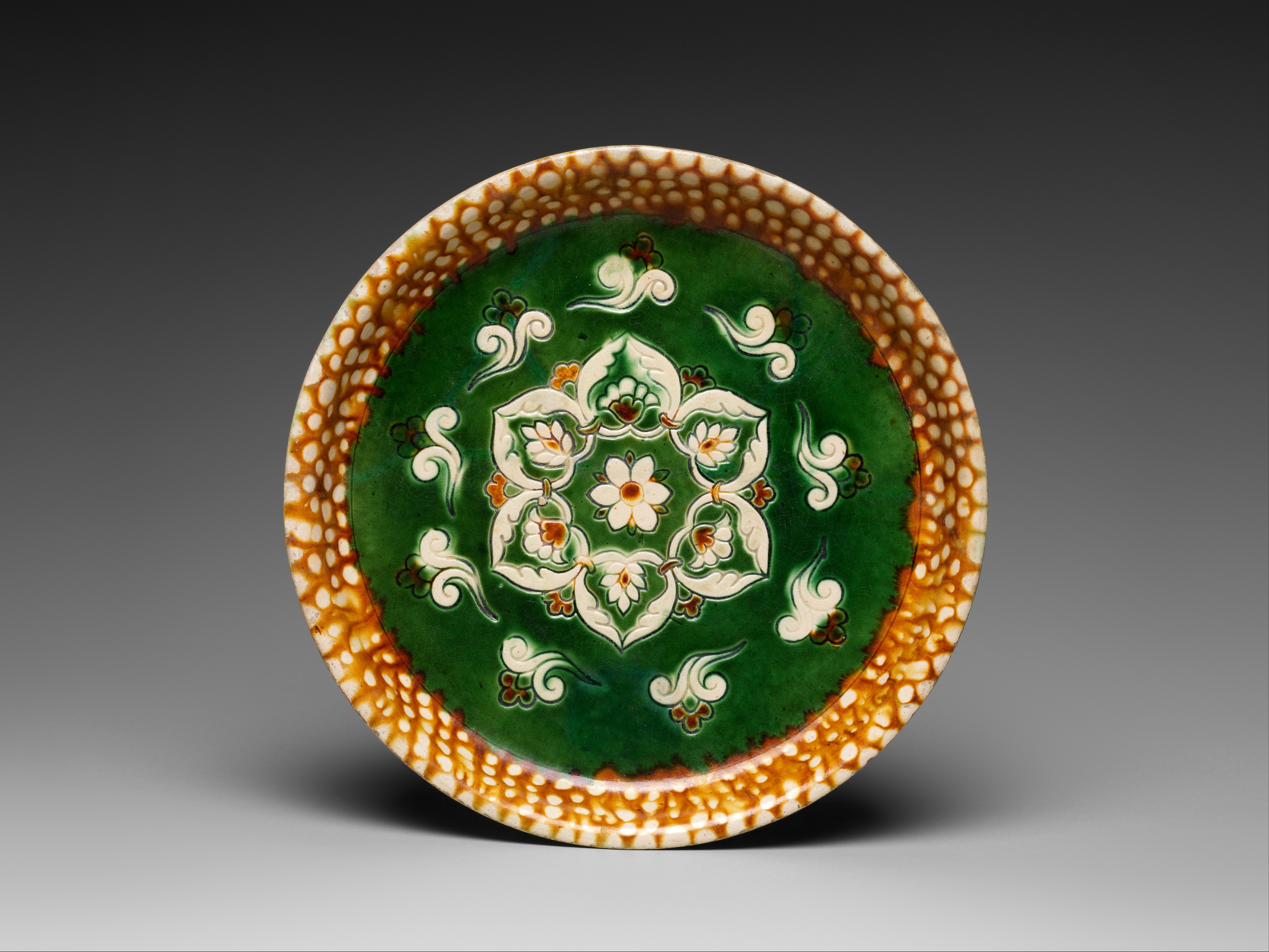
Item 11 - An incised sancai-ware tray. China, 8th century. The Met Museum item 1994.605.47

Song Dynasty (10th - 13th century)
The Song Dynasty further developed the Sancai style producing complicated green and yellow motifs on incised earthenware such as Ganwa-ware from Mongolia (14) and Cizhou-ware from northern China (15, 16). These items however, do not seem to feature cobalt as the earlier style did. This was likely due to the difficulty of sourcing the cobalt for the glaze at the time.

In addition to lovely plain white porcelaneous objects, the Song Dynasty also produced distinctive items dipped in a light green / celadon glaze (17). Following the seemingly standard path of pottery development, the Chinese potters also experimented with under-glazing such as this light blue example with purple splashes dated to the 13th century (18).

Ming Dynasty (13th - 17th century)

It is generally accepted that the methods of creating porcelain had been well established by the 14th century in China. Porcelain had been endorsed by the Emperor who theoretically controlled all production and the export of porcelain items. The kilns of Jingdezhen produced all the imperial porcelain however there were private kilns creating imitations concurrently. For a good rundown with comparison images check out the Imperial Palace Museum's website here.

The kilns at Jingdezhen produced items both for export and domestic use. To appeal to the export market, the Chinese artists imitated design motifs from a variety of sources. A 1520's jug (20) is the earliest item identified as being deliberately created for export. It features the classic key design around it's rim seen on earlier porcelain items (21) as well as an upside down copy of the Portaguese arms. This plate from 1580-1600 featuring a Portuguese coat of arms for Captain Don Joao de Almeida (22) exemplifies the early attempts at leveraging the export market. The tiny coat of arms featured is framed by plumes and crested by a very awkward attempt at a helmet suggesting the artists had a weak grasp of the subject matter.
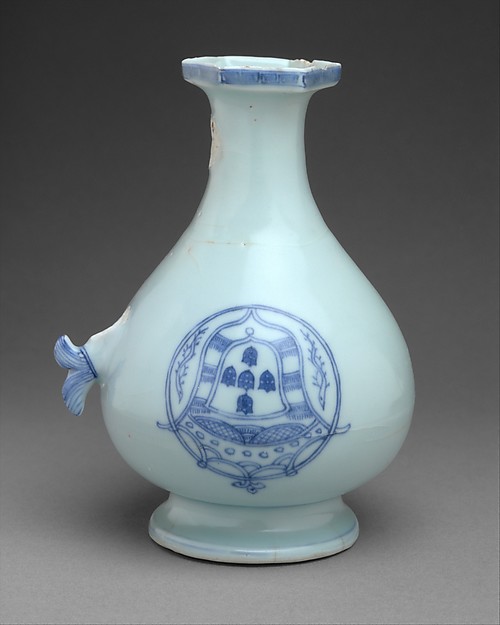

Item 21 - Ming-ware made for export featuring an upside down Portuguese coat of arms.

As trade along the silk road flourished and the European market increased, the export designs become significantly more refined and targeted. For example, this bottle made between 1662-1722 is very Persian with it's use of void space and stylised floral geometric patterns (24). The shape is also reminiscent of Iranian bottles popular at the time.. The imitation wasn't one sided, with the European and Middle Eastern ceramic centers creating their own imitations of Ming-ware. For example, these porcelain bowls created in 1600-1620 (25) spawned Iranian fritware copies (26). in the 16th-17th century, Chinese artists appear to have started adopting the Middle Eastern and European penchant for inscriptions in their work (27)


European countries weren't the only market or stylistic influence on the Chinese export trade. number of Ming-ware items also feature Mongolian style cloud designs which are a dominant feature in Turkey's Iznik design style (15th - 17th century) 28293031. It seems that the Mongolian / Persian influence was quite extensive. This jar features archers wearing Persian style garments and is decorated with various vegetable motifs as well as images of European houses (32). This 17th century asymmetric dish shows the Chinese artists were also incorporating Japanese styles into their work (33).

Identifiable Chinese Design elements
The number 8 is considered lucky and linked to prosperity and wealth. This may be the reason why there is a distinct subset of Mingware incorporating 8 lobes of panels around the main decorative element (34353637). The lobes very often feature auspicious symbols like a double gourd, a fan, a drum or a scroll. This subset of Chinese porcelain is occasionally referred to as Kraak after the carrak's of the Portguese traders who brought the goods to Europe. Porcelain is light and significantly stronger than the earthernware available that was available in Europe. This, in addition to it's link to the Chinese emperor, increased it's appeal as a status symbol. A number of renaissance paintings contain a blue and white porcelain bowl or ewer as a background feature. Rarer are those that celebrate the porcelain itself. The bowl featured in Treck Jan Jansz's (38) painting can be identified as Chinese in manufacture due to a combination of it's thinness, the sheen captured by the artist and the decorative lobes in the glazing.

The production and export of porcelain by the Chinese was the most significant factor in perpetuating the blue on white colour scheme as ceramic art became more sophisticated through the Renaissance and the range of colours available increased. Cultures which had well developed ceramic industries either renewed or built thriving local markets for the BoW goods. Chinese Kraak items were imitated by the Dutch (39), the Japanese (40), the Portuguese (41) and the Japanese (42). BY the 17th century, even the Spanish, who had several manufacturing hubs and a number of celebrated artistic trends were producing blue on white items for local consumption.


Item 38 - Detail, Still life with pewter flagon and two ming bowls. Treck Jan Jansz, 1651, National Gallery, NG4562


Additional references:

Valenstein, S.G, 1989. A handbook of Chinese ceramics. Metropolitan Museum of Art.


Friday, 28 December 2018

The hats of the landsknecht

This is a simple image reference collection of the various hats featured in Landsknecht woodcuts. No construction methods are proposed but styles types are grouped to align with my 1520's German hat research. I'm not a fan of Pinterest links within links so this is a more direct way of referencing.  The aim is to reduce the trolling through Pinterest and museum archives next time I need a specific fancy hat reference. Each image will only feature the hat detail and a link has been provided to the entire original image. Reference details are provided in the event the hyperlinks break. 

I started this post with an assortment of 30 images but as I was tidying up the references I realised that they fell into three sets. The British Museum has a collection of 50 odd images of Landsknechts block cut by Jost de Negker. There is a goodly number of Daniel Hopfer and then assorted random images. Unfortunately, some of the images aren't high resolution so end up a little pixelated.

This is by no means a complete collection and if you know of a hat I've missed please link to the museum reference in a comment!

1520's German hat Research part 4

Allegory of Virtues and Vices at the Court of Charles V by Hans Daucher 1522 (The Met Museum accession no. 17.190.745)

The previous parts of this research have discussed Tallerbarret's and Split Brim hats, Star fish and upright brim hats, and multiple ideas on constructing the hat crowns. The fourth, and final part, will examine the decorations on the hats featured in The Virtues. This discussion will also examine the art work within the cultural context to ensure this artwork is reflective of wider society and the information can be extrapolated beyond this context. This part of the analysis is important as many allegorical hats (and clothes) are not representative of what was worn at the time, being either a fantasy creation of the artist or an artists impression of 'ancient' clothing. I'm of the opinion in the SCA, that if you can find it and make it, you should wear it.  You should also be aware of its history and context so when asked why you're wearing a beautifully absurd hat, you can explain it's origins and inspire others.

Again, a lengthy and picture heavy post which can be found under the jump cut.

Saturday, 24 November 2018

1520's German hats research part 3

Allegory of Virtues and Vices at the Court of Charles V by Hans Daucher 1522 (The Met Museum accession no. 17.190.745)

In the previous two posts I reviewed the hats of The Virtues with regards to the varied brim construction (split brim and floppy hats). There is significantly less material to work with on this topic as displaying the full crown of a wide brimmed hat often means obscuring the face of the wearer. Working within the limited confines of the The Virtues, I've attempted to propose some constructions methods to achieve the look on display. These are aimed to direct future experiments with cloth to determine how construction and use requirements (function) might dictate form.

The rest of the post is below the cut as it's picture heavy, again.

Tuesday, 20 November 2018

1520's German hats research part 2


Allegory of Virtues and Vices at the Court of Charles V by Hans Daucher 1522 (The Met Museum accession no. 17.190.745)


The Allegory of Virtues and Vices at the Court of Charles V features a lovely spectrum of hats from the early 16th century. Tallerbarret and Split Brim hats were discussed in the previous post so this post will look at floppy hats, upright brim and combination hats. I consider floppy, or "Star fish hats" to be distinct from split brim as cuts do not overlap and more slashed than cut and pieced. For this analysis "Split brim star fish hats" will be a combination of both where the splits clearly extend to the crown and overlap in places and are additionally slashed. There are a variety of floppy hat patterns to be found here (beware the poor livejounal formatting) and a good tutorial by Geoneva von Lubeck can be found here

Further analysis is under the jump cut.

Sunday, 18 November 2018

1520's German hats research part 1

Allegory of Virtues and Vices at the Court of Charles V by Hans Daucher 1522 (The Met Museum accession no. 17.190.745)

When delving into a new area it's important to have a few prime images to fixate on otherwise you'll get lost down the rabbit hole. Often people use an image of something they've seen someone else wear and they try to find references to reference it, make it fit a costume or make it more period. In this case, I started by collecting a Pinterest board of Landsknecht, Cranach and general German-ish hats. This gave me a good reference base for the variety of hat types available within my scope. I then narrowed the field by focusing on one item and using it as the basis for my research. If you want to do the same, there's a large collection of hat references collated by Jeanne de Pompadore here. It'd be nice if they're hyperlinked to a primary source but they typically contain sufficient information in the caption to help you find the original without needing to use Google image search.

Personally I found my focus image deep in a Pinterest linked-linked-link. The sculpture by Hans Daucher contains a good number of hat types. As it's a crowd scene, it also has a few back of hats so we can see the crown detail. I've numbered the hats to assist as I discuss the various types and my construction conclusions.

Details are below the jump cut as this the first of three long research posts

Sunday, 17 June 2018

Ajanta caves

In December last year I attended a friends wedding in Delhi. I had only 8 days for this trip as I was taking it between FIFO swings. After the wedding, my traveling companions and I headed south to see the Ajanta Caves. Previous blog posts (here  had outlined some of my arm chair research about the cave paintings so it was especially great to go see them in person. I cannot rave enough about this trip or about this UNESCO wonder. I am so in love with this wealth of history and the epic nature of these paintings.

If you want to know about the geology of Ajanta, some tid-bits can be found here. The posts following in the sequence will feature of some of the better photos I took plus a little background on the caves they're found in. I can't say this has been ticked off my 'places to see' list, but I've now seen enough to make the most of my next visit!

Me, thrilled to be seeing all the things!


Monday, 17 July 2017

Qasam and the Kashani cobalt

As outlined in previously, Kashan, Iran seems to be the initial production site of Blue on White ceramics. This is due to Kashan's proximity to a source of cobalt and other minerals useful in creating glazes. The Kashani cobalt originates from Qamsar aka Ghamsar which is located in the hills south of Kashan. Ghamsar is located proximal the the boundary between the Sanandaj-Sirjan Zone (1) (associated with the subduction of the Neo-Tethys Ocean) and the Urumieh-Dokhtar Arc. The U-D Arc hosts porphyry copper-gold deposits (2) as well as epithermal lead-zinc deposit (3).

Figure1: Geology of Iran - adapted from Geology of the Sari Gunay Epithermal Gold Deposit (4). The blue star marks the location of Kashan and to the south, Ghamsar (aka Qamsar).

The cobalt in Ghamsar is formed as part of a skarn deposit (5) resulting from the intrusion of a microdiorite into the Qom Formation. For non-geologists, the limestone in the Qom Formation is dissolved by the hot hydro-thermal fluids originating from intrusion of diorite, a volcanic rock. The contact between these two rock types metamorphises and recrystalises becoming the skarn deposit. The mineralology of a skarn is determined by the composition of the hydrothermal fluids and the limestone. The Ghamsar deposit appears to be structurally controlled, with the mineralising fluids travelling through faults. The cobalt is spatially associated with magnetite veins in the faults however the cobalt may precede the magnetite ore. The cobalt (smaltite) likely took the form of a silvery metal and would have been locally processed and washed before transport. Cobalt glaze requires less than 5% cobalt to achieve a rich blue colour. Thus it is a valuable and highly transportable product. Given the comparative weights, the washed cobalt, and other metals, would have been transported to markets in nearby cities.

Summary: Due to the unique geological processes and structures involved, precitipation of cobalt ore is rare and unlikely to be accessible at surface in a form useful for glaze production.

As a side note, the presence of copper-gold in the area would have provided minerals for glaze and lustre while the nearby lead-zinc deposits allowed for the transparent lead glaze that resulted the beautiful underglaze ceramics (6).

Why Kashan rather than Ghamsar?


We can see why ceramics are produced at Kashan instead of Ghamsar, the source of the ore, by consulting a soils map. Figure 2 indicates that the soils around Ghamsar are calcareous lithosols which are calcium rich, and often contain chunks of partly or fully unweathered rock. They are calcareous (calcium rich) as their parent rock is likely the limestones of the Qom Formation. Kashan, on the other hand, has a source of salt marsh soils. Salt marshes are a low energy environment which accumulate sediment over long periods of time. Marsh soils are typically fine grain and well sorted, these appear to be grey and low in organic matter. Small grain clays require less work for the potter to purify and create into fine earthenware. The clay would likely have been dried, ground and sifted before being utilised.

When creating blue glaze, cobalt commonly composes <5% of the overall blend (8). The low concentrations required make transporting the washed cobalt the short distance to the source of clay highly viable.


Figure 2: A map of the soils of Iran indicates which medieval towns would have superior clay. (7)


1: A new tectonic scenario for the Sanandaj–Sirjan Zone (Iran) 2005 A. Ghasemia, C.J. Talbotb Journal of Asian Earth Sciences.

2: Porphyry Copper Deposits of the Urumieh-Dokhtar Magmatic Arc, Iran. 2005. A. Zarasvandi, M. Zentilli, S. Liaghat. PGS Publishing, Linden Park, 2005. pg 441-452

3: The Ay Qalasi deposit: An epithermal Pb-Zn (Ag) mineralisation in the Urumineh-Dokhtar Volcanic Belt of northwestern Iran. DOI: 10.1127/njma/2015/0284

4: Geology of the Sari Gunay Epithermal Gold Deposit 2006 Northwest Iran. by J.P Richards, D. Wilkinson and T. Ulrich. Economic Geology. DOI:

5: Ore Mineralization at Qamsar Cobalt Deposit:Skarn and Metasomatism Evidences .  Hadi Mohammaddoost, Majid Ghaderi, Nematollah Rashidnejad-Omran  The 1st International Applied Geological Congress

6: Islamic pottery, a brief history. Metropolitan Museum of Art.

7: Soils of Iran 1961. M.L Dewan, J. Famouri. Food and Agriculture Organisation of the United Nations. 

8: Ceramic Arts Network, accessed 31/12/2018.

Saturday, 30 April 2016

Pelican Outfil #4 - Cloud collar design research

As mentioned in a previous post Miriam of the Alawim of Stormhold has given me a number of PDF's of Persian Cloud Collar images. I believe she collected the images for a Laurel Prize Tourney entry. This week I've been analyzing the images in my typical science before art process. (This is going to be an image heavy post). My conclusions are as follows:


The first set of images Miriam sent me come from one manuscript. Firdawsī, Shāhnāmah, Book of Kings. which is Turkman/Timurid style. Dated 23 Jumadi II 891 (26 June 1486). This manuscript features to main styles of cloud collar, a floral style, and what I've been privately referring to as the geese style. Cloud collars of either design don't seem to be restricted to a certain class or sex and can be seen on a variety of coat styles. I've drawn up the designs from a couple of the images in black and white to make it easier to see the particular elements.


In both of the images above, the same goose like shape can be seen as a major symbol surrounded by blobs and tick marks. The goose is always pointing towards the left and is rarely inverted to balance out the pattern on the opposite shoulder. Given the frequent occurrence of this decorative element I began to wonder what it symbolised so I spent some time squinting at the screen and trying to determine what it actually was. One figure has a single goose on the upper thighs so I worked out the shape as best I could.

After looking at many examples of the goose, I've some to the conclusion that it's possibly a word or phrase written in islamic calligraphy. Islamic calligraphy is a beautiful art form but difficult to read for a Persian newbie. I've waxed lyrical about my reluctance to copy something I don't understand so that leaves the floral designs. Two of these come from military figures which wear a chain mail or scale coifs. Given the regular pattern and symbols, and the fact the pattern isn't adjusted to the lobes of the collar just the center neck, I'd suggest this fabric would have been a brocade rather than embroidered. Brocades are harder wearing and can be cut from second hand garments. The threads of the embroidery are more likely to be caught and damaged by the rings used in construction of either coif. The third floral design appears to be a leaf pattern and I copied it because it seems to blend seamlessly with the coat along the arm. Perhaps this one is embroidered directly onto the coat rather than onto a separate piece of applique attached to the shoulders?


Second manuscript set of images Miriam sent me were from The Khamsah' of Niẓāmī which dates from 1539-1543. This manuscript features cloud collars which were counter-coloured against the coat. The designs are stylistic and floral reminiscent of the Iznik tiles produced in the area. There's one I particularly like which has a tiny bee or month amongst the flowers. Once again, all sorts of figures wear these sorts of collars. The manuscript also has a number of indivisuals with the gold on base style collars seen in the previous manuscript. I've drawn up two of these designs.


The first is a seated man with a repetitive design on his collar. This may be done in multiple colours of silk. I've drawn the central medallion with a Star Wars twist as it's hard to tell what it is given the size of the image. The other collar is gold and features floral designs which are repeated in each lobe. This figure also has a slightly different floral design around the sleeve cuffs. I like both of these designs as repetition creates balance but I'm also away it may not be possible with my pattern given the different shapes and sizes of the lobes. This is something I'm going to have to research further and maybe draw up a bunch of mini images to see what I like the most.


One question you might be asking, if you've been following these posts, why am I researching Timurid / Turkish cloud collars when I've already stated I wanted to make an Indo-Mughal outfit?
The reason being is the image I'm most drawn to is Babar seeks his Grandmothers advice. It's a Mughal manuscript which depicts the Turkish born (1483) Babar who established the Mughal empire. At first I thought this image, painted around 1590, was a 16th century impression of garb worn by Persians in the 15th century. I then did some more research and found that cloud collars were a thing well past the 16th century so it was possible this scene was depicted with the figures wearing 'modern' clothing to assist the audience in relating to the tale. The Mughals did wear cloud collars and Persian inspired outfits. I've found a few other images that document this and will continue looking for more.

Detail - Court of Ravana, folio from a Ramayana. India, 1605. Met Museum, Accession no. 2002.505