Showing posts with label Plate. Show all posts

Tuesday, 13 June 2017

Squwark plate

I made a plate for my friend Phillipa. She's pretty awesome and loves her chickens so when I found the following image I couldn't help but modify it. I believe the original is supposed to be peacocks, but their little bug eyes and beaks made me think of chickens. So they became chickens.

Bowl. Iran, Nishapur 10th century. Earthenware, buff slip, underglaze slip-painted,. LACMA M.73.5.289. (No direct link is possible, check out items 30 and 52 of 99)

The LACMA have two bowls in this style. The other one (M.73.5.266) has a lot more intricate detail but a similar peacock shape. The buffware with this figerative style is specific to Nishapur, Iran. The Meteropolitian Museum of Art conducted a number of digs in the city in the early 20th century and recovered numerous artifacts (1). The style is closely linked to sgraffito but lacks the incised decorations (2). A good example of sgraffito ware can be found here for those curious as to it's styling.


The finished plate complete with a variety of personalized chickens.
I've been doing a number of yellow and green items recently. I quite like the colour combination, but I'm also aware there a much more experienced artist who produces sgraffito in my Kingdom, Alex the Potter. Since I don't make my own bisque yet, I'll be steering clear of sgraffito and limiting my emulation of buff ware.

I'm really happy with how this turned out. The green/yellow/white/black contrast looks great and is appealing to modern tastes as well. I only hope Phillipa likes it as much as I do.

1) The Met at Nishapur. http://www.metmuseum.org/toah/hd/nish/hd_nish.htm
2) Sgraffito from Nishapur. http://www.metmuseum.org/blogs/ruminations/2015/production-history-of-sgraffito-ware-from-nishapur

3) The extant plate - http://islamic-arts.org/2011/ceramic-vessel-collection-at-lacma/

Wednesday, 5 October 2016

Ceramic 52 - Nyssa's household plate


 Sketches of wolf anatomy by J.C. Amberlyn

This plate has been on the go since I completed Vandels plate in 2013!. I started the two at the same time but Nyssa hadn't registered her device yet so I didn't want to make the plate until she had. After registration, I'd sort of lost interest in this project because it was at the time consuming central blue bits stage and I'd already done two of these. I have a very short attention span. This plate, in it's half finished form, moved house with me three times before finally ending up in Perth. I decided Nyssa's birthday was the perfect reason to finally complete this thing so I could stop worrying about scratching the underglaze and give my friend something she'll hopefully use at every future event. I like the fact she and Ro have a matching set now.

 Nyssa's banner by Lasy Elizabet Hunter.

Nyssa  device is, quarterly purpure and sable, a wolf statant and a bordure argent. I had a bit of trouble with the device as heraldic wolves tend to be a little too dog like. I was tempted to copy the wolf that Lady Elizabet had used for Nyssa's heraldic banner but I didn't think the outlines would work as well in the size I was working on. I was also worried that the underglaze wouldn't allow me to make the fine shapes I needed to do. After much googling and a number of sketches, I decided to go with a smidge of viking knot work to tie in where her Norse name.


I also received some great advice at the Laurel Prize Tourney this year which was to investigate the skeleton of any animal I plan on drawing to work out the most realistic body shapes. This was specifically for jaw lines so my badgers would stop looking like racoons but the same concept apples to any animal. I purchased Drawing Wildlife by J.C. Amberlyn. It's a great book which shows skulls and skeletons of many creatures as well as fur patterns and postures. It takes you through how to draw particular animals step by step. I found it amazingly useful!


I wanted to honour Nyssa's viking persona and have a wolf that looks more wolfy than the typical heraldic wolf so I did some sketches and practiced and practiced.

Finally, I was able to paint the plate and drop it off at the team at Glaze It for firing. Of the three plates in this series so far, I am most happy with this one! I'm also pleased that Nyssa and Rohan have matching couples plates. I don't often make sets but when I do the satisfaction is -almost- work the tedium.


Sunday, 17 January 2016

Plate - 14th century Sultanabad

I've been rather quiet these last three months as I've been moving across the country and am still finding my feet in this new city. I have now found a place to rent and my furniture gets delivered in three days! I am enjoying finding all sorts of new things but last weekend I thought I'd try something new and old at the same time. I had passed through a homewares and overpriced duct collectors shop and found the sales lady painting white plates with some sort of commercial poly-paint. I've seen this stuff before, you paint it on, put the item in the oven and ta da - customized item. Unfortunately, the paint doesn't really stand up to wear and tear, the Stormhold Baronial plates haven't really withstood knives, forks and hand washing by people not told about their special needs. This is why I prefer to glaze my plates rather than buy the ceramic paint from spotlight. True, this restricts me in size, shape and I need people to fire it for me but the end product is much more durable. I've decided that finishing the A&S 50 challenge was enjolyable but I'm not done with the ceramic painting yet. So, I need to find someone in my new city who can supply the bisque and fire the finished products for me. Or make arrangements to get the my bisque to Melbourne for firing and collection by a friend.

So last weekend, off I went to All Fired Up in Joondalup. I've mentioned this place on my 'where to make your own ceramics' list for a while now so I thought it was the perfect first candidate for a replacement ceramics facilitator (i only have two candidates). So I saved a number of reference images from the Met Museum on my iPhone and off I rode (image 1). I arrived at noon, spent half an hour browsing their limited stock of bisque before settling down to another project. When I went I had no real plan in mind as I wasn't sure what sort of bisque range they'd have (small). I was there until closing (5pm) and finished the front of a plate and made an attempt at the back.

The blackwork outlines complete. I was tempted to finish here because the grey and white looked so lovely and balanced just by themselves but I knew it'd fire to black and throw the look off.

The blue is complete. Note the solid look of the blue over the black. The original used transparent glazes in blue and turquoise of the Saltanabad style. This is really hard to replicate using opaque glazes so I aimed for a wash and hoped the fired results would be satisfactory.
Finished! Well balanced and really happy with the front.

 The center of the design - surprisingly balanced for a free hand experiment.


Replicate or create original designs?
This is always a question I ask myself when creating something new. Should I replicate an original extant item I'm really taken with, or should I use design elements from a specific time/place and design my own items? I think every SCA artisan asks themselves this same question and I believe the answer comes down to, will the item be fit for purpose? SCA items seem to fit into two categories, 1) cheap make do items for a single or short term use or 2) expensive or hand made items design to hopefully last an SCA lifetime. The items in the second group are not used on a daily basis and are often expected to last for years beyond their more often used modern counterparts. For many people in the SCA, a ceramic item that is fit for use must look medieval. For some people this means old, worn or clearly handmade (see previous rants), others want ceramic items that fit their game, either referencing their personas storyline or featuring their heraldry. The final group of SCA users want items that completely replicate medieval items.

I feel that I make items that generally fit into five categories.
a) appropriation, the grotesques are an example of this. I copied images from manuscripts into a new medium. They are the least medieval ceramic thing I've made (let's not count the escher plate).
b) adaption, I count my early household plates in this category. The elements came from a number of related sources but the combination was created to meet a specific need.
c) insertion, Into this category I fit the Gabs & Stanzi plates. The design and a majority of the plate were period replicas with small elements of heraldric symbols to craft something appropriate for the leaders of my other household.
d) replication, I have replicated the designs on many of my A&S items straight from the originals adapting them only slightly so they'd fit on the bisque available. This Sultanabad item is one such item.
e) creation, the items I'm often most proud of, the Dr Suess bowl and plate fit into this category. These items are inspired by their medieval counterpart but the design is very much original.

Extant reference - Bowl, Il-Khanid, Iran, Sultanabad. 14th century. Freer Slacker, S1997.129.

Wednesday, 28 October 2015

Ceramic 42 & 43 - Birthday presents for Tamar

Detail from the Hastings Hours.

I completed ceramic 42/43 ages ago but I've been terribly slow in delivery. I created a plate and shallow bowl set for Lady Iglesia Delamere because I think she's wonderful and deserves pretty things. This project was born from her request to Lady Elizabet Hunter for a silk veil. I believe Iglesia received the veil as a Great Northen War prize which Elizabet kindly donated a voucher for. You can check out some of Elizabet's projects on her pinterest page here.

Corner of hand painted silk veil by Lady Elizabet Hunter made for Lady Iglesia Delamere. Photo by J.Coath.

A slightly blurry picture of the inspiration page from the Hastings Hours.

Together Elizabet and I conspired to make these projects match. We examined a number of sources of medieval illumination and settled on the Hastings Hours as it contains a large variety of floral borders. The challenge was finding something that would work well as both a silk painted and ceramic painted item. We ended up choosing the design above together. Because she is MUCH more organised than I am, Elizabet finished her project before I'd even started mine so I ended up copying the style of her border rather than directly from the book of hours. Below is a project montage followed by some thoughts on authenticity.

Roughing out the layout with a 6B pencil. An owl has been used above the device due to my fond memories of hanging out at Great Northern War with Iglesia. Also, wisdom, or some such.

 Plate painted in but no shading with black on vegetation yet. Light green sections have been shaded with dark green glaze.

Bowl painted and shaded

The bowl post firing - success!

Plate post firing, mostly success. I decided prior to firing that the plate would look better if the vegetation was purple/red and greens. I scratched off some of the purple/red acanthus leaves and replaced them but only noticed I missed part of one after firing. Damn!

Angry owl is angry.

Some thoughts on authenticity:

Is this 100% authentic?
No. The plate and bowl shapes can be documented (see previous projects) however my use of white bisque and modern ceramic glazes are not 100% authentic.

Is the design authentic?
In part yes. The floral design elements are documented in the Hastings Hours. Acanthus leaves and flowers feature on a number of Italian Maiolica items (1, 2, 3, 4). It seems rare to have them placed on a white background but it does occur. Plates will often feature a small central rondel which occasionally contains a heraldic device (5, 6, 7).

Would I change anything to make this more authentic?
Not for this project. The recipient is happy and I'm rather pleased with how this came out! The set is microwave and dishwasher safe and uses non-toxic glazes. It was produced by someone (me) who has no skill in the area of pottery and prefers just to apply glazes.


Sunday, 23 November 2014

Ceramic Project 37: 1400's Dr Suess set

1400's Apothacary/Pharmacy Jar, Florence, Italy. Met Museum. Accession No 46.85.11

I found the above item while trolling through someones Italian Ceramic board on Pinterest. I fell in love with it. It's obvious I like the dark blue on white in ceramics, and this fish looked so Dr Seuss I just had to make it. I started by making a bowl with the original image because it was smaller and easier to handle while glazing. Originally I was going to have the same design on both items (below) and just change up the rim decoration but the curved sides of the bowl made that too difficult. As a result the bowl is very close to true-to-reference but unfortunately I didn't take a picture before dropping it off at Glazeit.


Friday, 10 October 2014

Sicilian Acquisitions

The items I bought while in Sicily

The artist is replicating a style of tin-glazed earthenware from Manesis, in Spain such as this example below. I am quite taken with the style and wish I had the funds, and baggage limit to acquire more.


Wednesday, 1 October 2014

Project 36 - Aneala Plates

Another commission from the Crown. Her Majesty requested gifts for the incoming Baron and Baroness of Aneala. Rather than make them items with their personal device (which I'll make for their step down), I thought I'd make them some Baronial regalia. More specifically, plates. I haven't glazed a plate in a while, concentrating more on cups and tiles so I thought it'd be interesting.

I started by documenting a design. This was quite a challenge as I wanted an extant item that displayed heraldry but I couldn't do anything too complex as I had only a month. As it was I picked up the final piece and posted it to Kilic the Thursday before the step up/down. Australia post sucks though, so it didn't arrive in time. Also, thanks to Kilic who bravely agreed to do the random stranger on the phone a favour and accept the package at his house.

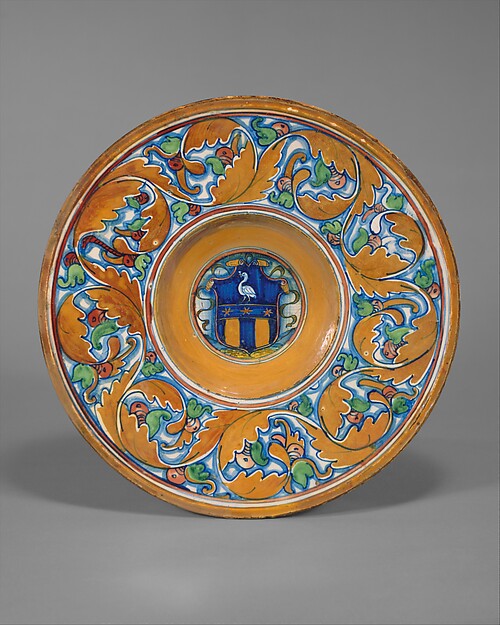
Plate (tondino) located in The Met Museum. 1525-30.
Italian, from the workshop of Maestro Giorgio Andreoli. Accession number: 1975.1.1092


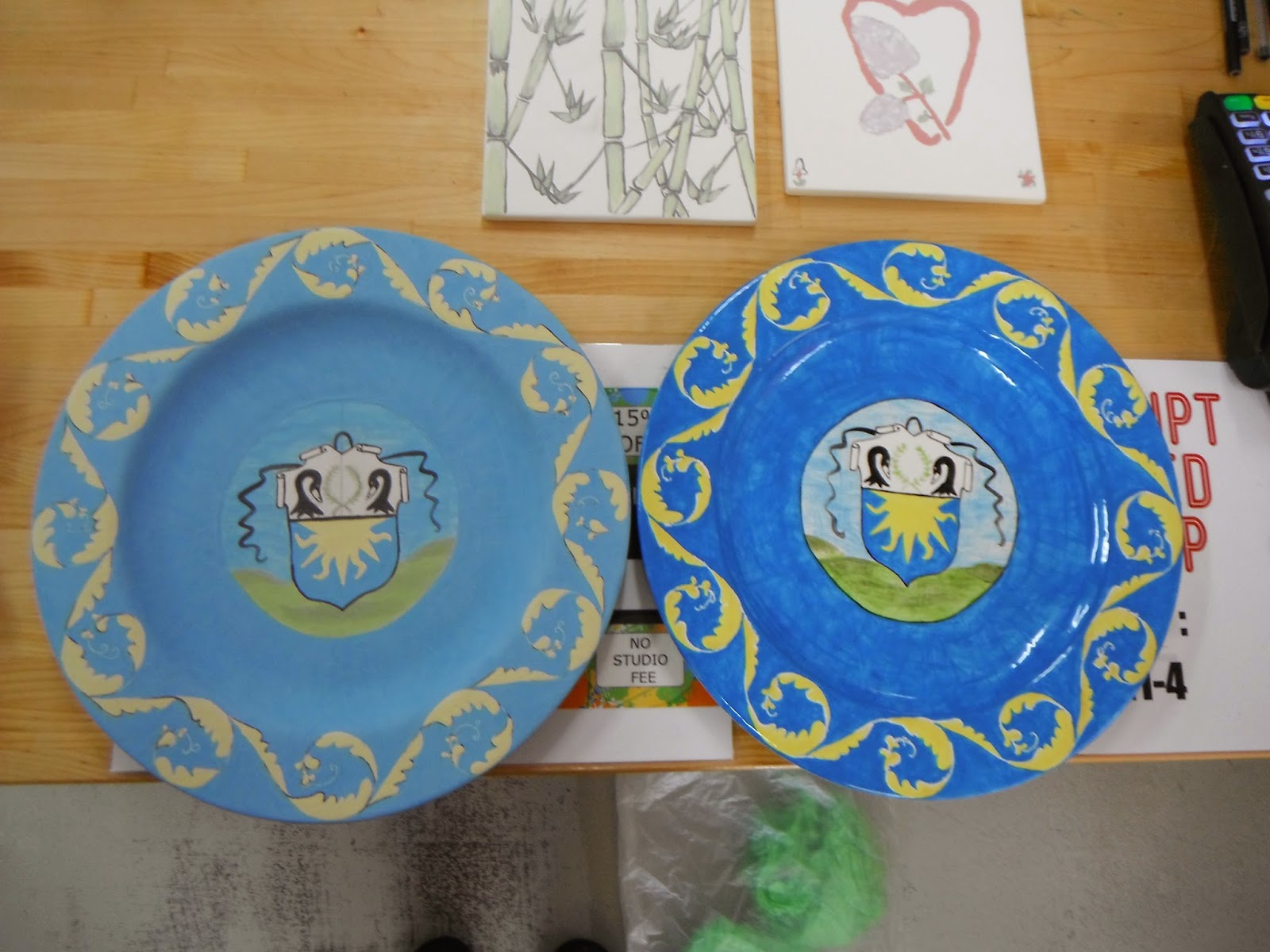
I used many of the elements of this plate. I did away with the berries and smaller green tendrils. Originally I was going to paint the side of the plate blue, the background green and the acanthus yellow but I realised that there wasn't sufficient contrast between the yellow and the green so it all became blue. On the back I made concentric circles of yellow (centre), blue/turquoise, and green. I tried to replicate the white highlights by scratching white lines in but the yellow isn't orange enough to make the contrast sufficient in this image. I'm not 100% happy with these plates (will I ever be?) but on the upside, Aneala now has baronial plates that are microwave and dishwasher safe. One Barony down, many to go.

Completed plates. Left - prefired, right - post firing.