Showing posts with label Tile. Show all posts

Saturday, 20 May 2017

Belated ceramic 48 & 49 - Tiles 12, 13, 14, 15 & 16

The tile project is ongoing! I collected four new tiles this April and I'm so happy with how the design is going. I'm going to start posting my reference chart as well as boast about my project. Forgive the not so amazing picture but it's the best I have.

One of the small 1/4 cross tiles isn't show here as it doesn't have it's matching stars yet. The key (belated) tiles are the three in the bottom left of the image.


Two of the tiles are from one reference panel, the third on the panel is already featured on the right of the middle row.

Lustre tiles. 14th Century. Kashan, Iran. The British Museum. 1888.0109.4

Sunday, 14 May 2017

Why Iran? Why Kashan?

So, I have resolved my first research question:

How did Blue and White ceramics transition from China to Europe?
Turns out they didn't. Blue and white ceramics originated in Iran and spread across the middle east and eventually made it to China. China developed a new style as they were able to fire their glazes at a higher temperature for porcelain. This changed the colour slightly as they were able to burn out arsenic and some of the manganese. China eventually discovered their own deposits of cobalt, but were dependent on imports from Iran for many years. The lighter, stronger porcelain transitioned out of China into Europe along the silk road. It resulted in the revival of Blue on White popularity and the many duplication of patterns onto heavier earthenware. This Asian-appropriation was adopted by the Dutch in their manufactories and given a more European theme (Delft) while the Italians went down the multi-colour path of majolica. Turkey meanwhile, developed their classic red, blue, turquoise of the Iznik style.

The next research question to be answered (it's a two parter):
Why Iran and Why Kashan?
What was it about Kashan that permitted the production of such a large number of tiles? Was it geology, geography or political?
Where did the cobalt actually originate from? There are a number of geological settings that could produce cobalt ores. How was it refined?


Wednesday, 5 October 2016

Ceramic 47 - Tile 11

This one collected dust for a while. That is to say, the plastic I wrapped it in after it was glazed and dry collected dust as I didn't have an opportunity to drop it off to get glazed for months. This is the start of the top corner. I'm not sure if I'm going to finish the entire square but I do hope to finish at least the top half.


Saturday, 25 April 2015

Blue on White Ceramics, Iran pt 1- Extant objects 50-89

This is the post contains extant references 50 - 89 which I utilised in my blue-on-white ceramics in Iran pt 1 (the first 45 can be found here, and yes, I skipped numbers 46-49). I've downloaded each of the images and provide the reference details so those who don't want to have an explosion of tabs while reading my little essay can enjoy the making the visual comparison of all the items together. If you wish to see all the images I don't mention but helped me form my conclusions please visit my pinterest collection. 
If you know of an extant item that contradicts my research or that belongs in my pinterest collection, please throw a link in the comments below!

Monday, 13 April 2015

Blue and White ceramics - Egypt


Blue on White ceramics: the reciprocal influence of Chinese porcelain on European and Middle Eastern ceramics - Egypt

Other essays on the history of BoW in Iraqearly Iranlate Iran, JapanChina, Turkey, Spain, The Netherlands, Italy and England.

This brief investigation of blue on white ceramics is focused on Egypt as my previous investigation suggested that the potters of Basra moved to Cairo around the 10th century and the rise of the Mamluks.

Pre 10th century
The Ancient Egyptians produced some beautiful items with blue overglaze such as these bowls (1, 2, 3). Over a long period of time, the Egyptians were producing items such as the iconic scarab in solid blue or turquoise overglaze (4). This range of blueish-turquoise items is sometimes call Egyptian blue (copper-calcium-silicate) but others appear to have been coated in a cobalt glaze the source of which is suggested to be evaporite deposits. Interestingly, the combination of blue and white doesn't seem to be culturally attractive and there are very few extant examples from this time (5).

In the 5th - 7th centuries Egypt was controlled by the mostly Christian, Copts. Coptic earthenware featuring blue motifs seems to have consisted of red clay objects that were fired (or dried) and then decoratively painted. Many jars were painted with lines of text however there are some examples of figures or patterns. The British Museum collection contains a number of whole (6) and fragmented items (7) from this period. This decoration method appears to be traditional in the region as similar ones can be found dating to the 18th Egyptian Dynasty (8) (1543 - 1292 BCE).

The 7th century saw the Byzantinians fighting a loosing battle for control of Egypt against the Rashidian Caliphate. The islamic influence of the Rashidians and later the Umayyadian Caliphate resulted in the conversion of much of the population. I have yet to find any items with blue glaze from this period but the Rashidians are important to note as they established the capital at Fustat (now part of Cairo), near what was Coptic Cairo. After the Umayyadian Caliphate (the largest Empire in the world at the time), the Abbasid Caliphate came to power.

10th-13th centuries
The 10th century saw the Baghdad based Abbasidian Caliphate suffering from internal political strife. Sections of the empire were breaking away, and trade relationships were fluctuating. Fustat (Old Cairo), under the Fatamid dynasty, was rising as a political power at this time, resulting in the shift of production from more marginalized regions of the empire, i.e. Basra, to Cairo (Attwood). I have found no extant BoW items that support this theory as there is no evidence of the simple designs employed by the artists of Basra in items recovered from Egypt. The Egyptians do seem to have adopted the lustreware first developed in Iraq around this time. It's possible the lack of local cobalt, the local penchant for turquoise and the desire for the more decorative lustreware squashed the transfer of the BoW designs.

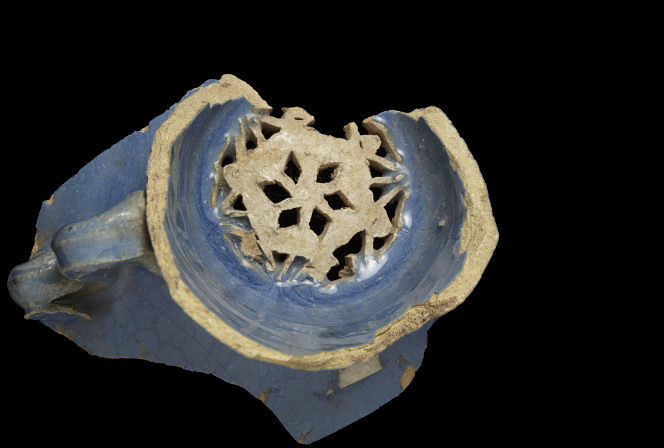
In the 10th century common ceramic objects in Egypt are still being dipped in overglaze before being fired (9) as part of the ongoing traditional decorative theme. The blues are becoming more varied by the 12th century with the introduction of a more purplish tint to the glaze (10). This may indicate an iron contamination in the cobalt source. This shift away from the more traditional lapis or turquoise colourings may be a result of the Islamic influence or a reduction in quality/quantity of pigment sources. The blue-purple strainer is an interesting item because typically these lovely objects are natural clay (11) and rarely glazed. I have found a couple of extant items that were glazed in turquoise as well (12, 13) indicating the love of this colour is deeply rooted in the Egyptian potters traditions. It seems that even though more complex and decorative methods are available, the production of common household goods such as filters and lamps (14) continued to involve simple glazing techniques. Lamps are of particular interest because they need to be glazed to prevent the terracotta from absorbing the oils. Lamps are also a common household object that would require mass production. Colours range from yellows (15), to greens and turquoise (16) and the rare blue (17). (side note: I love the pied colour of this one - 18).

Support for Attwood's suggestion on the move of Basra potters to Cairo is derived from lustre-ware items (19) recovered from Fustat. Stylistically these items are very similar to objects produced across the Abbysaid Empire (20) and even imported from Spain (21). This makes identification to a hobbiest like myself particularly challenging and I initially assumed the stylistic diversity at Fustat was solely due to their geographic location and the importation of high-level ceramics. However sherds such as 22 are marked with 'sa' which may be a potters mark, a workshop or a Fustatian tradition, either way, the item has been identified as Egyptian in origin. Essays on Islamic ceramics on the Ashmolean Museum propose that the Basra potters migrated to Egypt bringing the skills of lustreware. These potter families them migrated to Syria and later spread to Spain after the fall of the Fatamid dynasty in the 12th century.

10 - Bluish-purple strainer from Fostat, Egypt. 12th century, glazed fritware. Victoria and Albert Museum, item number c.914-1919

13th - 14th century
By the 13th century, the Mamluks had risen to power in Egypt ousting the Abbysaidians. On a side note: the Egyptian Mamluks seem to have made the greatest imprint on history, but the Delhi Sultinate was also controlled by the Mamluks which is often overlooked by hobbies scholars discussing this period in the middle east. Through the 13th and 14th centuries, Egypt was an important trading hub connecting the Mediterranean, the Red Sea, India and the East Indies.
Where the potters of Basra produced stylistically individual designs which are reasonably easy to identify. If anything, the potters of Fustat can be most easily identified through the use of solid Egyptian blue and turquoise glazes. This method of identification unfortunately, doesn't work for styles that require the use of different glazes. Items recovered from Fustat have a broad range of stylistic influence with sgraffito (23), incised and dipped (24) and polychrome underglaze (25) items all being produced from the 10th - 14th centuries. The position of Fustat as the hub of trade networks allowed local potters to adopt patterns and techniques from across Europe, the Middle East and Asia. A good example of this is the black and blue (BBW) items produced in Fustat during the 14th century (26). Some blue and black fragments have been recovered from Fustat (27, 28) and the style is quite similar to items produced in Syria at the time (29, 30)

Blue on White in Egypt
The production of BBW items in Fustat indicates the potters are conversant with the method of applying a white underglaze, then decorative elements and a clear overglaze. Sherds of Chinese porcelain (31) have been recovered from Fustat confirming the transport of such items to Egypt. There is no doubt these items influenced local designs. Sherds have been recovered that sport chrysanthemum like flowers (32), ducks (33) and other Chinese motifs (34). A number of sherds have been recovered from Fustat with patterns are reminiscent of Asian and iznik designs (35, 36, 37, 38, 39, 40). While I would like to wax lyrical regarding BoW trends in this region, I simply do not have sufficient extant objects to do so.

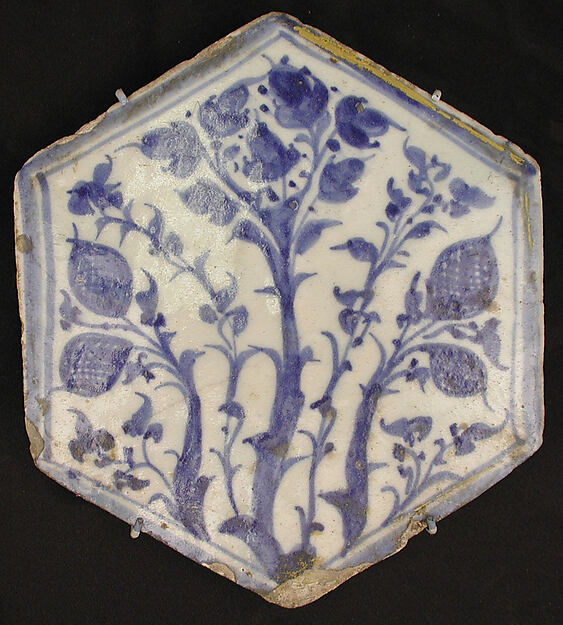
As well as the importation and imitation of Chinese BoW items, the Mamluks were producing BoW tiles (41, 42, 43, 44, 45, 46) very similar to the turquoise and blue hexagonal tiles being created in Syria with an almost Iznik flavour (47).


45 - Hexagonal Tile, 15th Century, Egypt. The Met Museum Accession Number 67.69.6


Additional resources:
A section on the Abbasiddian potters from a web based teaching course on islamic ceramics hosted by the Ashmolean Museum. http://islamicceramics.ashmolean.org/Abbasid/pottery.htm 

A PDF article on the Abbasid perception of Chinese Ceramics.
Hallet, J. 2010 Pearl Cups like the Moon, The Abbasid perception of Chinese Ceramics. Shipwrecked: Tang Treasures and Monsoon Winds.. eds Krahl, R. Guy, J. Wilson, J.K. Raby, J. Arthur M. Sackler Gallery, Smithsonian Institution, pp 75-81

A great scientific paper PDF on the reciprocal influence of Tang China and Abbasid Iraq ceramics.
Wood, N., and Tite, M., (2009), ‘Blue and White – the Early Years : Tang China and Abbasid Iraq compared.’ Transfer : The Influence of China on World Ceramics. (Colloquies on Art & Archaeology in Asia No. 24. Percival David Foundation of Chinese Art. ed. Stacey Person, ed. London University, pp 21-45

A short article on Basra's Potters and their developments
Attwood, R. 2005 Basra's Inventive Potters. Archeology Reviews. Vol 58, 2.

A PhD thesis I'd really like to get my hands on, scientific analysis of the origins of cobalt.


My collection of BoW images mapped to location of creation. Note: only 80 items initially load, you need to scroll to the end of the collection before they'll all show up on the map. Zoom into your area of interest to see clusters around centers of production.


Tuesday, 1 July 2014

Item 30 - Stormhold Fidchel board

 I decided to make a Fidchell / Fitchell set for my latest project. The idea came from Don Gregory Tortouse one day when he was proudly showing me the recent additions to his games collection. We got into a discussion about games at events and feasts. I quite like the idea of starting a feast earlier and leaving time for people to enjoy gaming and relaxing rather than eating-court-lights on. I started investigating what sorts of games were available and came across a couple of potential boards. I was originally thinking about painting a round board onto a plate, so you could eat and then play. Or play with your food.


Eventually I settled on Fidchel as it was a beautiful square board - perfect for a tile! I don't know how to play this game but it looks reasonably simple (famous last words). As the Stomhold Baronial Investiture / Winterfeast was coming, I decided to give the game a Stomhold feel. I did my best to replicate the details of the original Balinderry board (above) and used Stormholds drakar as the center motif. I'm pretty impressed with how circular my freehand circles are in the yellow decorative bits.


The game was gifted to their Excellencies at their invest / Stormhold Winterfeast. I added some glass tokens (blue and clear) and a castle/king piece. I hope they, or who ever they pass it to, gets many hours of enjoyment out of it.

Saturday, 18 January 2014

Ceramic 24 and 25 - Tile 9 & 10


Tile 10 - 7th star tile.


Part of the Imam Zade Yahya,Veramin group. British Museum. Museum number G.468. Fritware (stonepaste), painted in lustre over an opaque white glaze. The central field is decorated in reserve against a lustred background with foliate motifs. The border is decorated with a Qur'anic inscription. The reversed surface is undecorated


The set so far:  7 star tiles, 3 cruciform... 10/25!


Sunday, 8 December 2013

Ceramic 22 - Tile 8

This is the last tile I'm going to post for sometime. There's nothing really new to say about them except post a picture of the finished tile, and the reference tiles. GIven that I plan on making 25, that's going to get mighty boring mighty fast. So I might post update photo's of the tiles together from time to time.

Tile 8, row 2.


CENTRAL IRAN, LATE 13TH CENTURY This design appears as the central design on a number of Kashan lustre star tiles bearing dates of the second half of the 13th century. It is however very unusual to find it without any inscription border at all. This tile is very similar to the centre of one of the large star tiles made for the Imamzada Yahya at Veramin, dated 1262 but painted on a smaller size tile and thus excluding the inscription border. Sold by Christies in 2004. Link and Image found on Invaluable.com, an auction search engine.


Wednesday, 20 November 2013

Ceramic 17 - Tile 5

Tile 5


It's getting harder and harder to find good crosses. I tried three different ones for this tile. One of them was a rather floral, skinny cross. I started with a solid background and carved the flowers into it. It really didn't work well. The original was too skinny and I couldn't reproduce the dimensions, even after removing one of the flowers. I guess I was right to avoid animals and such figures. Upon investigation, the tile is Tamurid not what I'm looking for

So I painted over it and carved a more swirly pattern (below). I've only managed to find one, not very good at all, image of this cross and had to extrapolate. I'm rather happy with how it turned out but as the glaze was so thick, this tile has a texture to it.

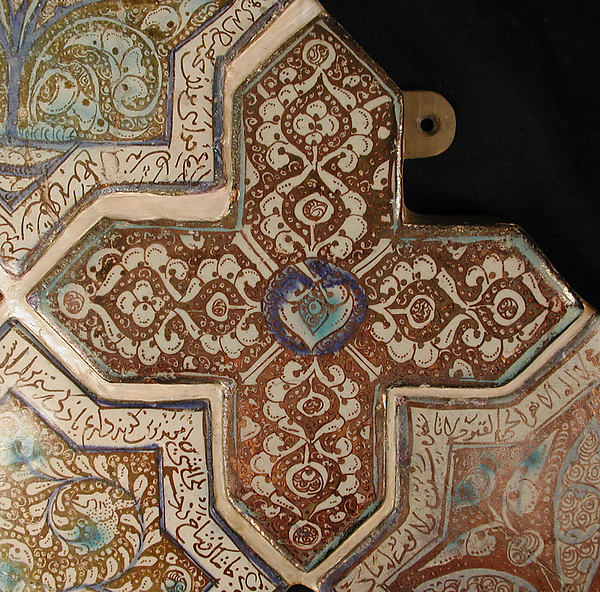
Cross tile from the mausoleum of Imamzada Yahya in Veramin near Tehran. Part of a panel of glazed lustre-ware tiles. State Hermitage Museum. Inv. nos IR 1026-1062. 1097 - 1118.


The other cross on this tile is also a new one. The cross in the image below on the left is the one I used. It's in the Louvre as a panel. The image in the Louvre is small, but there's a good collection of representative images of different regions and art styles at the Walter Chapin Simpson Centre for Humanities.

Details of panel made of individual tiles.
Iran, Kashan, 1267 CE/665 AH. Fritware, overglaze lustre with color splashes. The panel if from the tomb of imamazade Djafar at Damghan. Inv. no.: OA 6319. Website (photo shows whole panel). Individual panels can be found here.

It saddens me that so many tiles have been pillaged from the Imamzada Yahya mausoleum. It's good that they are ending up in museums so internet hobbiests like me can appreciate them, but I really think they should have stayed on the mausoleum. I'm feeling particularly annoyed by it at the moment because there's a whole bunch of tiles in Shangri La, Honolulu, a rich woman's beautiful home. There are no good close up images but there's treasure upon treasure there, all hoarded away. It's like taking fossils from the rocks - these are things that will never occur again. They should be left for others to appreciate rather than squirreled away by people who have more resources than sense.

Tile 5. First of the second line.

Tuesday, 19 November 2013

Ceramic 16/18/19 - Tiles 4, 6 & 7

Tiles 6, 4 and 7


Tile 4 is the terminus star tile (in the center). So there are no new cruciforms, just one star. I still haven't decided how big my tile panel is going to be, but I do know where one end is now. Tile 6 and 7 are edge tiles, covering only one quarter cruciform. I'm quite happy with how these three turned out and look forward to completing the whole set.


This close up shows how much better I am at getting the quarter cruciforms to line up.

The original star tile is one of a group of 12 tiles auctioned at Bonhams in 2008. The tiles are Kashan and date from the 12/13th century. As has been my policy throughout this tile project, I've removed the writing and replaced it with a wide blue border.

Friday, 15 November 2013

THe Ashmoelean on Iranian tiles

From the Ashmolean on Iranian tiles:

Tiles were not produced in great quantities before circa 1200, and large-scale tile production kicks off at basically the same moment as the new "Kashan" style of painting: it is rare to find tiles decorated in the "Monumental" or "Miniature" styles althought they do exist. However, from the turn of the C13th, much of finest work of the Kashan potters is on tiles. The two prominent figures in this development are the potters Muhammad ibn Abu Tahir and Abu Zaid, who are known through signatures to have worked together on the most important tilework projects of the pre-Mongol period.
Their earliest dated joint effort is a sarcophagus in the tomb-chamber at Qumm, where the top panel is signed by Muhammad and the main frieze is signed by Abu Zaid. This work is dated 1206. At Mashhad in 1215 they undertake a much more ambitious project, cladding the walls in star and octagonal tiles surmounted by an inscription frieze, and installing two large and elaborate mihrabs, one of which is signed by Abu Zaid as well as a number of the star tiles. This is extremely high quality work, and shows that Abu Zaid produced some of the best products of the whole Kashan industry. There has been some confusion over dating this shrine, because two dates exist side by side in the inscriptions: 1215 and 1118. It is now thought that the tiling dates to the C13th, but the earlier date is included to commemorate the decoration that was replaced in 1215.
This pre-Mongol era in tile production sees a peak of artistic and technical achievement that is never again matched. The sudden decline in tile production after 1220 may be a result of the first wave of Mongol invasions, but may be equally due to the death of the pottery industry’s two major figures, Muhammad ibn Abu Tahir and Abu Zaid. The former’s last dated work was 1215 (Mashhad) and the latter’s was 1219. Thereafter there appears to be a vacuum which proves difficult to fill.


From this vacuum emerges the next generation of potters, who attempt to imitate the high quality work of their predecessors, and who do produce some masterpieces, but the technique and quality of execution is generally more simplified and standardised than the earlier products. The leading lights of the next generation emerge first in the 1220s and 1230s, but their artistic talents do not really emerge until the resumption of large-scale tile production in the 1260s. Hasan ibn al-Arabshah signed the mihrab from the Maidan Mosque in Kashan (d.1226) which according to Watson is timid and restrained in design; the son of Muhammad ibn Abu Tahir, Ali, produces a mihrab in 1242 for Mashhad, in which the cobalt has run badly, implying Ali’s technical skills are not yet developed.
Very few dated pieces are known from the period 1220 – 1260, but thereafter a number of grand commissions by the new Il-Khanid rulers stimulate the Kashan industry into a resurgence of productivity, in which Ali ibn Muhammad ibn Abu Tahir dominates. The major complex of the 1260s is the tomb-chamber of Imamzada Yahya at Veramin. The Ashmolean holds a group of these tiles in its collection. There are a series of lustre tiles from different dates from this complex, beginning with star and cross tiles dated 1262; a large mihrab is dated Sha’ban 1265, and another mihrab is added to the complex in Muharram 1305, signed by Ali’s son Yusuf.
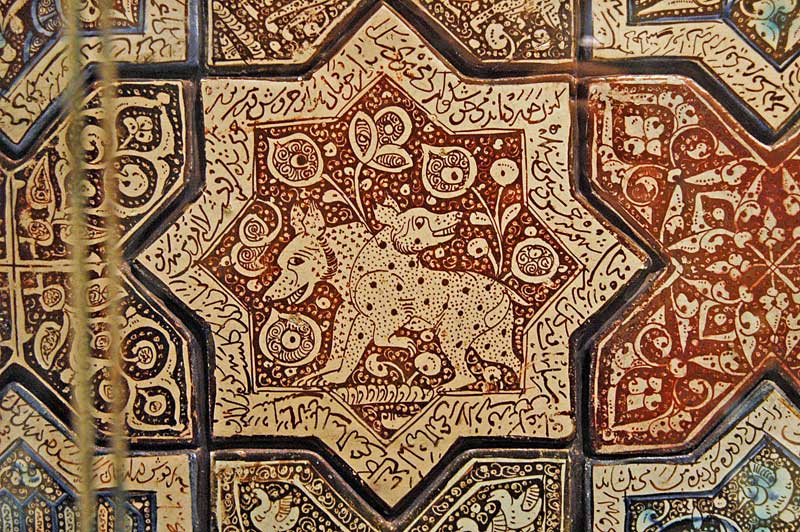
The tomb-chamber of Imamzada Ja’far at Damghan (d.1266-7) is the next big dated complex with lots of lustre decoration: star and cross tiles survive with animal and human figural decoration, and inscriptions bearing Persian poems. There is a beautiful panel of these tiles in the Louvre. The sizes of the tiles are smaller, and they use blue and turquoise in the design. Watson thinks the drawing naïve compared to pre-Mongol production, but the technical quality is excellent.
The most important commission in the 1270s is the extensive palace complex at Takht-i Sulaiman, built by Abaqa Khan: this is the sole surviving secular building of this period which has lustre decoration. It is lavishly decorated in tiles of different techniques including lajvardina, which is the medium in which the new Chinese designs (phoenix, dragons, lotuses) especially appear. Star and cross tiles with inscriptions in Persian verse are dated 1271, 1272 and 1275; pictorial friezes show scenes of hunting and fighting, and also scenes from the Shah-Nameh: a lustre tile frieze tile in the V&A shows the hero Bahram Gur hunting with his favourite concubine Azada.


The next upturn in production is the first decade of C14th: in November 1300, 250 tiles were installed in mosque of Ali in Quhrud near Kashan. These bear arabesque and floral motifs, and Quranic inscriptions; further tiles were added in 1307, identical in style though with inscriptions in Persian verse. Yusuf ibn Ali ibn Muhammad ibn Abu Tahir also signs an inscription frieze dated 1310-11. After this, production again tails off, with a final and surprising burst of activity in the1330s when Yusuf signs a large mihrab for Imamzada Ja’far in Qumm (1334); a series of star tiles installed in same building d.1337 contain two which are inscribed: "…in the place Kashan in the workshop of Sayyid of Sayyids, Sayyid Rukn al-Din Muhammad son of the late Sayyid Zain al-Din Ali, the potter; the work of the most noble, the most excellent master, Master Jamal, the painter (al-naqqash)."
A few other tiles carry dates in the 1330s, but the very last dated item to be produced from Kashan kilns is a star tile bearing the date 1339. In the year before this, another star tile bears the desperate plea: "…in the place Kashan, may Allah, be He exalted, protect it from the ravages of time." Was this a cry for help in the face of declining orders? 

http://islamicceramics.ashmolean.org/Kashan2/profiles.htm

Also visit the above website for dish shapes

Thursday, 19 September 2013

Ceramic experiment 15 - Tile 3

Star and cross tiles in a manuscript. From Bābur Seeks His Grandmother's Advice Leaf from the Read Mughal Album, but formerly fol. 86 in the British Library's Bāburnāma. Mughal, ca. 1590–92, probably by Sānvalah, with early-nineteenth-century borders. 440 x 294 mm  MS M.458.18. The Morgan Library & Museum.


Star tile, Iran, Kashan, 1260-1270. The Met Museum. Accession Number: 41.165.22


I have completed my third islamic tile. It has also been designed to link to tiles 1 and 2. I'm rather happy with how it came out. While I can't claim this is an experiment, this is part of my ongoing A&S 50 challenge. Given that I'm now at number 15, and I have another 35 to complete in a little over a year and a half, I need to get cracking.

Tile from Iran, Kashan, 1000-1250. LACMA Kashan tile, 13th Century. Met Museum of Art.


Tiles 2, 1, and 3 in order.


Monday, 26 August 2013

Ceramic experiment 14 - Tile 2


The star tile reference for tile 2 is about 150 years older than the reference for tile 1. Tile 2 shares some of the references for the crosses with tile one. As with previous works, I haven't replicated the inscriptions as a) I don't know the letters so I can't be sure when I screw it up and b) I'm not going to write anything I can't read/understand. Due to space limitations, I did bastardise one of the cross tile replicas, leaving out a third repetition of the droopy flower things.

14th century polychrome tile from Kushan, Iran. Victoria and Albert Museum. Item number 734c-1888.


Cross tile by Ali ibn Muhammad ibn Abi Tahir. 1262. Iran. Victoria and Albert Museum. Item Number 1838B-1876

I actually made tile 1 and tile 2 at the same time so I could line up the designs properly. So, without further ado, the two tiles: I'm going to keep making these until I have enough for a bathroom feature, when I buy a house (I have plenty of time!). So now the hard question... keep going left to right forming a line, or create 2 more below to make a square?